
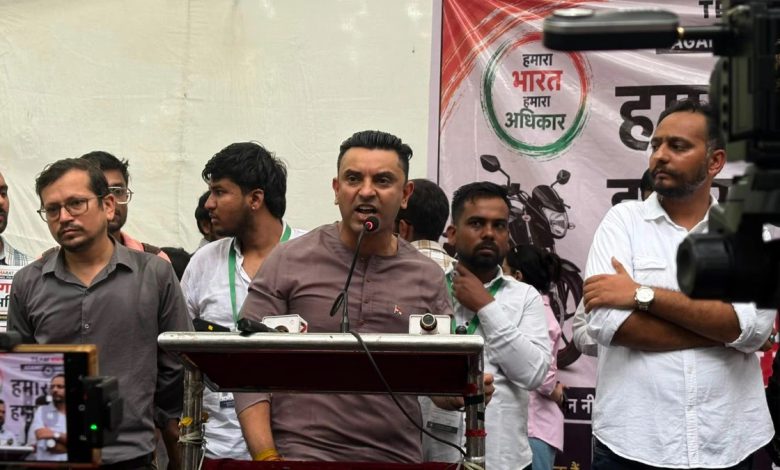
Car owners gathered at Jantar Mantar in New Delhi on Sunday to push back against India’s Ethanol Blending Programme, the first public demonstration against the nationwide E20 mandate.
The protest was organised by entrepreneur and TV personality Tehseen Poonawalla through his advocacy group Team Bharat, under the slogan “Hamaari Gaadi, Hamaara Adhikaar.” Attendees said E20 petrol had cut their mileage, clogged their fuel systems, and left them with expensive repair bills.
The government has dismissed those complaints. Before Sunday’s event, a group of experts from the auto and energy sectors said their testing found no evidence that E20 harms compatible vehicles. Attorney General R. Venkataramani had already told India Today TV that the 20 per cent ethanol blend is government policy and will not change.
Though the protest targeted a scheme closely associated with Union Minister Nitin Gadkari, several participants said the demonstration was not a party issue. Some identified themselves as BJP supporters who specifically objected to how the transition was handled.



What motorists said
Complaints about E20 petrol have been circulating online for months: stalled engines, falling mileage, blocked filters, and costly repairs. Several people at Sunday’s gathering said the same things had happened to them.
Sarthak, a software engineer from Gurugram, said his 2018 Baleno, rated for E10 not E20, had gone from 18 km per litre to under 14. “Since the last couple of months, my mileage has dropped from 18 km a litre to under 14 km,” he said, putting the drop at around 22 per cent.
Raj Singh from Patel Nagar said seven months of filling E20 ended with an engine warning light and a Rs 35,000 repair bill for a full fuel system overhaul. “I have been filling E20 for the past seven months thinking it would save some money, but last month my car suddenly started losing power and the engine warning light came on.” He said the car had given him no trouble before that.
Delhi resident Mudit Agarwal, who owns a Skoda Slavia, said his car stopped without warning while he was driving. He had it towed to an authorised service centre, where he said staff told him similar cars were arriving daily. “I have sent the video to Skoda service centre. They have not yet rejected that it could have been because of E20 fuel,” he said. Agarwal ran as a Congress candidate in the 2025 Delhi Assembly elections but said he came Sunday as a car owner, not a politician.
Wear, tear, and altitude
Auto enthusiast and rally driver Ratan Dhillon of Team Bharat said he intends to prove the damage in court. “Wear and tear is from ethanol. Fuel filter and the entire pipeline gets choked. I was in Leh last week, and I had to leave the car there.” He estimated replacing fuel filters in mid-range cars at Rs 25,000 to Rs 80,000 and said high-altitude cold starts are harder on ethanol-blended fuel.
Consumer choice
Several protesters had one ask: the option to buy conventional petrol. A doctor from Moradabad who requested anonymity said his 15-year-old sedan had run well until E20, after which mileage fell noticeably. “I am a man of science. I don’t make statements without verifying the facts.”
Himanshu Sharma of Dharmkalyan Foundation Education Programmes questioned why there is no choice at the pump. “Why don’t I have the option to choose the fuel? I need pure petrol.” He noted that where conventional petrol is available, it costs above Rs 160 per litre against around Rs 102 for E20, and asked why separate pumps are not offered for both. Some attendees also raised concerns about ethanol absorbing moisture, which they said creates storage problems at fuel stations.
Sugar industry concerns
Protesters questioned whether the policy serves the sugar industry more than consumers, given that Indian ethanol is produced mainly from sugarcane and that Uttar Pradesh and Maharashtra are both major sugar states with well-known political ties to the sector.
Also Read:The Release Of The Long-Battled Film “Satluj”: Story Of Jaswant Singh Khalra
Participants said they understood the government’s stated goals of cutting crude imports, raising farm income, and reducing emissions. They asked for greater transparency and the ability to opt out. Several also noted that Brazil, the US, Thailand and the Philippines rolled out ethanol blending over many years, alongside compatible vehicles, while India’s transition has moved considerably faster. Turnout at Jantar Mantar was modest. Participants said they did not expect it to stay that way.