
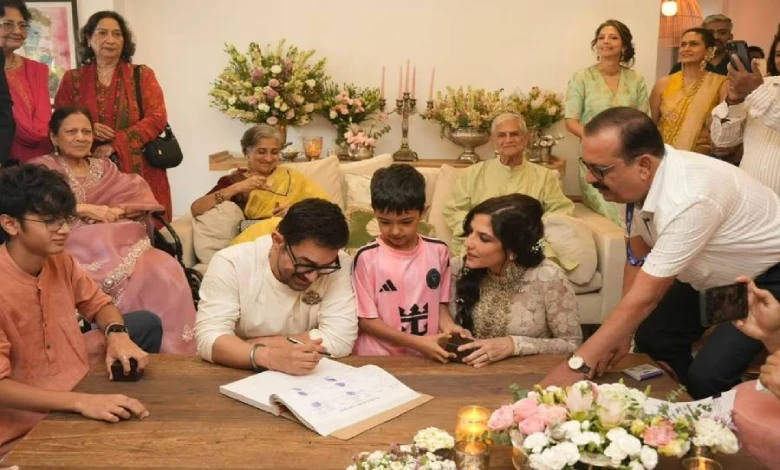
Bollywood actor Aamir Khan has spoken out against allegations of “love jihad” linked to his marriage with Gauri Spratt, while also responding to a religious edict issued in the wake of their union. The couple exchanged vows in a private civil ceremony on July 5 at Khan’s residence in Mumbai’s Bandra area, with around 150 guests in attendance, including his children Junaid, Ira, and Azad, as well as Spratt’s son. The wedding was conducted under the Special Marriage Act.
The marriage has sparked public debate, with some political figures criticizing it as an example of “love jihad” and urging reflection within Hindu society on personal decisions by prominent individuals. Separately, a religious authority issued a decree against the actor, asserting that under certain interpretations of Islamic law, a Muslim man cannot marry a non-Muslim woman without her conversion, rendering the union impermissible in that framework.
In response, Khan emphasized the inclusive nature of his family background. He noted that both of his sisters are married to Hindus, his daughter is married to a Hindu, and a cousin is married to a Christian. The actor highlighted that none of his wives, including Spratt, his former wife Kiran Rao, or his first wife Reena Dutta, had converted religions, as all his marriages were solemnized through civil procedures. He described Spratt as Christian by background but not a practicing one, adding that recent events had taken on an increasingly absurd tone.
Khan had earlier made public his relationship with Spratt on the occasion of his 60th birthday, mentioning that the two had known each other for about 25 years before reconnecting in recent times.




The developments have drawn attention to broader discussions around interfaith relationships, personal choices by public figures, and varying perspectives on marriage laws and traditions in India. Khan’s comments underscore his family’s history of cross-faith unions conducted under secular legal provisions.
This episode reflects ongoing societal conversations about individual freedoms, religious interpretations, and the intersections of personal life with public scrutiny in contemporary India.