
[By Sapna Desai Mumbai Samachar Desk]
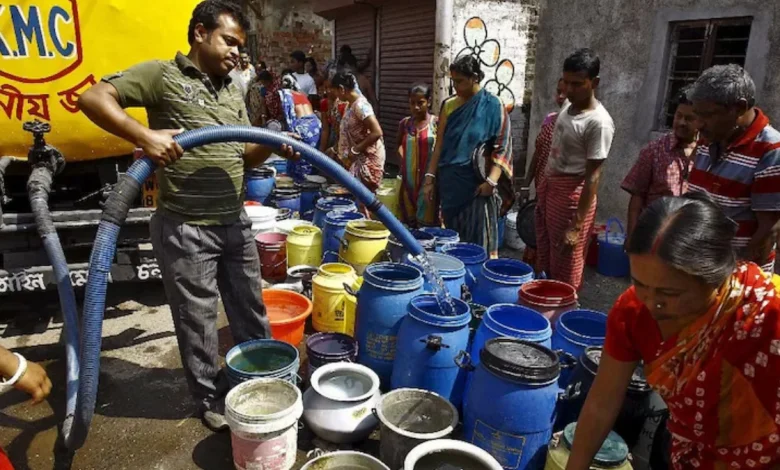
Mumbai: Mumbai is facing its most severe water crisis in recent years. The seven reservoirs that supply the city are left with barely 100,279 million litres of water just 6.93%. The country’s richest civic body still relies entirely on rainwater to meet the city’s water demand. With projects for alternative water sources still three to four years from completion, Mumbai has no choice but to depend on the monsoon to meet its needs. If this year’s erratic rainfall pattern continues, the city’s growing population could face recurring water crises. Future water cuts now hinge entirely on how much rain falls in the coming days.
This year, a delayed monsoon and insufficient rainfall have pushed water levels across Mumbai’s seven reservoirs below 7% significantly lower than last year. According to data from the civic Hydraulic Engineering Department, the seven reservoirs held a combined 1,00,279 million litres of water as of Monday morning, compared to 5,71,670 million litres (39.5%) during the same period last year.
Mumbai’s water supply depends entirely on rainfall. Rainwater collected in reservoirs is meant to last the city the whole year, but global climate shifts are increasingly disrupting the monsoon itself. Erratic rainfall in recent years has repeatedly strained Mumbai’s water supply, forcing water cuts in 2014, 2015, 2020, 2022 and 2023 due to weak or delayed monsoons.


Mumbai relies almost entirely on the monsoon for its year-round water supply. The civic body draws 4,100 million litres per day (MLD) from its five monsoon-fed reservoirs Modak Sagar, Upper Vaitarna, Bhatsa, Tansa, and Middle Vaitarna, the last of which became operational in 2014. The city’s daily water demand has now climbed to roughly 4,600 MLD, widening the demand-supply gap. Twelve years after its last reservoir came online, Mumbai still has no new water source and if the monsoon underperforms, the city could face a severe water crisis.
Also ReadHeavy Rain Lashes Mumbai Suburbs, Over 100mm in Just Four Hours Several Areas Waterlogged
No Rain Over Reservoir Catchment Areas
As the water crisis deepens, the civic body continues to tighten water cuts. After imposing a 10% supply cut on May 15, the civic body suspended water supply to construction sites and swimming pools, stopped issuing new water connections, and imposed cuts of up to 20% on commercial users. Beyond these emergency measures, Mumbai has very few alternatives to fall back on during a prolonged rainfall deficit. More worryingly, while rain is falling over Mumbai and Thane’s urban areas, the lakes and catchment areas in Thane and Palghar are receiving no rain at all causing reservoir levels to keep dropping and deepening the crisis further.
New Water Projects Delayed
Long-term solutions to Mumbai’s water problem are still years from implementation. The proposed Gargai Dam (440 MLD) in Palghar, along with desalination plants at Manori (400 MLD) and Versova (200 MLD), are expected to add 1,040 MLD to the city’s water supply. However, work on these projects has yet to begin and will take at least three to four years to complete once started. The civic body is also upgrading seven sewage treatment plants to process 2,464 MLD of wastewater daily, of which 1,232 MLD will be reused for non-potable purposes. But with this project unlikely to begin before 2028, Mumbaikars can expect no immediate relief from recurring water shortages.
The El Niño Effect
Concerns over the city’s water supply had already been raised earlier, given the delayed southwest monsoon and forecasts of a strong El Niño developing later this year. Current reservoir levels are still higher than the 5.43% recorded during the same period in 2024. The monsoon typically reaches Mumbai around June 10, but arrived late this year. Last year, by contrast, it arrived in May much earlier than its usual date. Citing the late arrival and slow progress, and following directives from the Maharashtra government’s Water Resources Department, the civic body imposed a 10% water cut in Mumbai from May 15, followed by a 20% cut for industrial and commercial users from June 17.