
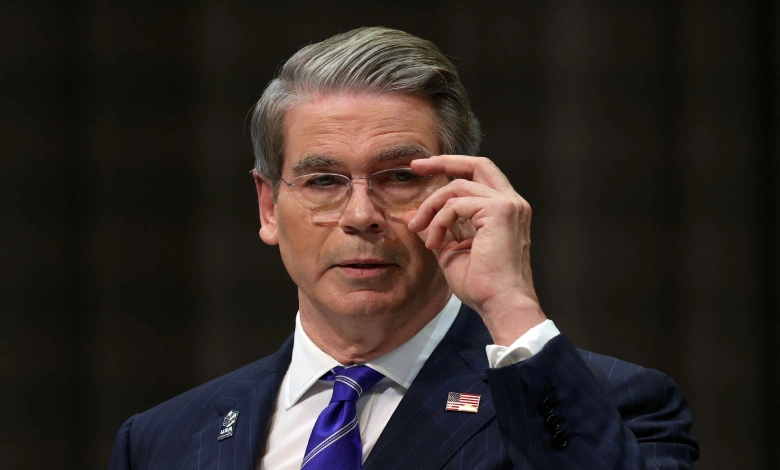
On Thursday, U.S. Treasury Secretary Scott Bessent announced that Washington would impose “the toughest sanctions in history” on Iran and asked Beijing to work with the United States. However, China claimed that penalties would not be helpful in resolving the issue. Bessent announced that he will share specifics at a press conference on Monday.
“It’s a one-two punch.” Bessent told the news agency CNN, “We have the blockade (on Iran) and we are going to have the toughest sanctions in history.” “It is going to work in Iran and we are going to collapse this regime.”
As the United States attempts to end the war it started with Israel almost six months ago, President Donald Trump issued a warning on Wednesday about economic repercussions for any nation that offered “any type of lifeline to Iran.” “Regarding the Iran issue, sanctions and pressure do not help resolve the problem,” he said.
In reaction to Bessent’s remarks, a spokesman for China’s embassy in Washington stated, “China calls on the relevant parties to take responsible actions and resolve the issue through political and diplomatic means.”

According to statistics from the analytics company Kpler from 2025, China purchases more than 80% of Iran’s shipping oil. The United States would run the risk of reprisal if it continued its economic fight with China, a significant exporter of essential rare-earth materials.
Since the Islamic Revolution in 1979, Iran has endured harsh economic sanctions for almost half a century. Trump’s remarks, according to Iranian Foreign Minister Abbas Araqchi, are an attempt to deflect American public opinion away from internal financial issues, such as record debt and rising interest rates.
Bessent stated on Thursday, “I believe oil markets are misinterpreting what this economic pressure means.”
“We have asymmetric information, and I’m not sure why oil has popped up on this,” Bessent remarked as oil prices surged to over three-week highs on Thursday. “If we are doing the maximum economic pressure, then that means that likely there will not be a large-scale kinetic restart.”
Bessent responded that many discussions were best conducted in private when asked if the United States could pursue China for conducting business with Iran.
“We are confident that everyone wants the Strait (of Hormuz) reopened, and for energy prices to come back down,” he stated. Remember that half of the energy used by the Chinese comes from within the Gulf. Thus, joining the program would be very beneficial to them.”
Also Read – Iran Slams Trump’s ‘Economic Terrorism’; IRGC Warns Of Using ‘More Precise And Destructive’ Weapons