
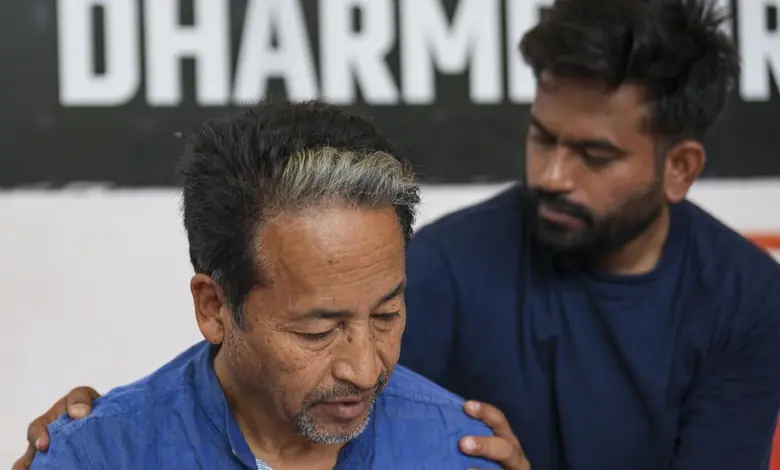
New Delhi: The protest organized by the ‘Cockroach Janata Party’ (CJP) at New Delhi’s Jantar Mantar has completed its 16th day today. Amidst demands for the resignation of Education Minister Dharmendra Pradhan and accountability for alleged irregularities in national examinations, climate activist Sonam Wangchuk’s indefinite hunger strike has now entered its eighth day.
According to the latest health bulletin, Wangchuk has lost approximately 6 kilograms over the past seven days, with his weight dropping to 60.95 kilograms. Doctors have expressed serious concern regarding his deteriorating condition; his blood pressure is currently recorded at 112/70 mm Hg, and his blood sugar level has dipped to 67 mg/dL. Despite these mounting physical challenges, Wangchuk remains mentally alert and resolute, asserting that he will not back down until systemic reforms are implemented and accountability is ensured.
CJP founder Abhijit Dipke has questioned the government’s silence, asking why the Education Minister has not been removed from his post yet. On Sunday, the movement gained further momentum when the father of Riya Kumari Thapa, a student who tragically lost her life following the NEET exam irregularities, visited the protest site. As an ex-serviceman, he appealed to the government to ensure that no other family has to face such a tragedy in the future.
ALSO READ: First Protest Against E20 Fuel Held in Delhi; Motorists Blame Mileage Drops and Repair Bills




The scope of the movement continues to expand. While students from the ‘All India Students Association’ (AISA) are continuing their separate hunger strikes, the ‘Samyukt Kisan Morcha’ (SKM) has also announced its support for the campaign. A delegation of farmer leaders is scheduled to visit Jantar Mantar on July 7 to express their solidarity.
Sonam Wangchuk’s struggle has now transcended the issue of exam scams, evolving into a larger fight for the future of India’s youth and administrative transparency. The surging crowds and the unwavering spirit of the students at Jantar Mantar clearly signal that the demand for systemic change is becoming a mass movement, one that the government can no longer afford to ignore.