
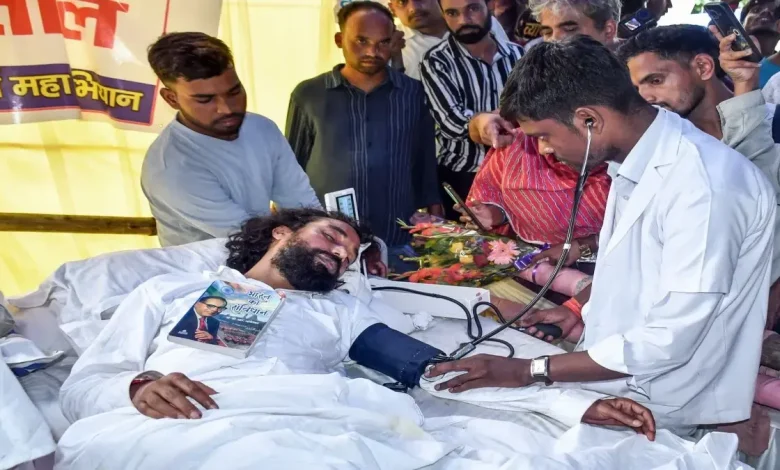
Ranchi: What began as a protest by a group of job aspirants has now turned into one of Jharkhand’s biggest youth movements in recent years. On Thursday, the agitation over alleged irregularities in government recruitment exams entered its 13th day, with six students continuing an indefinite hunger strike, even as pressure grows on the Hemant Soren government to respond to their demands.
The protesters, most of whom are candidates who appeared for examinations conducted by the Jharkhand Public Service Commission (JPSC) and the Jharkhand Staff Selection Commission (JSSC), say their fight is not just about a single recruitment process. They claim it is about restoring faith in the state’s recruitment system and ensuring that thousands of deserving candidates get a fair chance at government jobs.
At the centre of the movement is student leader Devendra Nath Mahto, who has been observing an indefinite fast despite concerns over his health. Five other protesters have now joined the hunger strike, taking the total number of fasting students to six. As news of the prolonged fast spread, noted social activist Sonam Wangchuk spoke to Mahto over the phone and appealed to him to at least drink water while continuing his protest, expressing concern over the students well being.
The agitation has continued peacefully in Ranchi, drawing support from students, job aspirants, and several civil society groups. Every day, hundreds of young people gather at the protest site carrying placards, raising slogans, and demanding transparency in recruitment examinations. Their primary demands include a thorough investigation into the alleged recruitment irregularities, action against those found guilty, and reforms to ensure that future examinations are conducted fairly.

The issue has also found its way into the political arena. The protest dominated discussions on the opening day of the Jharkhand Assembly’s Monsoon Session, where opposition legislators demanded answers from the government and called for a CBI investigation into the alleged recruitment scam. The opposition accused the state government of failing to protect the interests of unemployed youth, while the ruling side maintained that investigations are already underway.
Even as political exchanges intensified, the protesters insisted that their movement is not affiliated with any political party. Student representatives have repeatedly stated that their only objective is to secure justice for thousands of candidates who believe they have been affected by alleged irregularities in the recruitment process.
In a significant development, the state government has indicated that it is willing to hold talks with the protesting students. Representatives of the movement have expressed readiness for dialogue but have made it clear that any discussions should be transparent and preferably held in the presence of the media. According to the students, they want concrete assurances rather than verbal promises before considering ending the protest.
Meanwhile, the investigation into the alleged recruitment irregularities has continued to gather momentum. The Crime Investigation Department (CID) has made multiple arrests in connection with the case, with officials probing allegations linked to the examination process. While investigators continue their work, students argue that these actions should lead to broader accountability and systemic reforms instead of remaining limited to individual arrests.
The movement has also attracted attention beyond Jharkhand. Congress president Mallikarjun Kharge publicly expressed support for students demanding transparency in recruitment, while several opposition leaders have stepped up criticism of the state government. Some protesters and opposition parties have even demanded the resignation of Chief Minister Hemant Soren, alleging that the administration has failed to address the concerns of unemployed youth in time.
Despite the growing political attention, the atmosphere at the protest site has largely remained peaceful. Organisers have urged participants to maintain discipline and continue demonstrating through democratic means. At the same time, they have warned that if their demands remain unaddressed, the agitation could be intensified with larger public programmes, including a Tiranga March and an Assembly gherao in the coming days.
For thousands of young job seekers across Jharkhand, the protest has come to symbolise more than a dispute over recruitment exams. It reflects years of frustration over delayed recruitment, allegations of paper leaks, and repeated questions over the fairness of competitive examinations. Many aspirants believe that securing a government job should depend solely on merit, not on irregularities or administrative lapses.
As the protest enters another crucial phase, all eyes are on the state government and the ongoing investigation. Whether dialogue leads to a breakthrough or the agitation gathers further momentum could have far reaching consequences not only for the students on the streets today but also for the future of government recruitment and public trust in Jharkhand’s examination system.
ALSO READ: Jharkhand Student Protest Enters Crucial Phase As 11 Member Delegation Agrees To Government Talks