
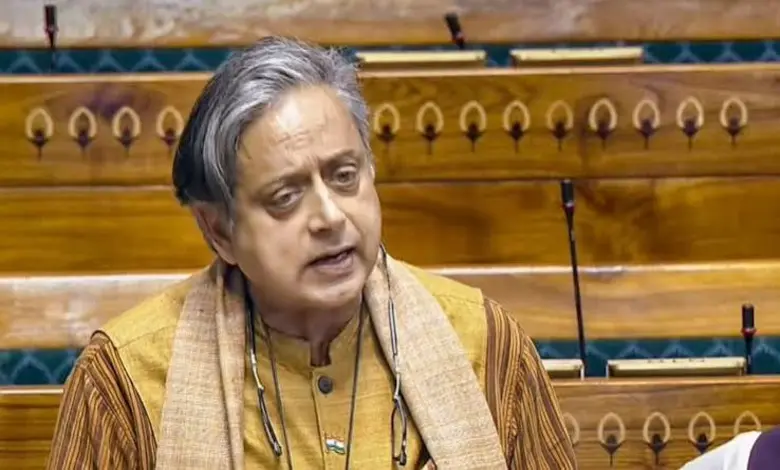
New Delhi: A fresh political storm has erupted over the Centre’s proposed amendments to the Foreign Contribution Regulation Act (FCRA), with Congress MP Shashi Tharoor warning that the changes could end up hurting ordinary Indians far more than the organisations they seek to regulate.
Launching a strong attack on the government, the Thiruvananthapuram MP said the proposed legislation gives the Centre sweeping powers over assets created through foreign funding and could have serious consequences for charities, educational institutions, hospitals and non profit organisations that work with overseas donations. He argued that the impact would ultimately be felt by millions of people who depend on these institutions for healthcare, education and social welfare.
The proposed Foreign Contribution Regulation Amendment Bill, 2026, introduced in Parliament, seeks to create a Designated Authority that would take charge of assets built using foreign contributions if an organisation’s FCRA registration is cancelled, surrendered or expires without renewal. The authority would oversee the management, transfer or disposal of such assets in accordance with the law.
Criticising the move, Tharoor described it as a significant expansion of executive power. According to him, the Bill goes far beyond regulating foreign donations and instead allows the government to assume control over properties and resources belonging to organisations that have legally received foreign contributions over the years.




He warned that many institutions operating schools, colleges, hospitals, orphanages and welfare programmes could face uncertainty if their registrations are revoked. While the law targets organisations, Tharoor said, it is ordinary citizens particularly those from vulnerable sections of society who stand to lose access to essential services.
The government, however, has defended the proposed amendments, saying they are intended to plug legal loopholes and ensure that assets created through foreign funding are properly managed if an organisation loses its registration. It maintains that the legislation is aimed at strengthening transparency, accountability and oversight, while preventing misuse of foreign contributions.
The Bill also contains provisions stating that if a place of worship comes under the management of the Designated Authority, its religious character must continue to be preserved. Another proposed change reduces the maximum jail term for certain offences under the Act from five years to one year, while introducing revised procedures for handling compliance related matters.
Opposition parties have strongly objected to the legislation, arguing that it grants excessive powers to the executive and could discourage legitimate charitable work. Several civil society organisations have echoed those concerns, saying the amendments may create uncertainty for NGOs engaged in education, healthcare, disaster relief, environmental conservation and humanitarian work.
The issue has also attracted international attention. US Congressman Riley Moore recently expressed concern over the proposed provisions relating to foreign funded religious institutions, adding another layer to an already contentious debate.
The FCRA has long been one of India’s most closely watched laws governing foreign donations. Originally enacted to regulate overseas funding in the national interest, it has undergone several revisions over the decades, with major changes introduced in 2020 that tightened compliance norms for organisations receiving foreign contributions.
The latest amendment has now emerged as one of the biggest flashpoints of the ongoing Monsoon Session of Parliament. While the government insists the Bill is an administrative reform designed to improve regulation and accountability, the Opposition argues it risks shrinking the space for independent civil society organisations.
With sharp exchanges continuing inside and outside Parliament, the proposed legislation is expected to remain at the centre of political debate in the days ahead as lawmakers, charities and legal experts closely examine its potential impact.
ALSO READ: Regional Parties Resist FCRA Draft, Threatening Consensus On Delimitation