
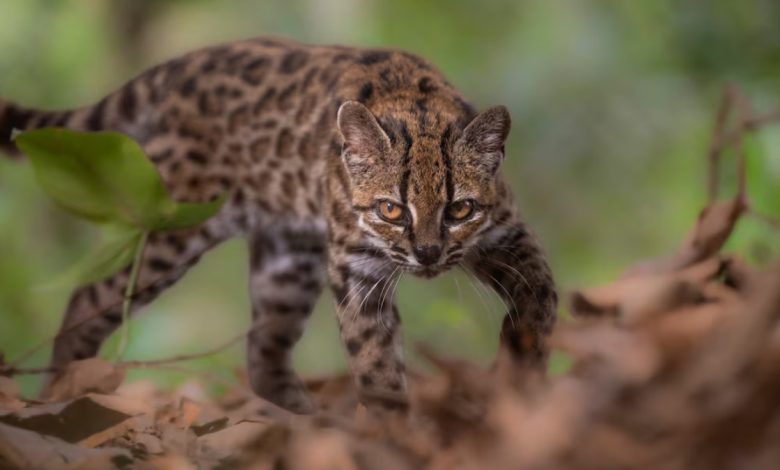
Scientists have discovered a new cat species for the first time in a century. The spotted feline lives in the forests of Bolivia, is remarkably small, and had until now been mistaken for other wild cats because of its spots and stripes. Named Leopardus tilcayo, or the tilcayo tiger cat, it is slender, with rounded ears, and inhabits the Bolivian Yungas — the region where the Andes Mountains meet the Amazon basin. The discovery was detailed in the journal Current Biology on Thursday.
Interestingly, study co-author Paola Nogales-Ascarrunz noted that almost every newly discovered species tends to be small in size. “This time, it’s a cat. That’s really novel. And it hasn’t happened in 100 years. No one else had named it. No one else had described it,” she said.
“It’s an amazing result that we have a new species for the world, which is the Leopardus tilcayo,” said Nogales-Ascarrunz, of Universidad Mayor de San Andrés in La Paz, Bolivia.
Number of Tilcayo Tiger Cats
The research team is not yet sure how many tilcayo tiger cats exist in the wild. “We really don’t know how many cats are still in the wild,” the researcher added. For now, only one confirmed living member of the species is known, currently housed at a rescue sanctuary in Bolivia. Even so, the team is confident there are more out there. DNA studies carried out by the researchers confirmed that the cat belongs to an entirely new classification.




Scientists hope the discovery will boost conservation efforts for tiger cats, a group of small wild cats found across South and Central America.
Tiny Cat That Looked Like a Kitten
The cat, now 10 years old and nicknamed “Tigrino,” was originally found in a forest by a local resident who assumed it was a domestic kitten. But as it grew older, he noticed it wasn’t behaving like an ordinary house cat. When Dr Nogales-Ascarrunz saw the cat at the sanctuary, she noticed something unusual about it it was extraordinarily small, so much so that it looked like a kitten despite being fully grown. Initially, others believed it might be a known tiger cat species from Brazil.
But Nogales-Ascarrunz suspected otherwise. Along with fellow researchers, she began investigating the cat’s family history, using DNA from both living animals and museum specimens to determine its true identity. The study identifies five tiger cat species found in South America.
The team said the discovery would aid conservation efforts, since a species cannot be protected if it remains unknown. “These are animals similar in size to a domestic cat, so you might think we would know them all by now, but this discovery shows how much biodiversity is still to be uncovered in some of the less-studied regions of the world,” said co-researcher Dr Caroline Sartor. The finding brings the total number of known tiger cat species to 44 or more.