
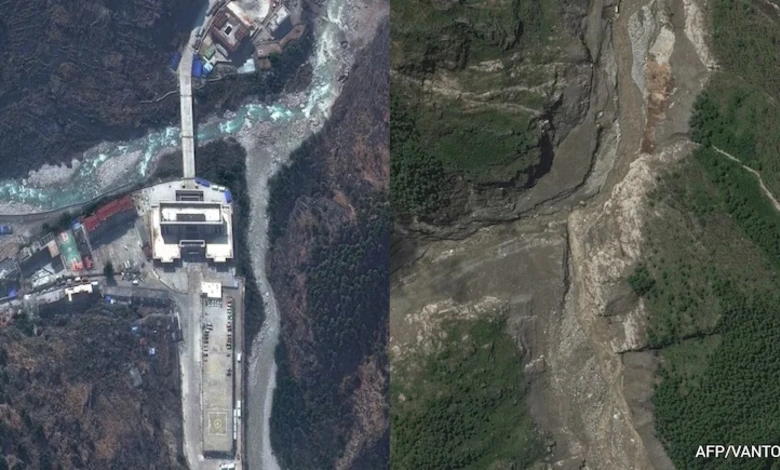
New Delhi: The devastation in Nepal’s Himalayas has left hundreds dead and thousands missing after a huge mass of rock, ice, mud and water swept through communities along the Nepal-China border. As rescue teams continue searching for survivors, attention is turning to something that makes the disaster even more troubling scientists had warned months earlier that the Himalayan region was becoming increasingly unstable.
The disaster struck on August 26 in Nepal’s Rasuwa district and China’s Gyirong County. Nepal has reported hundreds of deaths and thousands of people missing, while Chinese authorities have also reported deaths and hundreds missing on their side of the border. Roads, bridges and other infrastructure were badly damaged, making rescue operations extremely difficult.
Scientists investigating the disaster believe it was not simply a case of heavy rain causing a flash flood. Early findings point towards a massive ice and rock avalanche in the high mountains. The falling material is believed to have crashed into the river system, sending a powerful wall of water and debris rushing downstream.
The suddenness of the event left little time for people to escape. Reports suggest the river level rose dramatically within minutes. That also exposed a weakness in existing warning systems, which are generally better at detecting rainfall and gradual rises in river levels than sudden glacier or rock collapses.



The warning signs, however, were not new.
Reports released earlier this year by the International Centre for Integrated Mountain Development (ICIMOD) highlighted the rapid changes taking place across the Hindu Kush Himalaya. Glaciers have been shrinking, temperatures are rising and areas that once received snow are increasingly experiencing rain. Such changes can weaken mountain slopes and alter the way water moves through the region.
That does not mean scientists had predicted this exact disaster. There is no evidence that the reports identified the precise location, date or size of the collapse. But they did point to a wider problem a warmer Himalaya can become a more unpredictable and dangerous Himalaya.
For the families still waiting for news of missing relatives, those scientific warnings offer little comfort now. The immediate priority remains finding survivors and helping communities that have lost homes, roads and livelihoods.
But once the rescue operation is over, Nepal and other Himalayan countries will face a difficult question how prepared are they for the next disaster in mountains that are changing faster than ever?
ALSO READ: Flood Crisis Forces Nepal U-Turn, Accepts Indian and Chinese Rescue Support