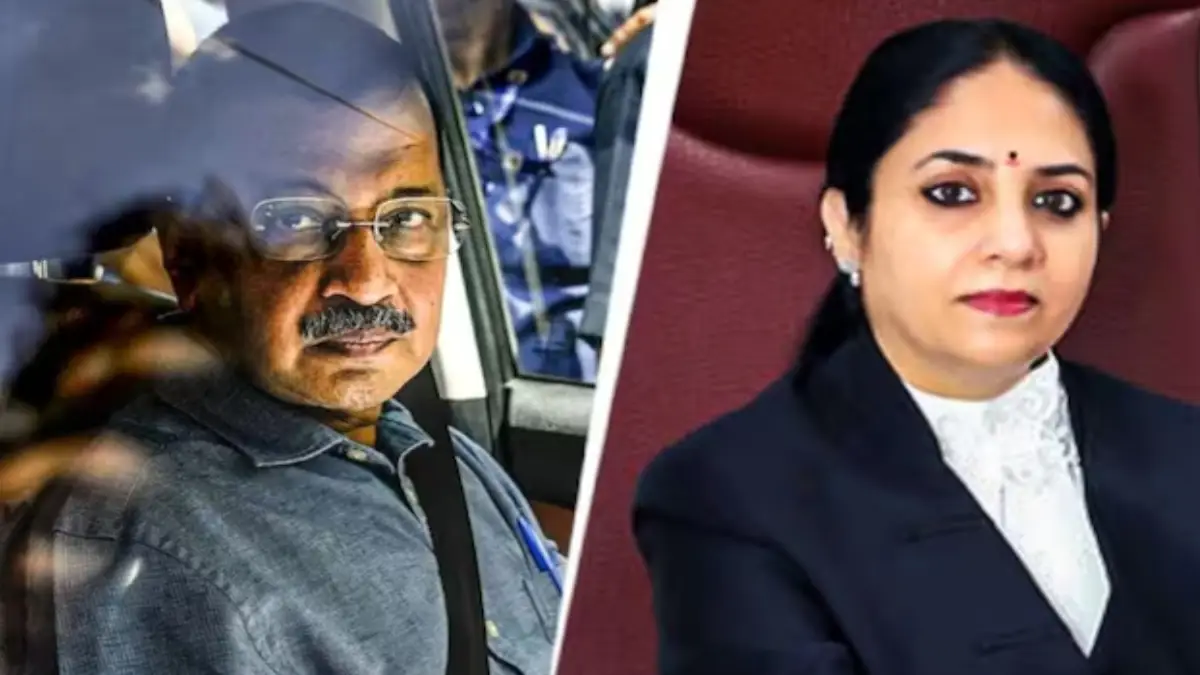
New Delhi : Former Delhi Chief Minister Arvind Kejriwal has said that he will not appear before Delhi High Court judge Justice Swarana Kanta Sharma who is hearing a plea challenging his acquittal in the excise policy case. Writing to Justice Sharma, Kejriwal said he had lost faith in her ability to deliver justice. Kejriwal has accused the judge of conflict of interest, claiming that Justice Sharma’s children, who work as panel lawyers with the central government, have professional links to Solicitor General Tushar Mehta, who is appearing against him in the case.
I have written the following letter to Justice Swarna Kanta Sharma, informing her that pursuing Gandhian principles of Satyagraha, it won’t be possible for me to pursue this case in her court, either in person or through counsel,” Kejriwal wrote. He added, “I have taken this difficult decision after coming to the clear conclusion that the proceedings being conducted in her court do not, in any manner, satisfy the fundamental principle that justice must not only be done but must also be seen to be done”.
I reserve the right to approach the Supreme Court to appeal against Justice Swarana Kanta’s verdict,” he asserted in the letter. However, legal experts are of the view that the non-appearance by Arvind Kejriwal might land him in trouble and result in a warrant against him. In a case of acquittal, the court would have made the accused sign a bond that he will appear before court for any appeal proceedings under relevant sections.
The court underlined the principle of judicial independence and rejected claims that the proceedings would not be impartial. My oath is to the Constitution. My oath has taught me that justice does not bend under pressure. Justice does not yield to any pressure. I will decide and adjudicate fearlessly without any bias. I will not recuse from this case,” Justice Sharma said while delivering her ruling.
The judge also cautioned against undermining institutional credibility, observing that “the floodgates can’t be opened to sow seeds of mistrust,” and described the situation as a “Catch-22,” where recusal or refusal could both invite criticism. She added that stepping aside without valid grounds would amount to “abdication of duty”. Kejriwal had sought the judge’s recusal citing a “grave, bona fide and reasonable apprehension” of bias.
The High Court had issued notice on the CBI’s plea and flagged certain findings of the lower court as prima facie erroneous, prompting fresh legal proceedings. Kejriwal, however, has maintained that the case is politically motivated and has repeatedly questioned the fairness of the process. His refusal to appear marks a significant escalation, as it departs from conventional legal recourse and introduces a protest-based approach within an ongoing judicial matter.
Read Also : India, New Zealand Set to Seal Landmark “Once-in-a-Generation” Trade Pact Today
-

-
-

-