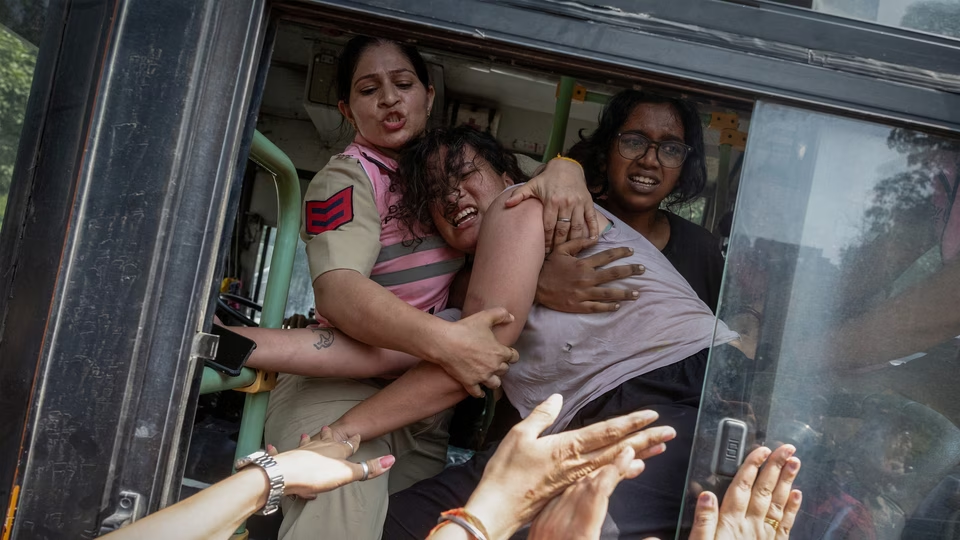
The Supreme Court on Sunday directed that peaceful and unarmed protesters in Delhi cannot be detained except in accordance with the procedure established by law. It also ordered that metro and railway services operate normally, internet connectivity remain undisturbed, and free movement of people be restored.
A special bench of Justices Joymalya Bagchi and V. Mohana issued the directions after an urgent hearing on petitions alleging mass detentions, restrictions on movement, suspension of internet services and non-compliance with the court’s earlier order on transport arrangements.
The petitions arose from the large-scale security measures taken on Saturday ahead of a planned protest at Jantar Mantar against Chief Election Commissioner Gyanesh Kumar. The demonstration was organised by the Cockroach Janata Party and other groups seeking his resignation over alleged irregularities in the Special Intensive Revision of electoral rolls. Around 41,000 security personnel were deployed and approximately 7,000 people were detained.
The court directed authorities to ensure metro and rail facilities run normally unless restrictions are required to address a genuine public order situation under Article 19(2) of the Constitution. Free movement must be permitted subject to law, internet services must remain undisturbed, and no person should be detained outside the framework of law, particularly in the case of peaceful, unarmed assemblies beyond areas covered by a prohibitory order under Section 163 of the Bharatiya Nagarik Suraksha Sanhita.
ALSO READ : India Rejects UN Remarks on Delhi Protests as Misplaced Interference
The bench also ordered the removal of any notice imposing prohibitory restrictions around the Supreme Court and other court complexes to safeguard unhindered access to justice. Notices were issued to the Delhi Metro Rail Corporation, railway authorities and Delhi Police seeking responses to allegations of non-compliance with the October 9 directions. The matter has been listed for October 13, with short affidavits and compliance reports to be filed by Tuesday.
Solicitor General Tushar Mehta told the court that metro services had operated on Saturday, though entry and exit were restricted at 45 of the network’s 303 stations, and that all stations had been open since 10 pm with internet connectivity restored. The bench sought detailed information on the affected stations and the extent of the restrictions.
Lawyers appearing for the petitioners alleged excessive detentions, including of advocates, and claimed the restrictions created a curfew-like atmosphere. The court acknowledged the concerns while reiterating that the right to protest under Article 19 is subject to reasonable restrictions and must be exercised within the legal framework. It emphasised that restrictions do not amount to a complete prohibition and that the court’s duty is to protect the fundamental rights and liberty of all individuals.
-

-
-

-