
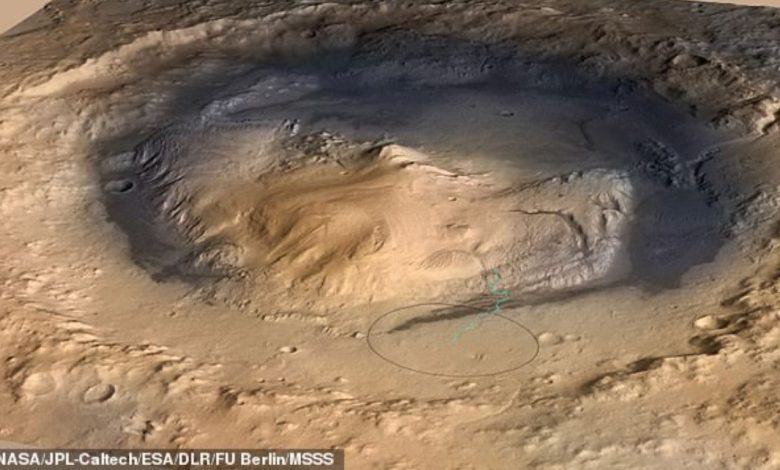
NASA’s Curiosity rover has discovered holes on the Martian surface that differ from those typically formed by meteor impacts. While Mars already has several such holes, the ones recently found are unusual and unlike anything previously observed elsewhere on the planet.
The discovery was made in Valle Grande, a broad valley cutting through Mount Sharp inside the Gale Crater. NASA noted that while meteorites regularly punch holes into the red, dusty planet, scientists are unsure how the pits in Valle Grande were formed.
According to NASA, the holes are broad and shallow, unlike anything documented in the past. Dr Michelle Minitti, MAHLI Deputy Principal Investigator, detailed the discovery in a blog post, noting that this particular section of rocks has been shaped by certain processes that scientists will attempt to understand in the near future.
How similar holes form on Earth
On Earth, small holes form in bedrock when a tougher stone or harder object becomes embedded in a bed of softer rock. Over time, these objects wash away or break apart, leaving behind impressions. However, NASA scientists did not find any such objects that could have left these holes on Mars.





“The pits of this week were much broader and shallower than past features and were not accompanied by obvious objects that were once in the pits,” Minitti wrote.
The holes were photographed closely using the Mars Hand Lens Imager (MAHLI), while the Mastcam camera captured several overlapping images of the surrounding region. NASA will use these imagesto build a three-dimensional map of the pits and measure their shape and depth in an effort to understand how they formed.

What the holes can reveal about the history of Mars
The rover also revealed that nearby rock layers changed rapidly in appearance. Certain tougher grey areas resist erosion differently compared to their surroundings. Scientists believe this could be evidence that the conditions under which these rock layers were deposited, millions or billions of years ago, underwent rapid transformation.
This region of Mars holds particular interest for NASA, as the Gale Crater is believed to have formed from an asteroid impact around three billion years ago. Mount Sharp, standing 5.5 km high, sits at the centre of the crater, and its sedimentary layers are thought to preserve a record of the environmental conditions present when each layer was deposited.