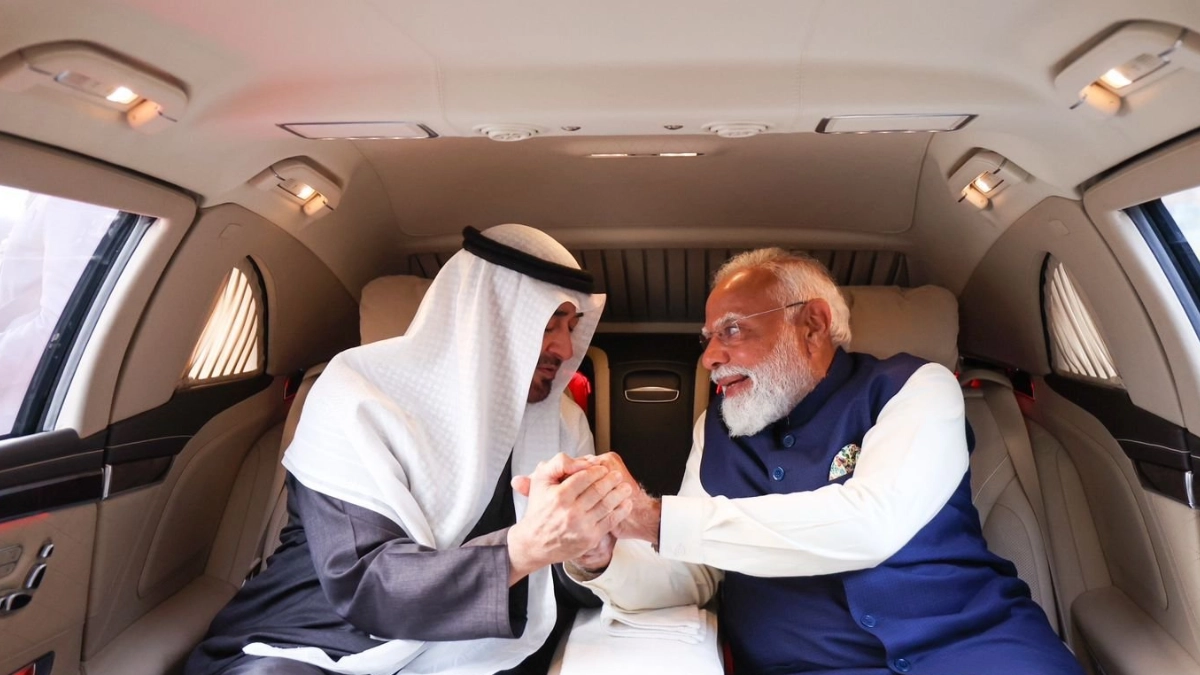
NEW DELHI — In a whirlwind visit lasting barely three hours, United Arab Emirates President Sheikh Mohamed bin Zayed (MBZ) and Prime Minister Narendra Modi on Monday significantly widened the strategic scope of New Delhi-Abu Dhabi ties. The leaders set an ambitious target to double bilateral trade to $200 billion by 2032 and initiated a framework for a comprehensive defence partnership.
The visit, marked by high protocol as Prime Minister Modi broke with custom to receive the UAE leader personally with a hug at the airport, underscored the Gulf nation’s position as a linchpin in India’s West Asia policy. The two leaders traveled together to the Prime Minister’s residence, signalling the depth of a relationship that bridges energy security, a 4.5 million-strong Indian diaspora, and deepening geopolitical alignment.
ECONOMIC ESCALATION: ENERGY AND INFRASTRUCTURE
Central to the discussions was the decision to accelerate economic integration. Building on the Comprehensive Economic Partnership Agreement (CEPA) concluded in 2022, which helped propel two-way trade to $100 billion in 2024-25, the leaders set a new benchmark to reach $200 billion within the next six years.
Energy security remained a cornerstone of the talks. Among the five key agreements unveiled was a significant hydrocarbon pact between Hindustan Petroleum Corporation Limited (HPCL) and ADNOC Gas. The deal secures the supply of 0.5 million tonnes per annum of Liquefied Natural Gas (LNG) to India for a 10-year period, commencing in 2028. The UAE currently stands as India’s fourth-largest oil supplier and second-largest source for LNG and LPG.
Beyond traditional energy, the two sides formalised investment cooperation for the Dholera Special Investment Region in Gujarat. A letter of intent signed between the Gujarat government and the UAE’s investment ministry outlines plans to develop strategic infrastructure, including an international airport, a greenfield port, and a smart urban township.
A NEW STRATEGIC DEFENCE FRAMEWORK
In a move indicating a shift toward harder security cooperation, India and the UAE signed a letter of intent to establish a “strategic defence partnership framework agreement.”
This framework aims to institutionalise cooperation across several sensitive domains, including defence industrial collaboration, special operations training, cyber-security, and interoperability. Foreign Secretary Vikram Misri described the pact as a “natural evolution” of existing defence ties, which have previously included joint exercises.
Addressing the geopolitical context, Misri clarified that the deepened defence ties were not a reaction to security volatility in West Asia. He emphasised that the agreement would not lead to India’s involvement in regional conflicts. This clarification comes against the backdrop of the UAE’s recent recalibration of its involvement in Yemen, following tensions with Saudi Arabia and the withdrawal of UAE-backed forces from key provinces.
FUTURE-READY: NUCLEAR, SPACE, AND ‘DIGITAL EMBASSIES’
The diplomatic engagement also opened new avenues for technology and civil nuclear cooperation. Following India’s enactment of the SHANTI law (Sustainable Harnessing and Advancement of Nuclear Energy for Transforming India), the two nations agreed to explore partnerships in advanced nuclear technologies. This includes potential collaboration on Small Modular Reactors (SMRs), large nuclear reactors, and nuclear safety protocols.
Also Read: PM Modi’s Rare Gesture For UAE President On 2-Hour Delhi Visit
Space collaboration also received a boost, with the Indian National Space Promotion and Authorisation Centre (IN-SPACe) and the UAE Space Agency agreeing to work on launch complexes and a startup accelerator.
Perhaps the most novel outcome was the directive to explore the creation of “digital embassies.” Officials indicated these facilities would operate under mutually recognised sovereignty arrangements to allow for the secure storage of sovereign data in each other’s territories. Furthermore, the leaders discussed interlinking national payment platforms to facilitate cost-effective cross-border transactions and agreed to collaborate on establishing data centres and a supercomputing cluster in India.
GEOPOLITICAL CONVERGENCE
Modi and MBZ reaffirmed their commitment to the India-Middle East-Europe Corridor (IMEC), a connectivity project viewed as crucial for long-term regional integration. The leaders also condemned terrorism in all forms, including cross-border attacks, and agreed to continue their coordination at the Financial Action Task Force (FATF) to combat terror financing.
Prime Minister Modi also invited UAE sovereign wealth funds to participate in the second NIIF Infrastructure Fund, slated for a 2026 launch, further cementing the financial bridge between the two nations.
-

-
-

-