
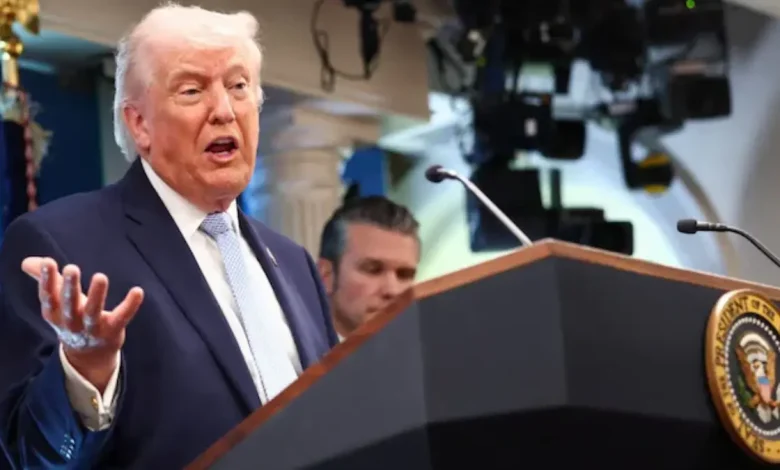
Oil prices moderated on Wednesday following fresh comments from US President Donald Trump, who reiterated that the ongoing war with Iran would conclude “very quickly.” Market participants, however, continued to exercise caution over the prospects of peace negotiations while supply disruptions across the Middle East persisted.
Brent crude futures declined by 45 cents, or 0.4 percent, to $110.83 per barrel by 0050 GMT. US West Texas Intermediate (WTI) crude dropped 27 cents, or 0.3 percent, to $103.88 a barrel. The benchmarks had already slipped nearly $1 the previous day after US Vice President JD Vance indicated progress in discussions between Washington and Tehran, noting that neither side sought a return to military hostilities.
Analysts highlighted persistent uncertainty. Toshitaka Tazawa of Fujitomi Securities observed that investors were closely watching whether the US and Iran could establish common ground for a peace agreement, amid shifting positions from Washington. He added that oil prices were expected to stay elevated due to the risk of renewed US strikes and the likelihood that crude supply would not rebound swiftly to pre-war levels even if a deal materialized.




Trump’s latest assertion to US lawmakers late Tuesday about a rapid resolution came alongside earlier statements suggesting the United States might need to strike Iran once more. He mentioned having been roughly an hour away from ordering an attack before postponing it. These remarks followed his previous indication that he had halted planned military action in response to a new proposal from Tehran aimed at ending the US-Israeli war. On Tuesday, Trump also claimed Iran’s leadership was seeking a deal and warned of potential new attacks in the coming days without an agreement.
The conflict between the US, Israel, and Iran has effectively shut the Strait of Hormuz, a critical chokepoint that typically handles about one-fifth of global oil supplies. This has triggered the largest oil supply disruption on record, according to the International Energy Agency.
Financial institutions remain concerned. Citi analysts projected on Tuesday that Brent crude could climb to $120 per barrel in the near term, arguing that markets were underestimating the dangers of a drawn-out supply shortfall and associated risks.
To offset reduced global supplies, nations have drawn on commercial and strategic stockpiles. In the United States, crude inventories declined for a fifth consecutive week, according to data from the American Petroleum Institute cited by market sources. Fuel stocks also fell. Official figures from the Energy Information Administration, due later Wednesday, were anticipated to show a drop of about 3.4 million barrels in crude stockpiles for the week ending May 15.