
Nobel Prize in Chemistry 2026: Henri B. Kagan and Kenso Soai Honoured for Molecular Asymmetry Research
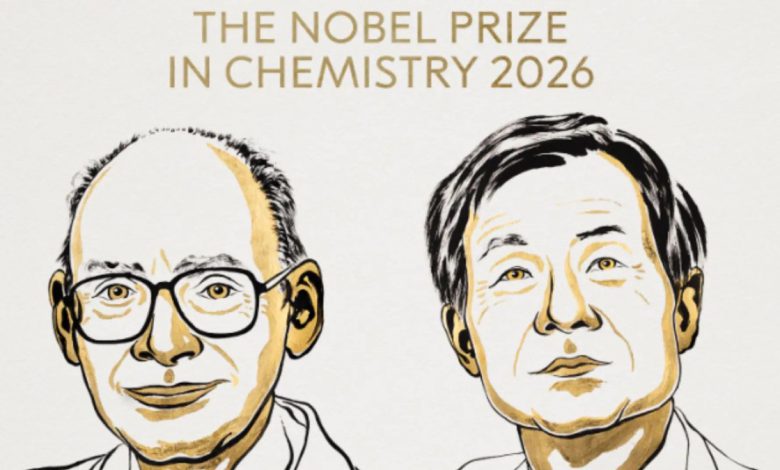
France’s Henri B. Kagan and Japan’s Kenso Soai have been awarded the 2026 Nobel Prize in Chemistry for their work on molecular asymmetry, the Nobel Committee announced.
The Royal Swedish Academy of Sciences recognised the two chemists “for the discovery of non-linear effects and autocatalysis in asymmetric organic synthesis.” Their research explains how homochirality the presence of only one mirror-image form of a molecule can emerge spontaneously.
Several molecules, including amino acids, exist in two forms that are mirror images of each other. Living organisms, however, contain only one of these forms. Chemists had long sought to understand how such asymmetry could arise.
Also Read:Tear Gas Used as Over 260,000 Rally Across France Demanding More Education Funding




Kagan made a major breakthrough in 1986, discovering a method to manipulate chemical reactions so that they produce an excess of one mirror-image form. This finding changed the understanding of what was possible in asymmetric synthesis.
Soai designed a reaction in 1995 with the potential to become homochiral. In 2003, he achieved a reaction that produced only one mirror-image form.
The Nobel Committee said the discoveries have been decisive for pharmaceutical manufacturing, where producing the correct molecular mirror image can be critical.