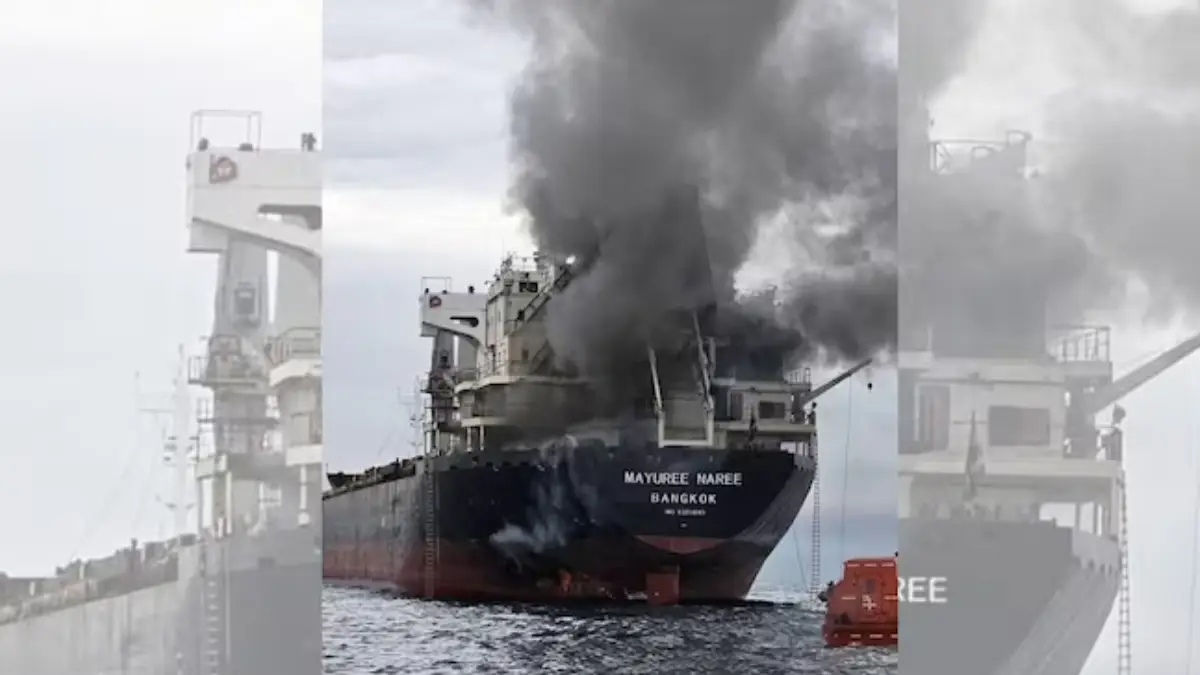
New Delhi : Five SOS calls in less than half a minute. Panic rising with each message. Voices breaking over open channel radio. For Indian seafarers caught near the Strait of Hormuz last week, it marked the beginning of a maritime nightmare unfolding far from shore and far from help. On June 8, 10 and 11, three merchant vessels carrying Indian crew — Marivex, Settebello and Jalveer — were attacked by the US Navy in separate incidents.
The strikes left engines burning and vessels disabled at sea. Videos released by US Central Command (CENTCOM) showed engine rooms engulfed in flames, even as Washington alleged the ships were violating a blockade and transporting Iranian oil. Ship operators disputed parts of the US claim, saying at least one vessel had been stationary for days and had received no warning or communication.
Sirens echoed as explosions ripped through machinery spaces. Yet despite the destruction, all 20 Indian seafarers onboard were eventually rescued. While Marivex was targeted 400 nautical miles from the Strait of Hormuz, the other vessels were attacked off Oman’s Shinas coast, closer to the strait. CENTCOM said that both Settebello and Marivex had violated the blockade and were attempting to ship Iranian oil.
As the US Navy stepped up attacks on vessels carrying Indian sailors, the body of a 35-year-old Indian sailor lay decomposing for nearly three days off the coast of Oman, while repeated distress calls from a vessel’s captain went unanswered. The MT Celestial, carrying Uirthanathan, had sent SOS calls to the US Navy — responsible for enforcing the naval blockade — on June 10 and 11, before he eventually died.
Crew members were seen placing cold water bottles over his body wrapped in plastic sheets to slow decomposition, according to the Forward Seamen’s Union of India (FSUI), which said the vessel lacked proper refrigeration facilities. The Indian Embassy in Oman said it was coordinating with all stakeholders for the early return of the mortal remains and confirmed that Uirthanathan had died due to medical complications while onboard at Duqm Port.
Washington, however, remained defiant and doubled down. In a call with External Affairs Minister S Jaishankar, Secretary of State Marco Rubio said that illegal transport through the strait would not be tolerated, while President Donald Trump alleged that Iran was behind the strikes.
Read Also : Nine Bangladeshi Nationals Caught in Tense Border Standoff Between India and Bangladesh