
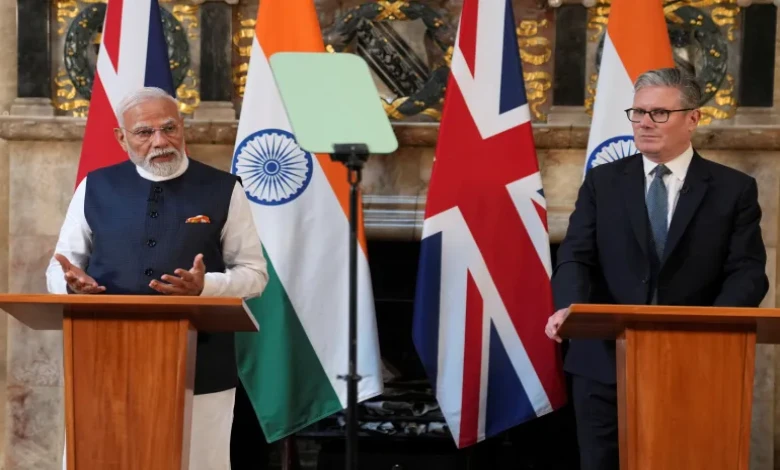
The Comprehensive Economic and Trade Agreement (CETA) between the United Kingdom and India has taken effect, lowering tariffs on hundreds of commodities and expanding access for service companies in both nations. The deal, which went into force on Wednesday, is anticipated to boost labor-intensive industries like textiles by providing Indian exporters with instant duty-free access to the majority of British tariff lines.
However, with gradual tariff reductions and quotas in industries like vehicles, the UK will have more access to Indian markets.
India’s Commerce and Industry Minister Piyush Goyal described the deal as a “defining milestone in India-UK ties” in a post on X.
“Our textiles, leather, gems and jewelry, engineering goods, marine products, chemicals, processed foods, MSMEs, farmers, and manufacturers have never-before-seen opportunities thanks to the India-UK free trade agreement,” he stated. “It also expands mobility for Indian talent and opens new frontiers for our IT, professional, financial, education, and business services sectors.”




The agreement is anticipated to cut the price of British imports and boost India’s exports to the UK.
CETA was praised in a British government policy paper released on Wednesday, which claimed to have negotiated the “best deal that any country has ever agreed with India.”
According to the strategy paper, “India will remove or reduce tariffs, or pre-existing zero tariffs, on 90 percent tariff lines, which will cover 92 percent of existing goods imports from the UK (based on 2022 trade).”
At the same time, 96.8% of tariff lines, or 97.7% of their trade value, will have their tariffs instantly eliminated by the UK.
However, the UK’s removal of tariffs on nearly all Indian goods is what makes the pact significant.
Additionally, India will phase out tariffs on an additional 21% of tariff lines and immediately reduce levies on 64.1% of them, with the exception of sensitive goods.
India exported $13.44 billion worth of commodities to the UK in the fiscal year 2025–2026, while imports totaled $11.68 billion, according to figures from the Ministry of Commerce and Industry. According to data cited by the Reuters news agency, bilateral services trade reached $35.44 billion in 2024, with India operating a services surplus of around $7.9 billion.
Indian Prime Minister Narendra Modi stated that the two nations’ “economic linkages are going to get even deeper” in a post on X on Wednesday.
“A number of thriving industries will have better access to the UK market. Additionally, it will promote increased mobility for talented Indian workers and strengthen collaboration in the fields of technology, professional services, and innovation, he said.
The trust between our democracies and our will to create a forward-thinking alliance based on trade, technology, investment, and innovation are reflected in this moment. The UK and India will keep cooperating for mutual prosperity.
British Goods that have become cheaper
The British policy paper claims that goods like lamb, soft drinks, chocolates, whiskies, and cosmetics will be less expensive as a result of the tariff reduction.
The deal is also anticipated to boost manufacturing industries, such as automobiles, electrical circuits, high-end optical items, and medical devices.
The agreement also includes market access and a five-year exemption from National Insurance contributions for Indian workers who temporarily relocate to the UK for employment.
Additionally, Minister Goyal stated that “over 75,000 professionals & over 900 companies expected to benefit” from the CETA’s implementation.
He said, “IT, ITeS, financial, professional, healthcare, education, engineering, telecommunication, and consulting services to gain.”
Indian Goods that have become cheaper
The removal of duties on maritime exports, textiles, leather, footwear, jewelry, and gems will make it easier for Indian exporters to compete in the British market.
The agreement will also result in lower prices for fruits, vegetables, processed foods, and spices in the UK.
Although a variety of industries are covered by the agreement, dairy, eggs, poultry, and sugar are not.
Additionally, apples, walnuts, some types of gold bars, and smartphones are not allowed in India.
Also Read – India Launches Comprehensive Seafarer Tracking Initiative Amid Rising Tensions in Key Maritime Routes