
Chandipura Virus in Gujarat: Why the Deadly Pattern Keeps Baffling Health Experts — Answers From Four Specialists
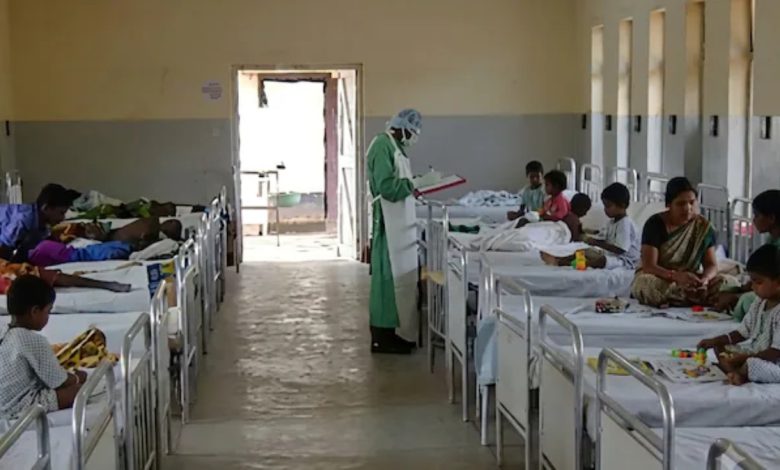
In 2024, the Chandipura virus claimed 82 children’s lives in Gujarat. This time, it has already claimed 12. The virus enters the body through the sand fly a tiny brown insect long associated with rural Gujarat. But is this fly confined to villages, or can it reach cities too? And why does Chandipura’s pattern in Gujarat continue to confound experts?
Is the sand fly found only in Gujarat’s villages, or can it appear in cities as well?
Answer: The fly does not originate in villages and then fly into cities it breeds wherever there is filth, moisture, and old buildings, regardless of location. There is no reason to assume this dangerous fly exists only in rural areas; it can be present in cities too. Parents in urban areas need to stay equally alert. If a child develops even a mild fever, they should be taken to a doctor immediately rather than relying on home remedies, since the tiny brown fly could be present nearby without anyone realising it.
Dr. Neelam Patel, Additional Director of the Public Health Department under Gujarat’s Health Department, said that in 2024, cases were reported from three municipal corporation areas three in Ahmedabad, two in Surat, and one in Rajkot. This shows Chandipura is not exclusive to rural children; it can occur in cities too, though at a much lower rate. No urban cases have been reported since 2024.
Vinod Pandya, a retired biology teacher and expert in entomology, explains that female sand flies lay eggs in moist areas, small cracks, mud, and garbage heaps. This means breeding is not restricted to villages wherever cities have filth or old, damp buildings, the fly is likely to be present.




Rural children have been the primary victims so far — are urban children also at risk?
Answer: Yes. Urban children are certainly at risk from the Chandipura virus. The dangerous sand fly can be present within or around housing societies. A child playing outdoors in half-sleeve T-shirts or shorts is more likely to be bitten.
Dr. Rakesh Joshi, Superintendent of Ahmedabad Civil Hospital, says the chances of urban children contracting Chandipura are lower than rural children, but not zero so caution is essential regardless. Wherever there is filth, the sand fly is likely present. If a child shows even mild fever, vomiting, or diarrhoea, the early hours are critical, and treatment should be sought immediately during this golden window.
Dr. Joshi added that the fly bites adults too, but adults’ stronger immune systems typically prevent the virus from taking hold. Children under 15 have weaker immunity, allowing the virus to overwhelm the body quickly. Since there is no definitive cure or vaccine for Chandipura, prevention remains far more effective than treatment.
Is death certain once a child is infected?
Answer: Dr. Devang Solanki, Chief Neonatologist and Paediatrician at Ahmedabad’s Divine Institute of Child Health, says outcomes depend on the child’s own resilience and how far the virus has progressed into the brain. If the virus has invaded 60 to 70 percent of the brain, saving the child becomes extremely difficult.
He added that with monsoon travel trekking and outings in forested areas — becoming increasingly popular, avoiding such trips can help protect children from exposure to the fly. Since most such viruses are contagious, infection can spread from one child to another through close contact. The same precautions adopted during COVID-19 — masks, sanitisers, physical distancing, and frequent handwashing can help protect children here as well.
What has Chandipura’s pattern in Gujarat looked like, and what comes next?
Answer: Sabarkantha, Mehsana, Kheda, Mahisagar, and Aravalli are the five districts where Chandipura virus impact has been most significant. Dr. Neelam Patel said the virus rarely reappears in the same village sometimes not even in the same taluka. Often, a case in one village is followed the next year by a case in another village many kilometres away.
Numerous cases were reported in 2024; in 2025, only a single case emerged, from a village in Kheda district. Cases have risen again in 2026. Gujarat’s Chandipura pattern remains difficult to decode and highly unpredictable, posing a major challenge. Health department teams are working hard, but where exactly to focus that effort remains unclear. Villagers are being advised to keep beds away from walls, so flies residing in wall cracks cannot make direct contact. Beyond this, several other precautions are also being communicated. Awareness remains the single biggest tool against Chandipura.
Jayesh Parmar, Health Officer of Aravalli district, said the district recorded three Chandipura cases in 2024, one of which was fatal. Those cases came from Mota Kantharia in Bhiloda and Vaghpur in Meghraj. There were no cases in 2025, but this year a suspected case emerged from Meratimba village in Bayad’s Othamba area though the test result came back negative.
A Rapid Response Team has since arrived in Aravalli district, and officials are working with the team to prepare an action plan, including efforts to prevent the virus from recurring annually. Teams are visiting villages house to house to spray powder, advising residents to seal cracks, and encouraging full-sleeved clothing.
Dr. Kamlesh Upadhyay, Head of the Medicine Department at Ahmedabad Civil Hospital, said there has been a gap between cases rather than a continuous cluster. His team is working with ICMR to study which districts had cases previously, which districts have cases now, and which districts have reported none at all building a clearer picture of the virus’s pattern. Both affected and unaffected districts are being studied separately, and a long-term study is expected to eventually yield a solution.
Is the sand fly the same as the common housefly, or is it different?
Answer: The two are entirely different. The common black housefly is visible to the naked eye. The sand fly is only slightly larger than a mosquito and brown in colour, making it difficult to spot at first glance.
Entomology expert Vinod Pandya explains that during monsoon, when temperatures range between 36 and 46 degrees Celsius, female sand flies lay eggs. The fly typically does not travel more than 107 metres from its breeding site. After hatching, it takes 40 to 50 days to mature into an adult, after which it lives for roughly 15 days. An adult female lays eggs only once in her lifetime, typically between 20 and 70 eggs. Producing these eggs requires specific nutrients drawn from blood whether from animals or humans.
The sand fly responsible for Chandipura virus can also spread other diseases, which is why it cannot be taken lightly. According to the World Health Organization, 90 species of sand fly are capable of transmitting the Leishmania parasite. The common housefly’s life cycle is shorter than the sand fly’s around 9 to 12 days, compared to two or three days longer for the sand fly.
How does the virus travel from a fly bite to a child’s brain?
Answer: According to a research paper by Dr. Pragya and Dr. Kaushal Bhavsar published on ICELink, sand flies carry three virus subtypes Naples, Sicilian, and Toscana. Of these, Naples and Sicilian typically cause only fever without serious damage. Toscana, however, is dangerous and capable of reaching the brain.
A research paper on ScienceDirect titled “Chandipura virus: A comprehensive review” states that Chandipura infection occurs in two phases. The virus first infects white blood cells, followed by a neurotropic phase where, much like a squirrel climbing a tree trunk, the virus latches onto cells and gradually makes its way to the brain. This allows it to enter the nervous system, triggering encephalitis, a severe brain fever.
The paper notes that the exact mechanism by which the virus penetrates the central nervous system is not yet fully understood. However, research on similar viruses suggests it may enter through a protein-uptake cellular process called clathrin-mediated endocytosis. Once inside, the virus is believed to use this transport mechanism to travel to the brain. Chandipura infection attacks the blood-brain barrier (BBB) within 24 hours.
Dr. N.P. Bhatt and F.M. Rodrigues of the National Institute of Virology, Pune, were the first to document that Chandipura virus shares characteristics with the Rhabdoviridae family the same viral family responsible for rabies.
The bigger picture
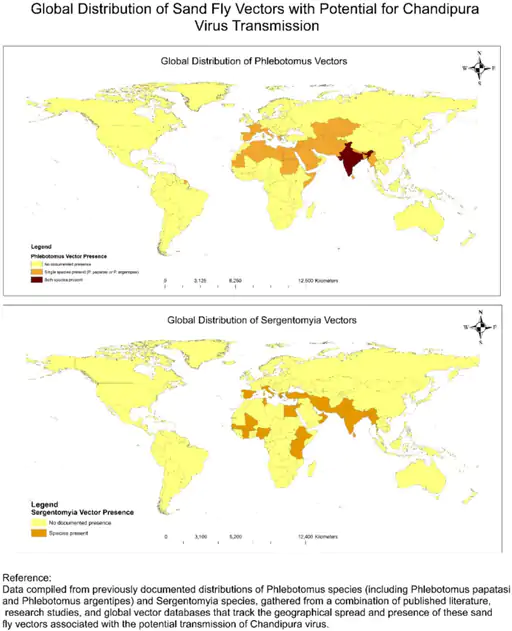
A graphic circulating on the subject identifies two sand fly species responsible for spreading Chandipura virus Phlebotomus and Sergentomyia. The Global Vector Database, which tracks the spread of these species, has noted a striking fact: both species are found nowhere else in the world except India. Andhra Pradesh, Maharashtra, and Gujarat report the highest number of cases, with scattered cases also seen in Rajasthan, Madhya Pradesh, Uttar Pradesh, Bihar, Odisha, Karnataka, Kerala, and Tamil Nadu. (Based on the research paper “Chandipura virus: A comprehensive review”)
In 2024, Chandipura virus swept through Gujarat, with 245 recorded cases and 82 child deaths. Tribal belts across north, central, and south Gujarat bore the brunt of that outbreak.