
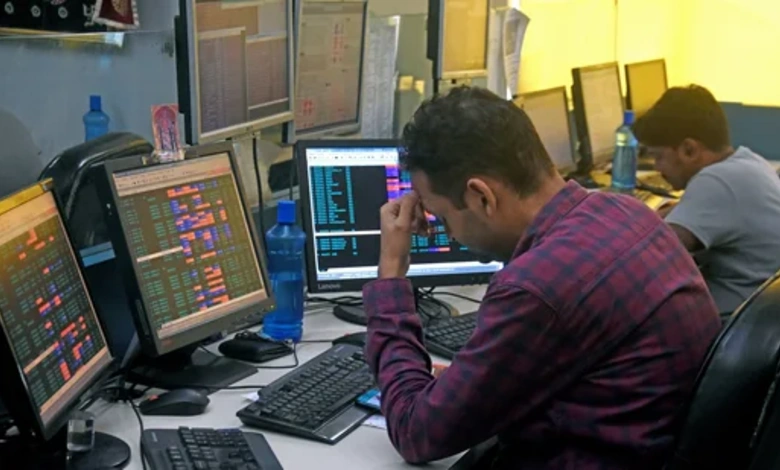
Indian equity benchmarks experienced a dramatic downturn on Friday, with the Sensex and Nifty sliding sharply in the last hour of trading as investors navigated multiple headwinds, including doubts over a potential US-Iran peace agreement, adjustments in global index weights, and persistently high crude oil prices.
The BSE Sensex closed 1,092.06 points, or 1.44 per cent, lower at 74,775.74. The NSE Nifty50 dropped 359.40 points, or 1.5 per cent, to end at 23,547.75. The decline accelerated after 3 pm, with the Sensex shedding nearly 1,450 points from its intraday peak of 76,220.02, while the Nifty pulled back from a high of 24,002.8. Declining stocks outnumbered advances on the BSE, with 2,507 losers against 1,568 gainers.
A primary factor behind the sudden sell-off was mounting uncertainty surrounding prospects for a durable peace deal between the United States and Iran. Market participants, who had fueled a robust recovery in April following a significant correction in March, chose to book profits amid fears that geopolitical strains in the Middle East could linger.
Arun Malhotra, founder and fund manager at CapGrow Capital, told Reuters that a sustained rally in Indian stocks appears unlikely until clarity emerges on the US-Iran situation. The Nifty had tumbled 11.3 per cent in March before rebounding 7.5 per cent in April, leaving it exposed to profit-taking.




Selling intensified in the closing minutes as MSCI’s May index rebalancing took effect. Funds tracking these indices typically reallocate portfolios at the close on such days, leading to volatility, particularly in major constituents. IIFL Capital noted that India’s weight in the MSCI Emerging Markets Index, which had climbed to around 20 per cent in July 2024, is set to fall to approximately 11.2 per cent after the latest changes.
ALSO READ : Company Is Behind Rivals In Agentic AI Coding : Google CEO Sundar Pichai
Elevated oil prices added to the caution. Although Brent crude futures declined roughly 19 per cent in May, they remain more than 27 per cent above pre-conflict levels. As the world’s third-largest oil importer, India faces risks of higher inflation and a wider current account deficit from sustained energy costs.
Foreign investors continued to adopt a selective approach toward Indian equities, citing rich valuations, oil price pressures, and the lack of a strong artificial intelligence-driven technology surge seen in other global markets. Heavyweight financial and IT sectors declined 1.2 per cent and 0.9 per cent respectively. Reliance Industries fell 7.7 per cent over the month, exerting significant downward pressure on the benchmarks.
Sector-specific moves varied. ONGC dropped 11.4 per cent on profit-booking and project concerns, while ITC shed 8.9 per cent amid worries over potential volume impacts from price increases. In contrast, Adani Enterprises jumped 22 per cent after US authorities dropped fraud charges against Gautam Adani. Metal stocks like Hindalco and National Aluminium also rose on domestic demand and supply worries tied to the Iran conflict.
The late-session weakness pushed both indices into the red for May, with the Nifty down 1.9 per cent and the Sensex losing 2.8 per cent. Midcap and smallcap segments showed relative resilience on earnings optimism. Market watchers will closely monitor Middle East developments, oil trends, foreign flows, and domestic data for future direction.