
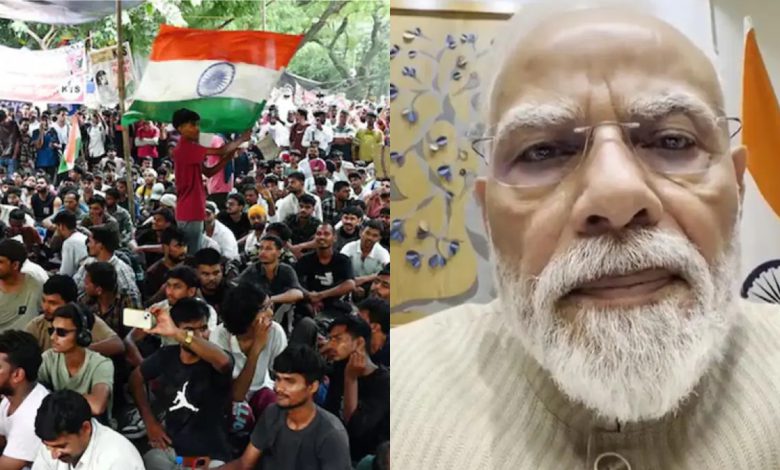
Within a span of just 30 days, what began as a protest by the Cockroach Janta Party (CJP) over exam paper leaks snowballed into a full-blown agitation against the education system as a whole. Throughout, the government maintained a studied silence. The crackdown on student protesters during their march to Parliament only gave the movement fresh momentum, spilling over into other metros. The speed and scale of the unrest caught the government off guard, triggering a 24-hour scramble on Thursday to calm student anger.
Over the week, the Opposition pushed the accountability battle all the way to the Prime Minister himself. An unprecedented sit-in outside PM Narendra Modi’s residence added further pressure. On Thursday, it was the Prime Minister who led the government’s outreach to the protesting students. In an early-morning post, PM Modi announced that the government would set up fast-track courts to ensure strict punishment for those involved in paper leaks.
“Nothing is more important than the welfare and future of our youth,” PM Modi wrote. However, there was no mention of the CJP protests or its allegations of police brutality during the July 20 ‘Sansad Chalo’ march, nor any word on Education Minister Dharmendra Pradhan.
Within hours, the Delhi High Court designated a special fast-track court to exclusively try offences related to paper leaks. Later, in a video message, PM Modi said government departments had worked “tirelessly throughout the night” to prepare a draft on fast-track courts a move meant to signal the government’s seriousness.



How The Government Moved To Defuse Student Anger
But it did little to quell the anger at Jantar Mantar. The CJP reiterated that its first demand remained the resignation of Dharmendra Pradhan.
Meanwhile, the protest site continued to see a steady stream of new arrivals. The movement had turned organic, drawing people from all strata and age groups who arrived of their own volition rather than on rented buses. Most were students and young jobseekers, cutting across religious lines.
For the government, the stakes went beyond politics. The protests had begun affecting normal life in the heart of Delhi, which houses several government offices. Through the week, 17 metro stations were shut due to security concerns, disrupting thousands of daily commuters for whom the metro is a lifeline.
As the protests swelled, the government’s top ministers went into a huddle. Rarely has the Modi government faced such a broad-based movement one distinctly different in character from the farmers’ protest or the anti-CAA agitation.
Union Home Minister Amit Shah, Health Minister JP Nadda, and Minister of State in the Prime Minister’s Office (PMO) Dr Jitendra Singh held a high-level meeting that lasted nearly four hours.
The meeting decided that the government would take a positive approach toward the demands raised by activist Sonam Wangchuk, who had been on a hunger strike for the past 25 days demanding education reforms. It was also decided that the government would engage with a CJP delegation for talks on Friday.
The government wanted to be seen as responsive rather than confrontational. Time was running short, as the CJP — bolstered by solidarity protests in other states had called for a nationwide agitation on Friday.
Outreach To Students
In the afternoon, Jitendra Singh reached out to the student protesters in a video message, inviting CJP leaders for talks at their “convenience” and at “any time.” The Union Minister noted that the government had sent four proposals to “our youth friends” for dialogue over the previous 24 hours.
But the location of the talks became a sticking point. The government wanted discussions held either at Union Health Minister JP Nadda’s residence or office. The CJP, however, made clear it would hold talks only at a neutral venue or at Jantar Mantar. Late at night, the government announced that talks with CJP leaders would instead be held at the Constitution Club.
As the back-and-forth continued, the government also ordered a major bureaucratic reshuffle in the Education Ministry. Two months after the NEET-UG paper leak fiasco, the government removed Education Secretary Vineet Joshi from his post.
Sonam Wangchuk Breaks Fast
There was more. Wangchuk’s health had been deteriorating, and he had lost 11 kgs during the strike. Nadda and Singh were dispatched to the Gurugram hospital where he was admitted. The ministers assured him that no punitive action would be taken against student protesters and that steps would be taken to plug paper leaks — both part of Wangchuk’s revised list of demands.
Shortly after midnight, Wangchuk ended his fast. Visuals of the Ladakhi activist being fed juice by the ministers to break his hunger strike were broadcast across television screens.
END OF HUNGER… BEGINNING OF ACCOUNTABILITY…!
— Sonam Wangchuk (@Wangchuk66) July 24, 2026
Sonam Wangchuk ends his fast after 26 days upon getting assurance from the government and members of parliament of all political parties that the issue of accountability in the failing examination system will be discussed on the… pic.twitter.com/0C9YX5VlsL
“This was done after long negotiations on various conditions and in view of possible violence in the country,” Wangchuk wrote on X.
As the news broke, PM Modi posted a selfie video around midnight, saying stricter action against paper leaks would follow.
PM Modi’s Midnight Video Message
Rarely has the Prime Minister addressed an issue twice within a single day underscoring the urgency and the government’s seriousness in trying to pacify student anger.
The video was in vertical format, under three minutes long a format suited for social media reels, seemingly tailored for Instagram to reach protesting students and young people directly. Despite the late hour, it reflected a calculated approach to messaging.
“I know paper leak is not an ordinary issue. It is very painful for lakhs of students and their guardians,” PM Modi said.
The Prime Minister also revealed that a bill containing provisions for strong action against paper leaks would be introduced in Parliament next week. The bill, expected to amend the Public Examinations (Prevention of Unfair Means) Act, is likely to impose a jail term of up to 10 years and a fine of up to Rs 1 crore.
Also Read:India Advances Layered Air Defence with Successful Kusha Missile Test
By introducing the bill, the government appears to be aiming to achieve two objectives at once blunting the Opposition’s attack while getting Parliament proceedings back on track after a week disrupted by the row.
The back-to-back developments over 24 hours all point to a government trying to catch up after being caught off guard by the speed and scale of the student-led unrest. Whether the damage-control measures succeed in calming tempers remains to be seen.