
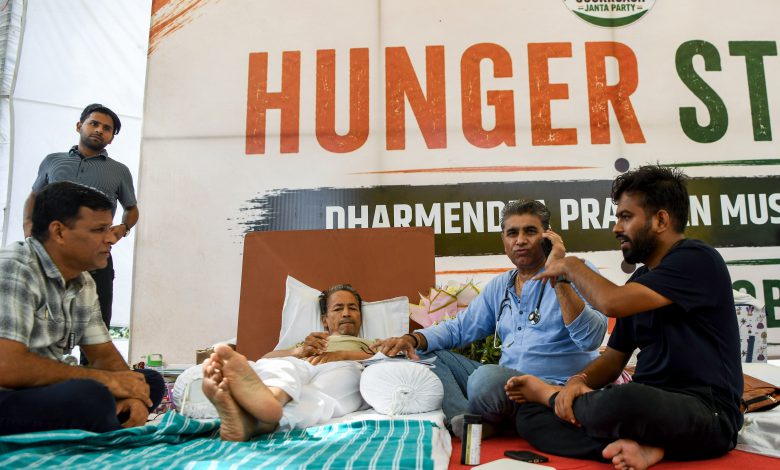
The Delhi High Court has upheld the government’s decision to move climate activist Sonam Wangchuk to Safdarjung Hospital, ruling that the action was not arbitrary in light of his worsening health following a prolonged hunger strike. The court also dismissed claims that Wangchuk was being held against his will or that his bodily autonomy had been violated, noting that he remains a free citizen and that doctors have treated him only with his consent.
The ruling came in response to a petition filed by Wangchuk’s wife, Gitanjali Angmo, who had asked the court to have him transferred from Safdarjung Hospital to Medanta, arguing that he should be able to receive treatment at a hospital of his own choosing.
The High Court issued notice to the government, police, and hospital authorities, directing them to submit a status report within three days. The case will next come up for hearing on Thursday, with no interim order passed for now. Arguments were heard from both sides, along with input from doctors at Safdarjung Hospital and the emergency medicine department at AIIMS.
Court finds government action was not arbitrary
The bench noted that Wangchuk had been on hunger strike for roughly 17 to 18 days, and that a Division Bench had already passed an order on July 16 after reviewing his critical medical condition.




The government told the court that Wangchuk’s transfer from the protest site to Safdarjung Hospital followed a marked decline in his health. It further submitted that his blood sugar and potassium levels were on the lower side, with reports describing his potassium as dangerously low.
Since the shift was made on medical grounds, the court held, it could not be treated as arbitrary.
“Since the government has taken the decision to shift him to hospital on account of his medical condition, this court does not see the same to be arbitrary action,” the court said.
The bench also acknowledged the government’s position that every life is precious and must be protected. The Additional Solicitor General told the court that Wangchuk had been fasting for around 18 days, and that the humid weather had compounded concerns for his health. The government argued that prolonged fasting combined with dehydration could trigger ketosis — a condition where falling insulin levels cause the kidneys to expel sodium and water instead of retaining them.
No detention, court clarifies
Whether Wangchuk was being held against his will at the government hospital formed a central part of the hearing.
His counsel, Kapil Sibal, argued that there was no detention in place and questioned how the government could insist on keeping a citizen at a government facility without a detention order or a criminal case against him.
“Without a detention order or offence, can the government say I want him in a government hospital?” Sibal asked.
He further argued that Wangchuk should be free to choose his own doctors and treatment setting, asking, “Why is a citizen of India denied doctors of their choice?” Sibal added that government doctors could continue monitoring Wangchuk’s condition even if he were moved to Medanta.
The court, however, repeated that Wangchuk was not in detention and remained a free citizen. It observed that he had not admitted himself to hospital voluntarily, and that this — given his medical state — made the government’s decision to shift him a reasonable exercise of its authority.
“Mr Wangchuk is not in detention,” the court said, adding that the fact he had not gone to hospital of his own accord was relevant to assessing the government’s decision.
Court rejects claim of force or violation of bodily autonomy
The High Court also turned down the argument that Wangchuk’s bodily autonomy had been compromised. It noted that doctors at Safdarjung Hospital had administered treatment only with his consent, and that this ruled out any suggestion of force or a violation of his autonomy.
The court further recorded that Wangchuk had been granted extensive access to his family, including visits outside standard hospital hours, with family members permitted to stay with him. His wife, Gitanjali Angmo, the court noted, could meet him at any time, and other relatives were also allowed to visit — a level of access the court contrasted with the more limited visiting hours typically available to other patients.
Conflicting medical reports raise trust concerns
Angmo told the court that she had sought a second medical opinion because of inconsistencies in reports on her husband’s potassium levels.
“I just asked for a second opinion because 2.9 level is not a joke,” she said.
She told the court that a blood sample drawn in the evening had produced a report around 2 am showing a potassium level of 3.5 — and questioned why a second opinion hadn’t been arranged sooner if a reading of 2.9 was being treated as life-threatening. The discrepancy, she said, had eroded her trust in the medical process.
Angmo also told the court that Medanta was prepared to admit her husband and that she planned to have him discharged against medical advice in order to move him there.
“I will get discharged against medical advice. Medanta is ready to take him. I am taking him there,” she said.
She alleged further that police personnel were stationed around Wangchuk, claiming that officers were present inside the room and listening in when she visited him — an allegation Sibal echoed in his submissions to the court.
Government cites need for extra caution
The Additional Solicitor General told the court that the government had to exercise particular caution given the circumstances surrounding Wangchuk’s health and his hunger strike.
“In the prevailing circumstances, the government has to be extra careful,” the ASG said, describing the need to be “more circumspect than it is normally” and “extra cautious,” adding, “Whatever happens to him will have consequences.”
The government also told the court there had been alternating periods of cooperation and non-cooperation from Wangchuk during his hospital stay. A doctor from Safdarjung Hospital told the court that Wangchuk had expressed distrust of the treating physicians.
“He has said, ‘I don’t trust you’. The question of trust is there,” the doctor told the court.
The hospital’s medical superintendent said doctors would have preferred to provide further medical intervention but that Wangchuk had declined some treatment, citing a lack of faith in them. The ASG argued that doctors could not simply be dismissed as untrustworthy, particularly given the extraordinary circumstances the government was managing.
Court directs Wangchuk to cooperate with doctors
The ASG requested that the court direct Wangchuk to cooperate with his treating doctors. The court agreed that he should cooperate with whatever medical intervention his condition required — a formulation Sibal objected to.
The court subsequently clarified that it was not compelling Wangchuk to undergo any specific treatment, but that he would need to cooperate with doctors and permit intervention should he choose to accept it. It added that final decisions regarding his medical condition would rest with the treating medical team, in line with standard medical protocol.
“The ultimate decision with regard to the medical condition of Mr Wangchuk will be monitored by the medical team, which shall take decisions as per medical protocol,” the court said.
The court also noted the ASG’s assurance that medical reports would continue to be shared with Wangchuk’s family.
No interim relief, matter to return Thursday
The High Court held that no interim order was warranted at this stage. It issued notice to the government, police, and hospital authorities, directing them to file their status reports within three days, with the case scheduled to return on Thursday.
Also Read:Amarnath Yatra Temporarily Suspended Amid Heavy Rainfall
The bench observed that bodily parameters are not static and that it needed to weigh the broader picture. “Every life is precious and has to be taken care of,” the court said.
The order comes amid an ongoing dispute over whether Wangchuk should remain at Safdarjung Hospital or be moved to a private facility of his family’s choosing. While his wife and legal counsel have pressed for him to be allowed to select his own doctors and treatment environment, the government has maintained that his declining health and extended hunger strike call for close and immediate medical supervision. At this stage, the High Court has sided with the government’s decision to hospitalise him, while making clear that he is not in detention and that his treatment will be guided by the medical team’s clinical judgment.