
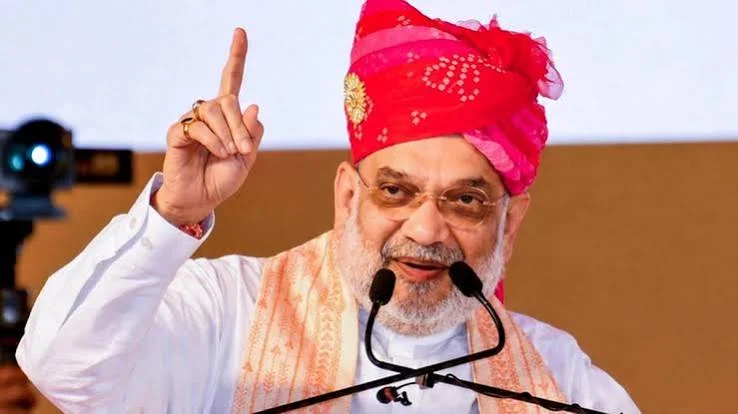
New Delhi: Union Home Minister Amit Shah on Monday used the occasion of Hindi Diwas to underline the importance of India’s linguistic diversity, saying the progress of Hindi must go hand in hand with the protection and promotion of the country’s other languages.
In his Hindi Diwas message, Shah described India’s many languages as a source of strength and cultural richness rather than a weakness. He stressed that Hindi should develop alongside other Indian languages and not be treated as a rival to them.
Shah’s message comes as the government is observing Hindi Diwas with the sixth All India Official Language Conference in Navi Mumbai on September 14 and 15. The two day event brings together government officials, language experts, academics, writers and other participants to discuss the development and wider use of Hindi and the relationship between Hindi and other Indian languages.
Shah stresses importance of mother tongue



A central part of Shah’s message this year was the importance of maintaining a connection with one’s mother tongue.
He said India’s languages carry the history, traditions and cultural experiences of its people. He also encouraged parents to speak to their children in their mother tongue and urged young Indians to acquire knowledge from around the world without losing their connection with their own language and culture.
The message reflects Shah’s broader position in recent years that strengthening Hindi should not come at the cost of India’s regional languages.
In 2025, he similarly called for respect for all Indian languages and said Hindi and other Indian languages should become stronger in areas such as technology, science, education, justice and administration. He also highlighted the potential of artificial intelligence, machine learning and digital platforms in expanding the use of Indian languages.
What is Hindi Diwas and why is it celebrated?
Hindi Diwas is observed every year on September 14.
The date marks September 14, 1949, when the Constituent Assembly adopted Hindi in the Devanagari script as the official language of the Union. The language provision was subsequently incorporated into the Constitution under Article 343.
The decision followed extensive debate over India’s language policy during the framing of the Constitution. The eventual constitutional arrangement gave Hindi the status of the Union’s official language while allowing for the continued use of English under subsequent constitutional and legal provisions.
It is important to note that Hindi is not India’s national language. India has no national language designated by the Constitution. Hindi and English are used for official purposes at the Union level, while states have their own official language arrangements.
The Constitution’s Eighth Schedule currently recognises 22 scheduled languages, reflecting India’s multilingual character.
Hindi and other Indian languages
Shah has repeatedly argued that Hindi should be developed in cooperation with India’s other languages.
During Hindi Diwas celebrations in 2025, he described Hindi as a companion rather than a competitor to India’s regional languages, saying that Indian languages should work together in nation building.
His position has also included the use of technology to make Indian languages more accessible.
The government has been working on translation and language technology initiatives aimed at improving communication between Hindi and other Indian languages. Shah has also highlighted the role of artificial intelligence and digital tools in making Indian languages more useful in modern administration and technological fields.
What is happening at the Hindi Diwas conference?
The sixth All India Official Language Conference is being held at the CIDCO Exhibition and Convention Centre in Vashi, Navi Mumbai, on September 14 and 15.
Around 7,000 officials, Rajbhasha personnel, writers, academics and experts are expected to participate, according to local reports. The programme includes discussions on Hindi as a people’s and link language, coordination between Hindi and other Indian languages, translation and the use of technology in language development.
The conference also features initiatives linked to India’s language ecosystem, including the launch of a Hindi dictionary, the Bharati mobile application and a language data centre in Pune, according to reports on the event.
The conference therefore goes beyond a celebration of Hindi and focuses on the government’s larger language policy, particularly the use of Indian languages in administration, technology and public communication.
Shah’s Hindi Diwas message in recent years
Shah’s comments in 2026 follow a consistent theme seen in his Hindi Diwas messages over the past few years.
In 2024, he highlighted the 75 year journey of Hindi as the Union’s official language and argued that Hindi and the languages of India’s states should develop together. He also pointed to efforts to improve translation and expand the use of Indian languages through technology.
In 2025, he placed greater emphasis on taking Indian languages into fields traditionally dominated by English, including science, technology, education, justice and governance. He argued that India’s languages should be capable of meeting the demands of the digital and artificial intelligence era.
This year’s message continues that approach, while placing particular emphasis on India’s linguistic diversity and the preservation of mother tongues.
Why Hindi Diwas remains significant
Hindi is one of India’s most widely spoken languages and has a major presence in education, entertainment, media, government communication and digital platforms. At the same time, India remains one of the world’s most linguistically diverse countries, with numerous languages and dialects spoken across its states and communities.
That makes the language question particularly significant.
For the government, the challenge is to increase the use of Hindi and other Indian languages in areas such as administration, education and technology while maintaining India’s multilingual character.
Shah’s Hindi Diwas message seeks to position the two objectives together Hindi can expand without requiring India’s other languages to shrink.
As India marks Hindi Diwas in 2026, the discussion is therefore no longer limited to the role of Hindi in government offices. It increasingly extends to how Indian languages can adapt to artificial intelligence, digital communication, education, science and a rapidly changing technological landscape.
The central message from Shah this year is clear the future of Hindi, in his view, should be linked to the future of India’s wider linguistic heritage.
ALSO READ: Union Home Minister Amit Shah Says Congress Disrespected Freedom Fighters