
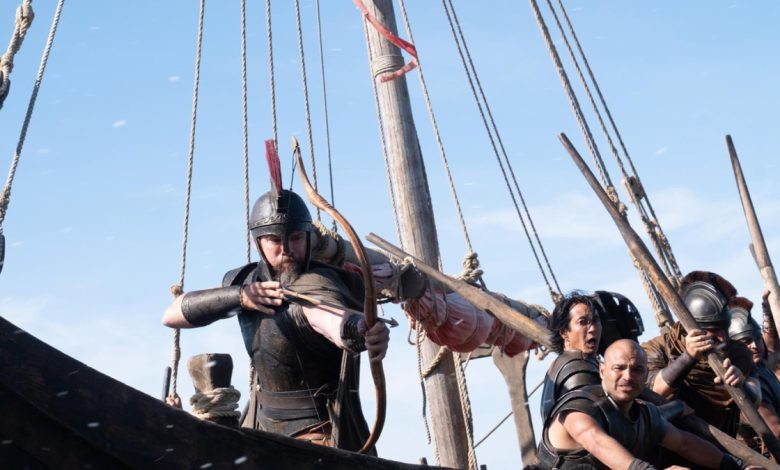
Christopher Nolan’s big-screen take on “The Odyssey” has done more than pull crowds into theatres it has ignited a surge of interest in Homer’s ancient epic and Greek and Roman mythology more broadly across the UK.
Some figures within Classics academia are now hopeful that the film’s commercial success and cultural reach could encourage more young people to take up the subject.
According to market research firm NielsenIQ, the film’s mid-month release helped push UK print sales of “The Odyssey” up by 1,400 percent in the four weeks leading to July 25, compared with the same stretch last year.
Emily Wilson’s 2017 translation of the ancient tale — the work of the British-American classicist — has seen a similarly dramatic jump in demand. Waterstones, the UK’s largest bookshop chain, reported that sales of Wilson’s translation climbed more than 1,000 percent versus 2025 figures, with a spokeswoman noting that numbers were “increasing every week,” alongside rising demand for “all other available translations.”




NielsenIQ also pointed to “significant” sales gains for related titles, including “The Iliad,” Madeline Miller’s “Circe” and Margaret Atwood’s “The Penelopiad.”
Also Read:Rashmika Mandanna Suffers Serious Hip Injury During Dance Shoot, Advised Six Weeks Of Rest
On Amazon’s UK site, actor and author Stephen Fry’s version of “The Odyssey” currently sits at the top of the history bestseller chart, while two of his other Classics titles, “Mythos” and “Troy,” rank second and fifth respectively.
The audiobook format is riding the same wave — Spotify reported that searches for “The Odyssey” translations have jumped 310 percent.
‘Buzz’
“People are drawn to these stories,” said Richard Kendall, a Classics lecturer at the University of Exeter, describing the sales spike to AFP as “fantastic.”
“And that’s not just writers who continually return to the Greeks and Romans — the history, the myths, the characters, the events — that’s also readers. These are ripping good yarns.”
Kendall, who earlier this year became the first expert-in-residence at Britain’s Classical Association, urged caution against framing the renewed literary interest purely as a byproduct of the film.
“If this is a gimmick, it’s been a gimmick that’s been lasting for over 2,000 years at this point,” he said. “It’s wonderful that this has created so much popularity. People are reading more, but this is just this iteration … People will always return to these stories.”
At University College London (UCL), where Nolan is reported to have studied Homer during his English undergraduate degree, staff are hoping the film’s popularity translates into higher enrolment.
“The buzz around the film has been tremendous, and we’re hoping to see a bounce in student numbers in the next few years,” Phiroze Vasunia, head of UCL’s Greek and Latin Department, told AFP. He added that there has been “an exceptional level of interest in Classics and in ancient studies” in recent years, a trend that has coincided with the growing attention around Nolan’s film.
Critics
Adapted from Homer’s poem, believed to have been composed in Greek around the 7th or 8th century BC, the film follows Odysseus as he battles a string of trials on his long journey home from the Trojan War.
Matt Damon and Anne Hathaway lead the cast as Odysseus and his wife Penelope, with Tom Holland playing their son Telemachus. It marks Nolan’s first film since his 2023 Oscar-winning “Oppenheimer,” and has drawn strong reviews and audience numbers, topping the US box office for two consecutive weeks and grossing $640 million worldwide so far.
Not everyone, however, has embraced this modern retelling of one of the oldest stories in human history. Wilson, whose translation Nolan has praised, made headlines this week after publishing a sharply critical review of his screenplay.
She wrote that the adaptation “lacks psychological, emotional, political and ethical depth,” and in a piece for the London Review of Books stated, “I would be ashamed to have written any part of this,” adding that it “lacks many of the elements that make the poem great.”
British historian Mary Beard offered a similarly critical assessment, though, like Wilson, she welcomed the renewed public interest in Homer. Writing in The Times, Beard lamented that the poem’s “erotic puzzles, the teasing ironies, the intriguing questions about truth and falsehood” had been swapped out for “a rather ponderous Hollywood message about civilisational decline.”