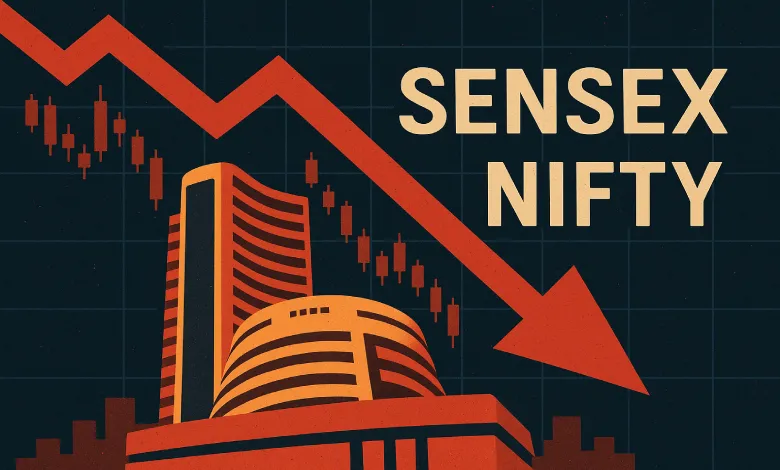
Mumbai: Indian benchmark indices witnessed a sharp decline as risk aversion swept through the markets, triggered by robust US employment figures that reduced expectations for immediate interest rate reductions and dampened investor confidence. The massive selloff erased approximately Rs 2.80 lakh crore from investor wealth, pulling the overall BSE market capitalisation down to Rs 472 lakh crore. The BSE Sensex fell more than 559 points to close at 83,675, while the Nifty 50 dropped over 147 points to settle at the 25,807 level. Just days earlier, the frontline index had regained the 26,000 milestone.
Among the 30-stock Sensex constituents, Infosys, TCS, Tech Mahindra, HCL Tech, HUL, and Eternal emerged as the biggest losers, declining by as much as 6%. Advances in ICICI Bank, Bajaj Finance, BEL, Trent and SBI failed to offset the broader losses.
Key Reasons Behind Today’s Market Decline
1. IT Stocks Under Pressure
The downturn was widespread, with the Nifty IT index crashing a dramatic 5.5% as major players including Infosys, HCLTech, Mphasis and Wipro plummeted up to 6%, pulling the entire sector significantly lower. The negative sentiment originated from US artificial intelligence startup Anthropic, which introduced a new tool specifically designed for corporate legal teams earlier this month. Anthropic, the creator of the Claude chatbot, stated the product can automate multiple legal functions, including contract reviews, non-disclosure agreement triage, compliance workflows, legal brief preparation and standardised responses. “Tech stocks, reeling under the Anthropic shock, are unlikely to recover soon,” cautioned Dr VK Vijayakumar, Chief Investment Strategist at Geojit Investments. “Indian IT will continue to struggle. The switch from IT to other segments will help performing stocks in performing sectors.”
2. Strong U.S. Jobs Data
Market sentiment remained guarded following a stronger-than-anticipated January jobs report. Although the data provided reassurance regarding the strength of the US economy, it also reinforced expectations that the Federal Reserve might decelerate the pace of interest-rate cuts, pressuring market sentiment. While traders continue to anticipate at least one 25-basis-point cut in June, the probability that rates would remain unchanged that month increased to 41% from 24.8%, based on the latest data from CME Group’s FedWatch tool.
3. Weak Q3 Performance by HUL
FMCG giant HUL declined 2% after recovering from a 5% intraday drop. The company reported a 30% decline in consolidated net profit to Rs 2,188 crore from continuing operations for the third quarter of FY26. The company’s revenue from continuing operations reached Rs 16,441 crore, representing a 5.6% year-on-year increase from Rs 15,556 crore reported in the corresponding quarter of the previous financial year, HUL said in a regulatory filing. Earnings before interest, tax, depreciation and amortisation (EBITDA) for continuing operations stood at Rs 3,788 crore, higher by 3% from the same quarter last year. However, the EBITDA margin contracted by 70 basis points YoY to 23.3%. One basis point is equal to 0.01% (one-hundredth of one percent).
Also Read: PAN Rules Likely To Change, Higher Limits Planned For Cash Deals
4. Profit Booking After Recent Gains
The 50-share Nifty ended a 4-day winning streak on the exchanges. “Nifty 50 opened with a mild gap-down, and near-term momentum has turned slightly subdued as profit booking dragged the index below the 25,900 mark. RSI is hovering in the mid-50s, indicating neutral momentum without strong directional conviction,” Ponmudi R, CEO of Enrich Money said. On the downside, a sustained break below 25,800 could open room for short-term consolidation or a mild retracement towards the 25,700–25,600 zone. On the upside, a decisive breakout and close above 26,000, supported by strong volumes, is essential to revive bullish momentum towards 26,100–26,300. In the early hours, price action is likely to remain range-bound, with stock-specific triggers guiding intraday movement unless a strong directional catalyst emerges.
5.) Geopolitical Tensions Persist
Escalating geopolitical tensions in the Middle East also shook market sentiment after US President Donald Trump warned of possible action against Iran if a nuclear deal is not reached, even as diplomatic talks continue. The discussions come amid rising tensions in the Middle East and ongoing negotiations aimed at curbing Iran’s nuclear ambitions. Netanyahu was expected to push for a tougher deal that not only halts Iran’s uranium enrichment but also restricts its ballistic missile programme and support for proxy groups such as Hamas and Hezbollah. Iran has indicated willingness to place limits on its nuclear programme in exchange for sanctions relief, though it has rejected broader demands beyond the nuclear issue.
(Disclaimer: Recommendations, suggestions, views and opinions given by the experts are their own. These do not represent the views of The Mumbai Samachar)
-
-
-

-