
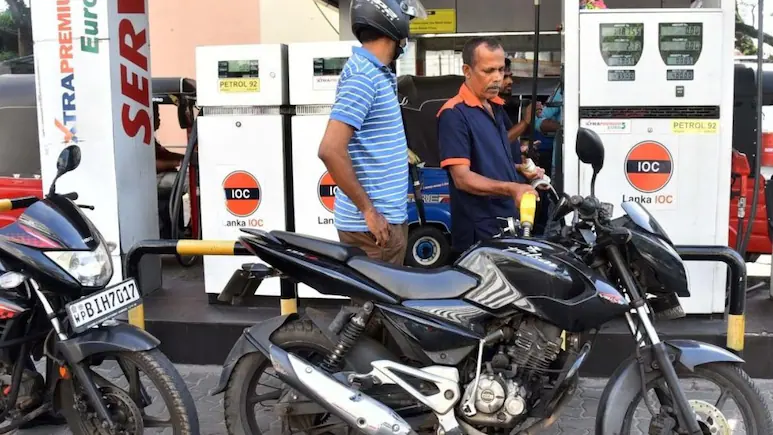
New Delhi: The Union Government has strongly rejected misleading and baseless claims circulating on social media regarding ethanol-blended petrol. According to an NDTV Profit report, the Ministry of Petroleum and Natural Gas clarified that India’s Ethanol Blending Programme (EBP) is entirely backed by scientific evidence and undergoes rigorous, continuous monitoring. The ministry pointed out that outdated images and videos are being intentionally recirculated online to create unnecessary panic among vehicle owners and consumers.
No Widespread Vehicular Damage or Breakdowns
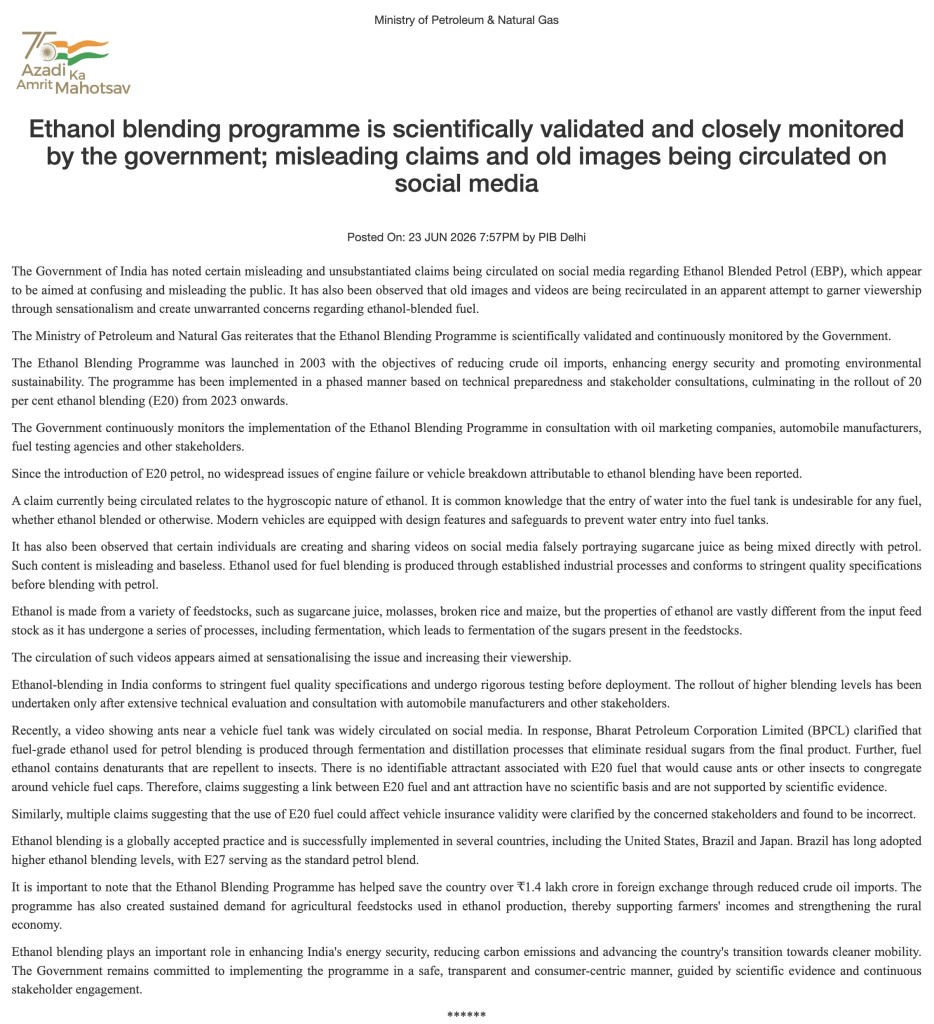
Addressing widespread concerns about vehicle health, the Ministry of Petroleum and Natural Gas stated that there have been no systemic reports of engine failures or vehicle breakdowns caused by E20 petrol since its initial integration into the market. The fuel program, which kicked off in 2003 and phased in E20 fuel starting in 2023, is consistently scrutinized through collaborative reviews involving automobile manufacturers, oil marketing companies, and specialized fuel-testing agencies.
Furthermore, responding to anxieties regarding the moisture-absorbing (hygroscopic) nature of ethanol, the government emphasized that water contamination is detrimental to any fuel type. It reassured consumers that modern vehicles are pre-equipped with advanced engineering safeguards designed to prevent moisture from entering fuel tanks.
Scientific Rebuttal to Social Media Claims
The Centre also addressed highly visible social media posts, including a viral video depicting sugarcane juice being directly mixed into petrol, labeling such claims as entirely false. The ministry noted that while ethanol is derived from various agricultural feedstocks—such as sugarcane juice, broken rice, maize, and molasses—it undergoes extensive industrial fermentation and distillation stages. These processes fundamentally alter its chemical properties to meet strict commercial quality benchmarks before any blending takes place.


Similarly, a viral video showing ants gathering around vehicle fuel caps was debunked. Citing data from Bharat Petroleum Corporation Limited (BPCL), the ministry clarified that fuel-grade ethanol contains zero residual sugars and is blended with specialized denaturants that naturally repel insects. BPCL confirmed there is no substance within E20 fuel that would attract ants or other pests.
Insurance Policy Validity Safeguarded
Another prominent piece of misinformation—alleging that using E20 fuel nullifies motor insurance policies—was flatly denied. The government confirmed it has engaged with relevant sector stakeholders to verify these claims and established that they are completely incorrect; vehicle insurance remains fully unaffected by the use of approved ethanol blends.
Macroeconomic and Environmental Gains
Beyond addressing consumer hesitation, the ministry highlighted the substantial positive economic footprint of the Ethanol Blending Programme. By lowering India’s heavy reliance on foreign crude oil imports, the initiative has successfully saved the nation more than ₹1.4 lakh crore in foreign exchange. Additionally, the industrial demand for agricultural feedstocks has created a reliable income stream for local farmers, boosting rural economic growth while simultaneously lowering vehicular carbon emissions to support a cleaner transport ecosystem.
Also Read: Viral Video: Indian Women Confront Bangladeshi Waiter Over Anti-India Slurs in Italy