
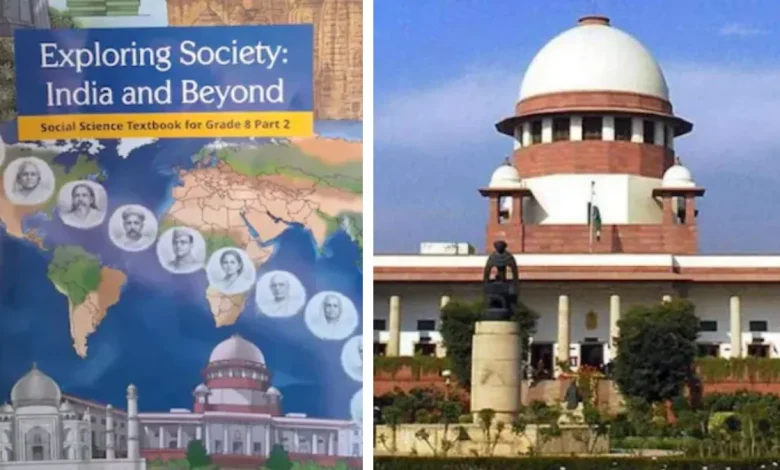
New Delhi: The National Council of Educational Research and Training (NCERT) on Tuesday, March 10, issued an “unconditional and unqualified apology” over a chapter on corruption in the judiciary included in its Class 8 Social Science textbook, “Exploring Society: India and Beyond” (Part II), and announced the withdrawal of the entire book.
In a statement posted on X, NCERT confirmed that the book is no longer available in any form. The move follows a Supreme Court order dated February 26, which imposed a “complete blanket ban” on any further publication, printing, or digital dissemination of the textbook.
NCERT’s Formal Apology
NCERT’s statement on X read: “The National Council of Educational Research and Training [NCERT] has recently published a social science textbook, ‘Exploring Society: India and Beyond,’ Grade 8 (Part II), which contained Chapter IV titled ‘The Role of Judiciary in our Society.’ The Director and Members of NCERT hereby tender an unconditional and unqualified apology for the said Chapter IV. The entire book has been withdrawn and is not available.”
𝐏𝐫𝐞𝐬𝐬 𝐑𝐞𝐥𝐞𝐚𝐬𝐞: 𝐏𝐮𝐛𝐥𝐢𝐜 𝐀𝐩𝐨𝐥𝐨𝐠𝐲
The National Council of Educational Research and Training [NCERT] has recently published a social science textbook, “Exploring Society: India and Beyond," Grade 8 (Part II), which contained Chapter IV titled “The Role of… pic.twitter.com/mZY15aJTDo— NCERT (@ncert) March 10, 2026





The council also expressed regret for any inconvenience caused and reaffirmed its commitment to responsible content. “NCERT remains committed to maintaining the highest standards of accuracy, sensitivity, and responsibility in educational content,” the statement added.
What The Controversial Chapter Contained
The chapter in question, titled “The Role of the Judiciary in Our Society,” was a first-of-its-kind addition to NCERT’s curriculum, introducing students to the subject of corruption within India’s judicial system. While the chapter continued to cover foundational topics such as the hierarchy of courts and the concept of access to justice, it also examined the system’s vulnerabilities including corruption and a massive backlog of pending cases.
Also Read: Samajwadi Party MPs Stage Potato Protest Outside Parliament Over Farmers’ Prices
The textbook cited stark figures to illustrate the scale of the problem: approximately 5.33 crore (53,321,000) cases pending across courts in India 81,000 at the Supreme Court level, 62.4 lakh (6,240,000) in various High Courts, and around 4.7 crore (47,000,000) in district and subordinate courts.