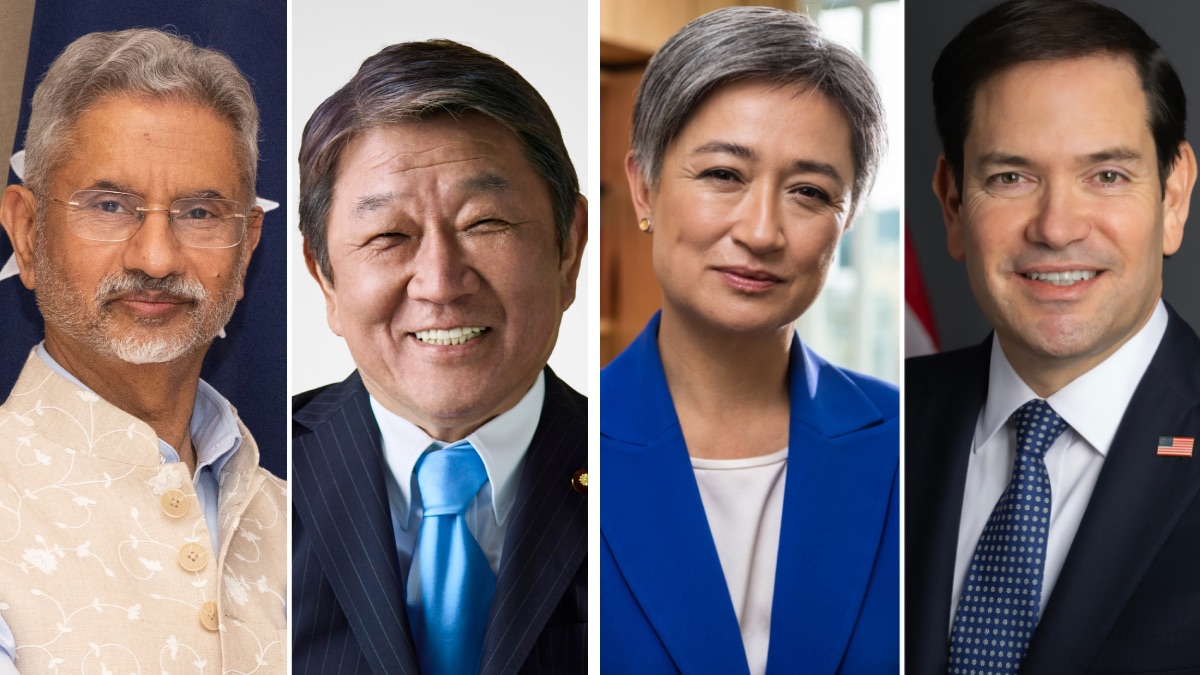
India is hosting the Quad Foreign Ministers’ Meeting in New Delhi on Tuesday (May 26), with External Affairs Minister S. Jaishankar chairing the session. US Secretary of State Marco Rubio, Australian Foreign Minister Penny Wong, and Japanese Foreign Minister Toshimitsu Motegi are attending the first such gathering on Indian soil since 2023.
The timing is pointed. The meeting comes days after US President Donald Trump met Chinese President Xi Jinping in Beijing, and with an active war between the US and Iran disrupting maritime trade routes. Both developments touch every country in the room.
Rubio arrives from Beijing with reassurances in hand
Rubio flew to New Delhi directly after accompanying Trump to the summit. His task, according to multiple analyses, is to convince India, Japan, and Australia that Washington’s commitment to the Indo-Pacific holds despite Trump’s visible effort to soften security tensions with Beijing.
The Trump-Xi summit produced modest results. Trade deals were signed or promised, but the feared “G2” scenario a US-China duopoly that would effectively partition spheres of influence and sideline regional powers like India did not materialize. The strategic status quo in the region remains largely intact.
The Quad’s edge has dulled
India’s anxiety about a US-China reset has eased somewhat, since the underlying competition between the two powers across technology, trade, and military positioning has not gone away. Analysts at Eurasia Review have argued that the Quad is not dead, but it has lost some of the urgency that defined its early years. Whether the grouping’s signature language on a “free and open Indo-Pacific” shorthand for freedom of navigation and unimpeded trade will be reaffirmed in forceful terms remains unclear.
China’s diplomatic calendar is hard to ignore
The meeting coincides with a stretch of unusually active Chinese diplomacy. Russian President Vladimir Putin visited Beijing during the Ukraine war. Senior Iranian officials whose country is now in active conflict with the US have also met with Xi. Pakistani leaders made their own trip to China as India-Pakistan tensions simmered. The optics are not subtle: China is positioning itself as the alternative venue for US adversaries and regional challengers alike.
Also Read: Donald Trump Propels Islamic Nations To Join Abraham Accords
Hormuz disruptions could enter the discussion
Whether the Iran war and the resulting strain on Strait of Hormuz traffic will feature explicitly in the communiqué is uncertain. The Quad’s stated remit is the Indo-Pacific, but maritime security and supply chains have appeared in previous meeting outcomes and those issues are directly relevant now. Global shipping disruptions affect all four Quad members.
What to watch for in the language
The wording that emerges from Delhi will be read carefully. This is the first real test of how the US can coordinate with regional partners under a Trump administration that has swung between pressure on Beijing and accommodation of it.
Substantive discussions are expected to cover maritime security, a free and open Indo-Pacific, and the West Asia crisis. Bilateral meetings are also scheduled between the visiting ministers and Indian officials, with calls on Prime Minister Narendra Modi.
Agenda items are likely to include critical minerals, supply chain resilience, infrastructure, connectivity, emerging technologies, cybersecurity, health security, and counter-terrorism. The meeting will also review earlier Quad work on vaccines, infrastructure development, and maritime domain awareness. The outcomes will feed into preparations for the Quad Leaders’ Summit, expected later this year.
-
-

-

-