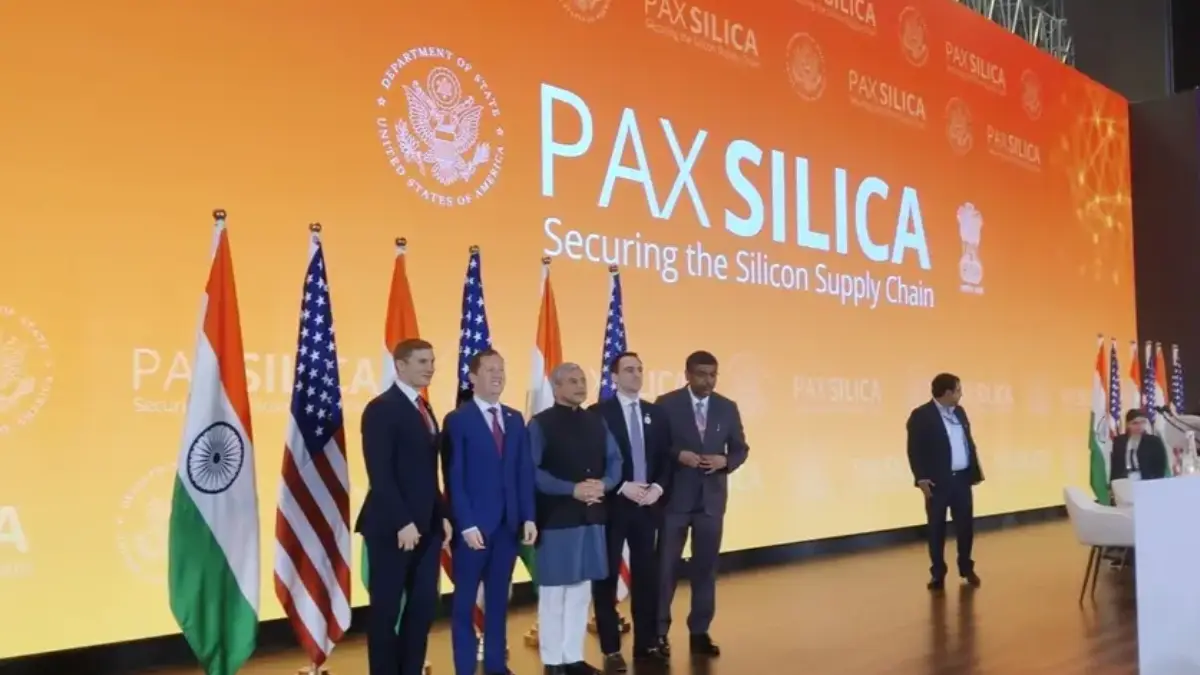
New Delhi : India on Friday signed a declaration to join a US-led strategic alliance ‘Pax Silica’, aimed at strengthening resilient supply chains for critical minerals. The declaration was signed at the ongoing India AI Impact Summit in New Delhi, marking India’s formal entry into a framework designed to build a secure, resilient, and innovation-driven supply chain for critical minerals and AI.
The move comes amid efforts by New Delhi and Washington to finalise a proposed trade deal and advance several other initiatives to deepen bilateral ties following a period of strain in relations. India has become a part of the Pax Silica. This will greatly benefit India’s electronics and semiconductor industry. Ten plants are already established in India and are in the process of being established, and very soon, the first semiconductor plant will begin commercial production.
Describing the initiative as a strategic coalition between India and the United States to shape the 21st-century economic and technological order, US Ambassador Sergio Gor said India’s participation was “strategic and essential”, citing its engineering talent, progress in mineral processing, and role in strengthening US-India technology cooperation. The partnership aims to advance trusted AI globally, emphasising that “peace comes through strength,” he said.
The declaration outlines a shared vision for deeper economic and technological cooperation across supply chains — from raw materials to semiconductors and AI infrastructure — alongside a commitment to mutual prosperity and security. One of the key pillars of Pax Silica is the creation of a durable economic framework to drive AI-powered growth across partner countries. Last month, Ambassador Gor had announced an invitation for New Delhi to join the strategic alliance. Pax Silica is a US-led strategic alliance launched to secure the global supply chain for artificial intelligence and semiconductors, marking a shift from the 20th-century reliance on oil and steel to an economy powered by silicon and critical minerals.
“Silica” refers to the mineral that forms the fundamental building block of computer chips and AI systems. The alliance, spearheaded by US Under Secretary for Economic Affairs Jacob Helberg, aims to create a “trusted” alternative to the current ecosystem dominated by China. A key objective is to reduce global dependence on China, which presently controls a large share of rare earth element (REE) processing.
Preventing supply chain disruptions, such as those witnessed in the automobile industry during geopolitical crises or due to the potential “weaponisation” of minerals, is another major focus of the alliance. Pax Silica seeks to cover the entire technology lifecycle, from mineral extraction and refining to semiconductor fabrication, software platforms, and frontier AI models. India is seen as a crucial node in Pax Silica due to its vast talent pool and largely untapped mineral resources.
The initiative could also facilitate partnerships with technology leaders such as Japan and the Netherlands in advanced mineral processing and chip manufacturing. Moreover, it aligns with India’s National Critical Mineral Mission and the India Semiconductor Mission, both aimed at strengthening domestic production and technological self-reliance.
Read Also : Five Maoists Gunned Down in Intense Border Encounter Amid Anti-Naxal Offensive