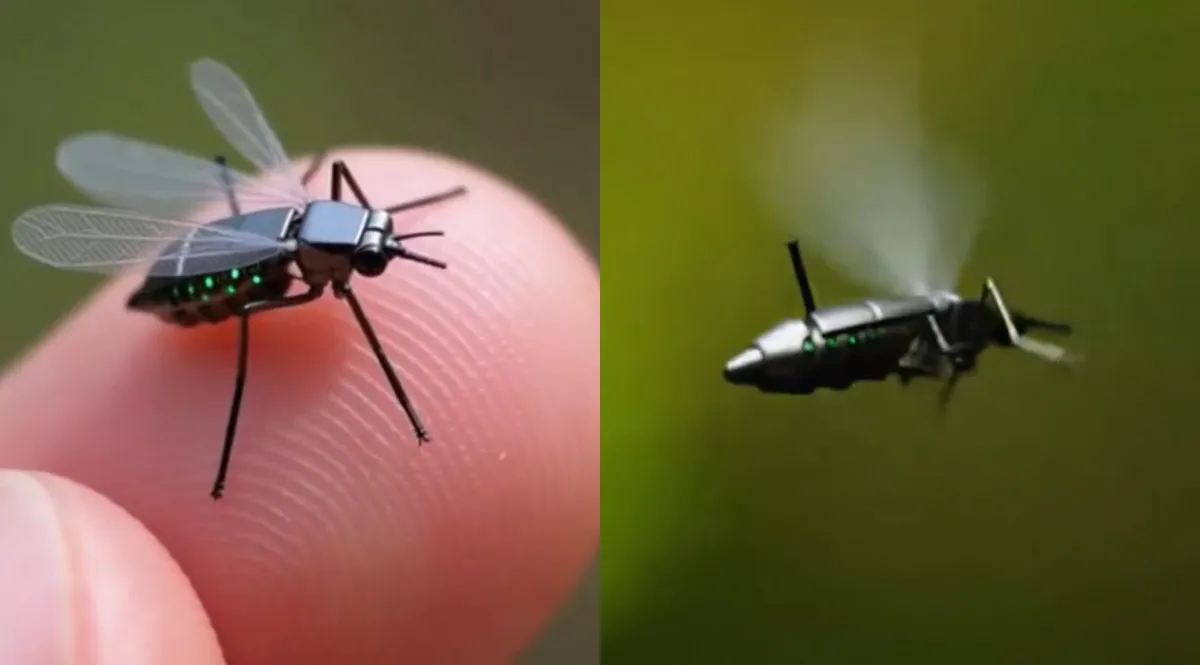
Beijing: China is reportedly working on mosquito-sized drones designed for covert military and surveillance operations, a technological development that could significantly influence the future of modern warfare. According to reports highlighted by India TV News, the ultra-miniature drones are being developed by researchers at the National University of Defence Technology (NUDT) in China’s Hunan province.
Tiny Drones Built for Stealth Missions
The newly developed drones are designed to resemble insects and are small enough to fit on a fingertip. Their miniature size makes them difficult to detect, allowing them to potentially carry out secret reconnaissance and intelligence-gathering missions in sensitive locations. Reports suggest the drones were recently showcased on China’s state broadcaster CCTV 7 during a segment focused on advanced military robotics.
One version of the drone reportedly features delicate wings and thin legs, closely imitating the appearance and movement of a mosquito. Experts believe such technology could be used in covert battlefield surveillance and special military operations.
Advanced Robotics and Surveillance Capabilities
According to reports, Chinese researchers have integrated several advanced components into the tiny drones, including sensors, communication systems, power units and control electronics. Some variants can reportedly be operated through smartphones and are part of China’s wider push into bio-inspired robotics and unmanned systems.
🇨🇳 The Chinese spy drone, measuring 0.6 cm and resembling a mosquito, was designed to carry out covert reconnaissance and infiltration missions. pic.twitter.com/BOmXjiMDgj
— China in English (@En_chinaNewsX) June 15, 2026
The development reflects growing global interest in micro-drone technology, where military organisations are increasingly exploring compact unmanned aerial vehicles capable of carrying out surveillance without being easily identified.
Global Concerns Over Security and Misuse
The emergence of insect-sized drones has also triggered international concerns over privacy, espionage and security threats. Defence and technology experts quoted in various reports warned that such devices could potentially be misused for hacking, spying or even delivering harmful biological materials in future conflict scenarios.
The technology has drawn comparisons with fictional depictions of robotic insects used for surveillance and targeted attacks. Analysts say the ability of these drones to blend into natural surroundings may create fresh challenges for conventional defence and counter-surveillance systems.
Global Race for Micro-Drone Technology
China is not the only country investing in micro-drone systems. Reports note that several countries and research institutions are already developing similar technologies. Norway’s Black Hornet micro-UAV and Harvard University’s RoboBee project are among the prominent examples often cited in discussions around miniature drone innovation.
At the same time, countries including India are also strengthening counter-drone and air-defence capabilities to tackle emerging aerial threats, including micro-UAVs and drone swarms.
Future of Warfare May Be Changing
Military analysts believe the rise of tiny drones could reshape surveillance, intelligence gathering and battlefield tactics in the coming years. While the technology may also have civilian applications in fields such as disaster management, medicine and agriculture, its military potential is drawing the greatest global attention.
The development of mosquito-sized drones underlines how rapidly military technology is evolving, with the boundaries between robotics, artificial intelligence and modern warfare becoming increasingly blurred.
Also Read: Tragic Shooting Claims Life of Young Australian Girl During Family Holiday in Pakistan