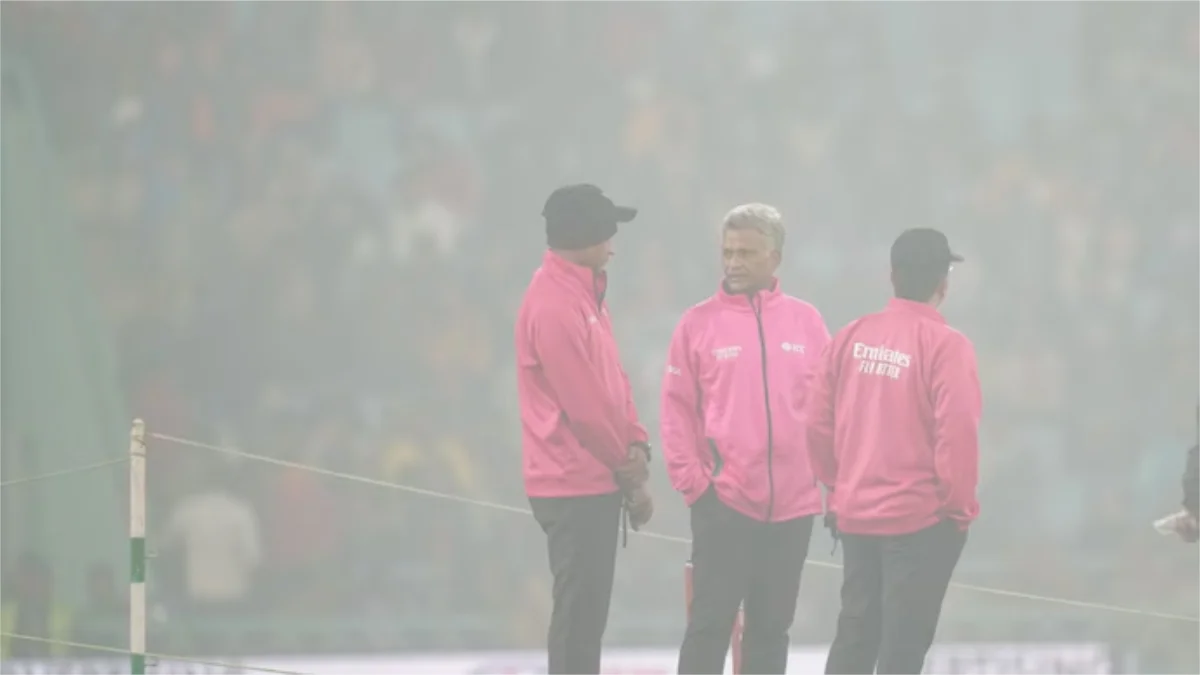
The fourth T20I between India and South Africa was called off without a toss on Wednesday after thick smog shrouded the Bharat Ratna Shri Atal Bihari Vajpayee Ekana Cricket Stadium in Lucknow, rendering play impossible due to hazardous visibility conditions. The abandonment has renewed criticism of the BCCI’s Tours and Fixtures Committee, especially regarding the decision to schedule international matches in northern and eastern India during winter months, when fog has consistently disrupted games in recent years. The choice to organize a day-night fixture in Lucknow during this season has attracted backlash, given the foreseeable visibility challenges.
A dense fog layer blanketed the venue, raising significant safety concerns, especially for fielders trying to sight the ball in the air. Consequently, the toss was postponed multiple times as match officials continuously monitored conditions. Air quality in Lucknow remained at dangerous levels on Wednesday evening, with AQI readings exceeding 400, according to AQI.in.
The on-field umpires conducted six inspections over more than three hours. Fans who had gathered in large numbers waited hopefully, only to leave disappointed. At one stage during the evening, the center of the pitch could not be seen from the stands.
The initial inspection was set for 6:50 pm, but with no improvement in visibility, additional checks were performed at 7:30 pm, 8:00 pm, 8:30 pm, 9:00 pm, and again at 9:25 pm. During the 7:30 pm inspection, umpires carried out an on-field visibility test, with one official near the pitch asking his colleague at the boundary whether they could clearly see each other and the ball. BCCI vice-president and UPCA president Rajiv Shukla also appeared to evaluate conditions during one inspection. The assessment confirmed that visibility remained unsuitable for play.
Was It a First for Fog?
This was not the first time an international match has been abandoned due to fog. In December 1998, dense fog in Faisalabad heavily disrupted the third Test of the series, with visibility so compromised that players found it difficult to take the field. The match was ultimately abandoned, a decision that attracted criticism from some observers who believed conditions had later improved and that the call had been hasty. The PCB also faced questions for scheduling a winter Test in a venue notorious for heavy December fog, though the abandonment proved meaningful for Zimbabwe, as it secured their first-ever Test series victory.
South African players, who had initially come out for a brief warm-up on the outfield, were compelled to return to the dressing room as the fog persisted. Despite the delays, players from both teams remained on the ground for extended periods, continuing their warm-up exercises as officials observed the situation. Indian all-rounder Hardik Pandya was also spotted wearing a face mask as the thick fog lingered over the stadium.
With visibility showing no signs of improvement despite multiple inspections, officials ultimately decided to abandon the match without a single ball being bowled.
Legendary South African fast bowler Dale Steyn, who was in Lucknow for commentary duties, recalled the poor visibility when he visited a local mall on Tuesday evening. “Last night, I walked across to the mall around 8 pm and it was really bad. You couldn’t see 20 metres ahead. I’m worried it might actually get worse.”
The fog in Lucknow has worsened over recent days following a steep temperature decline, a local source informed India Today. The city has been experiencing severe cold, with dense fog covering streets at night and during early morning hours, drastically reducing visibility.
The BCCI had escaped similar criticism earlier when the third T20I in Dharamsala proceeded despite foggy conditions in the mountains, but the Lucknow abandonment has revived the debate over winter match scheduling.
India maintain a 2-1 lead in the five-match T20I series, with the final game scheduled to take place in Ahmedabad on December 19.
-

-

-

-