
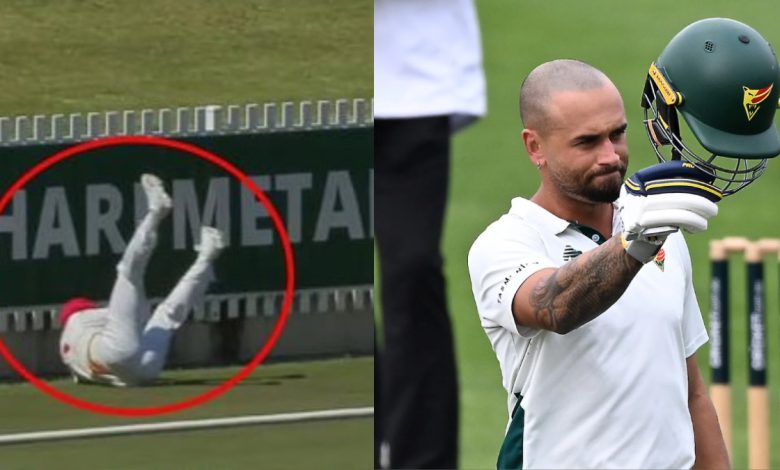
Melbourne: Just two months after playing his sixth Test match for Australia, 31-year-old opening batsman Jake Weatherald suffered a serious head injury in a domestic match and was forced to leave the field.
Weatherald, who has scored 224 runs in six Tests and 6,290 runs in 92 first-class matches, was injured while attempting to stop a boundary. He ran outside the boundary line and collided head-first with a metal advertising board, suffering a blow to the back of his head. The injury was treated as a concussion and reportedly had a significant impact on his condition.
He Could Not Stop the Four…
South Australia’s Weatherald was playing against Victoria when he attempted to prevent the ball from reaching the boundary. However, he went beyond the boundary line and the back of his head struck a nearby metal board. A nearby fielder immediately rushed to his aid, while other players on the field also gathered around him.



At first, Weatherald appeared to be in good condition. However, as the effects of the injury gradually became more serious, he was taken off the field for immediate medical assessment and treatment.
When Can He Return to Cricket?
Under Australian cricket’s concussion protocols, a player who suffers a concussion must begin a gradual return-to-training process under medical supervision. If the player makes a full recovery within 14 days, he can gradually resume practice.
Since the injury involves the head, players are advised not to rush their comeback. A player can return to competitive cricket only after completing the required recovery period, receiving medical clearance and being declared fit to play.
What Problems Can a Player Experience After a Concussion?
A player suffering a head injury or concussion can experience symptoms such as headache, dizziness or loss of balance, vomiting, blurred vision, confusion, repeated disorientation, difficulty concentrating, memory loss, fatigue after minimal exertion, sensitivity to light or loud noises, and slower reactions.