
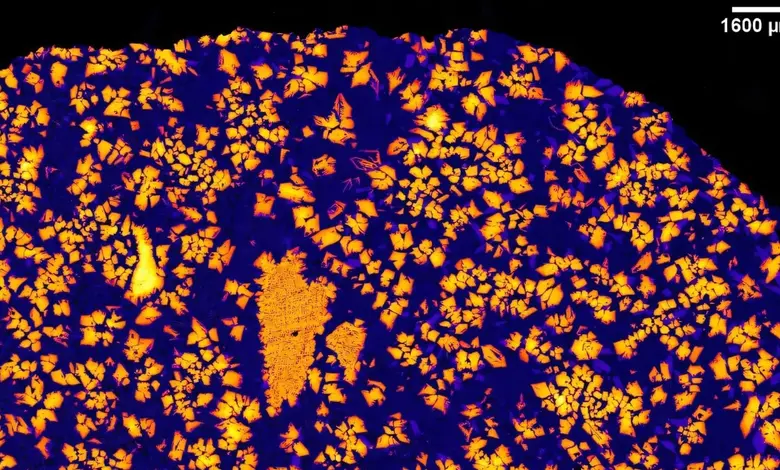
A scarce element has been discovered in the sands of the Sahara Desert; at first glance, it looked like an ordinary meteorite, but study revealed something deeper and startling. Weighing less than a pound, the 454-gram meteorite is believed to have existed on an ancient planet that is assumed to have been wiped from the Solar System long before the existence of human life on Earth.
The meteorite, known as Northwest Africa (NWA) 12774, was found in 2019 and was classified as an angrite, an extremely rare type of meteorite that joins the oldest volcanic rocks in the Solar System in age. NWA 12774 caught scientists’ eyes when an uncommon chemical signature was found, one that suggests the Solar System’s earlier creations were different from other planets, according to researchers. Geoscientist Aaron Bell revealed, “The materials that formed the angrite parent body are fundamentally different from the ingredients of Earth and Mars.” Further adding to the surprise, he continued, “These meteorites preserved evidence of a completely different pathway through which early planets developed.”
ALSO READ: Creating Earth-Like Planets Requires Distant Stellar Explosions, New Research Reveals
By studying radioactive elements, researchers measure age, and an angrite is as old as the Sun, carrying its essence for more than 4.5 billion years. They have hints which are used to know how planets are formed and evolved. Only 68 of more than 80,000 meteorites are recognized as angrites. Unlike Earth and its neighbor Mars, these angrites include a very small amount of silica (a component of planetary crusts); because of NWA 12774’s unconventional chemical composition, scientists suggest that it formed from something which didn’t belong to Earth from the start.




NWA 12774 is said to have formed under immense pressure. To visualize, it required at least 17.5 kilobars, which means more than 17 times the pressure at the bottom of the Mariana Trench, the deepest point on Earth. The absence of such depth in a small asteroid rejected the idea that it stemmed from a relatively small asteroid near Earth, so the parent body must have been larger. The study observed sharp edges on the rock, which is expected when it has formed at shallow depths; so, in turn, the forming body must have been huge. Further, researchers deduced that a planet of the Earth’s moon’s size, with a radius of around 1,800 kilometers, existed, and fragments of it arrived on Earth upon its destruction.
It is astonishing how a lost world left its tiniest fragments on Earth, only to enlighten humans about its existence billions of years after its erasure.