
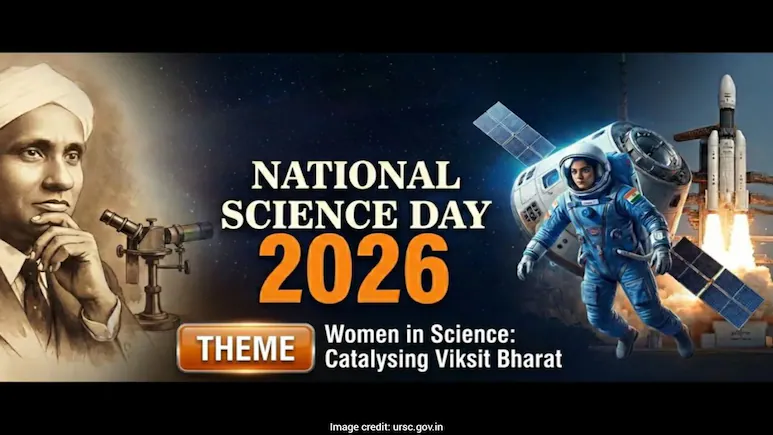
New Delhi : India is observing National Science Day 2026 on February 28, as communities across the country honour a landmark achievement in scientific research and promote the value of science in everyday life. The annual event marks the announcement of the Raman Effect by Indian physicist Sir Chandrasekhara Venkata Raman on this date in 1928, a discovery that later earned him the Nobel Prize in Physics in 1930 and helped establish Indian science on the global stage.
National Science Day was formally proclaimed by the Government of India in 1986, and has since been celebrated each year to encourage scientific thinking, curiosity, and participation among students and the wider public. Educational institutions, research centres and science organisations hold activities such as exhibitions, lectures, science fairs and demonstrations to highlight scientific achievements and inspire innovation.
The 2026 theme, announced by the Department of Science and Technology, centres on “Women in Science: Catalysing Viksit Bharat,” aiming to recognise the contributions of women researchers and innovators while advancing India’s vision of becoming a developed nation through science and technology.
Today, on National Science Day, we celebrate the spirit of research, innovation and scientific curiosity that drives our nation forward.
— Narendra Modi (@narendramodi) February 28, 2026
This day commemorates the groundbreaking discovery of the Raman Effect by Sir CV Raman. This discovery placed Indian research firmly on the… pic.twitter.com/YcjOAdPosr
In New Delhi, the national observance at Vigyan Bhawan brings together scientists, policymakers and educators to reflect on the role of science in national development and to discuss strategies for strengthening research and public engagement. Across the country, universities and institutes host outreach programmes to make science accessible and relevant, especially for young minds.
For many schools and communities, National Science Day also serves as an occasion to spotlight achievements in fields ranging from environmental science to space technology, while encouraging students to pursue careers in STEM (science, technology, engineering and mathematics). The celebrations underscore how scientific inquiry, discovery and education play a central role in shaping India’s future.
Also Read : India Gears Up For Free Nationwide HPV Vaccination Drive Targeting Teen Girls
-

-

-

-

