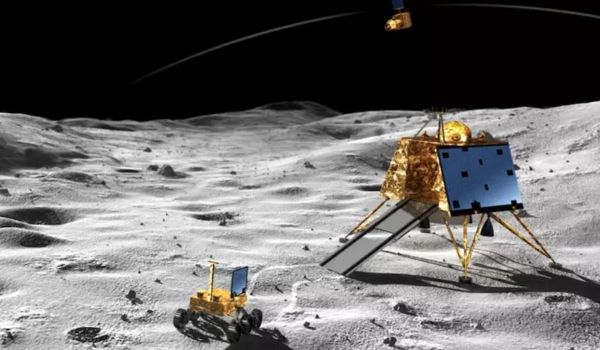
Bengaluru: The Indian Space Research Organisation (ISRO) and the Department of Atomic Energy have begun working together on an advanced artificial heating system designed to help future lunar landers withstand the Moon’s extreme temperatures. The development is expected to significantly improve the duration of future lunar exploration missions.
ISRO Plans Longer Lunar Missions
Speaking at the CSIR-RISE Conclave in Bengaluru, ISRO Chairman V Narayanan said the Chandrayaan-3 lander Vikram, which relied on solar power, functioned on the lunar surface for only 14 days. He explained that the new collaboration aims to develop a lunar lander capable of surviving on the Moon for nearly 200 days.
According to Narayanan, the proposed lander will use artificial heating systems to endure the severe climatic conditions found on the lunar surface. The technology is expected to support long-duration lunar exploration missions in the future.
Moon’s Harsh Environment A Major Challenge
The Moon experiences extremely harsh temperature variations, with lunar days and nights each lasting nearly 14 Earth days. Temperatures can rise to around 121 degrees Celsius during the day and plunge to nearly minus 129 degrees Celsius at night. The artificial heating system is being developed to protect spacecraft systems during these prolonged freezing conditions.
Wider Scientific Collaborations Underway
V Narayanan also revealed that ISRO and the Council of Scientific and Industrial Research (CSIR) have identified 40 areas for technological collaboration. Out of these, 17 projects have already received approval for implementation during the first phase.
He further stated that ISRO has entered into research partnerships with the Department of Science and Technology as well as private-sector organisations to develop space medicines for the Gaganyaan human spaceflight programme.
ISRO has additionally collaborated with the Department of Biotechnology on microgravity experiments conducted by Group Captain Subhanshu Shukla during the Axiom-4 mission aboard the International Space Station.
Also Read: Massive Solar Eruption Headed Towards Earth, NASA Issues Geomagnetic Storm Alert
-

-

-

-