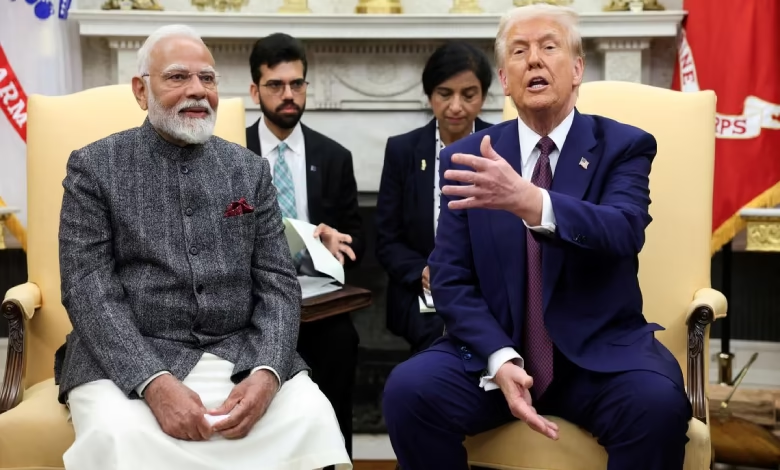
US President Donald Trump has extended an invitation to Indian Prime Minister Narendra Modi to join a newly formed international body designed to oversee Gaza’s post-conflict reconstruction and governance transition, following a fragile ceasefire that ended over two years of hostilities between Israel and Hamas.
The initiative, formally announced on January 15 as part of the second phase of Trump’s comprehensive 20-point peace plan—which has received backing from UN Security Council Resolution 2803—seeks to establish what Trump has described as “the Greatest and Most Prestigious Board ever assembled.”
Also Read: A Hindu Petrol Pump Worker Fatally Run Over in Bangladesh After Demanding Fuel Payment
A spokesperson from the US Embassy confirmed the development to WION, stating: “On January 16, President Trump announced the formation of the National Committee for the Administration of Gaza and shared that additional Executive Board and Gaza Executive Board members will be announced over the coming weeks. I have nothing further to announce at this time.”
The Board of Peace is tasked with managing multiple critical dimensions of Gaza’s future, including demilitarisation efforts, delivery of humanitarian assistance, reconstruction of damaged infrastructure, and the establishment of technocratic Palestinian governance structures. These functions will be carried out under the National Committee for the Administration of Gaza (NCAG), which is being led by Ali Shaath.
The founding executive committee includes prominent international figures spanning politics, finance, and diplomacy. US Secretary of State Marco Rubio leads alongside former British Prime Minister Tony Blair, Trump’s son-in-law Jared Kushner, special envoy Steve Witkoff, World Bank President Ajay Banga, billionaire financier Marc Rowan, and adviser Robert Gabriel.
Coordinating implementation on the ground is Nickolay Mladenov, former UN Middle East envoy, who serves as High Representative for Gaza. A parallel Gaza Executive Board incorporates regional representation through figures including Turkish Foreign Minister Hakan Fidan, UAE Minister Reem al-Hashimy, and Qatari diplomat Ali Al-Thawadi, reflecting an effort to blend American direction with Arab regional input.
Beyond Modi, Trump has issued invitations to multiple heads of state and government to participate as founding members. Argentine President Javier Milei has publicly accepted, describing the invitation as an honour. Canadian Prime Minister Mark Carney has also received an invitation, while Turkish President Recep Tayyip Erdoğan was approached through a personal letter from Trump. Egyptian President Abdel Fattah el-Sisi rounds out the confirmed list of invitees.
Trump envisions the Board potentially expanding its mandate beyond Gaza to address future international conflicts, positioning it as a model for crisis resolution and post-conflict reconstruction.
The initiative is expected to feature prominently in discussions at this week’s World Economic Forum, where global leaders will assess its viability and implications.
Supporters characterise the Board as a pragmatic, American-led framework capable of delivering stability, spurring economic recovery, and ensuring Gaza’s demilitarisation. However, the proposal has drawn scrutiny from regional stakeholders and human rights organisations who have raised concerns about its legitimacy, the extent of authentic Palestinian representation, and the risk of external powers exercising disproportionate control over the enclave’s political trajectory.
-

-

-

-