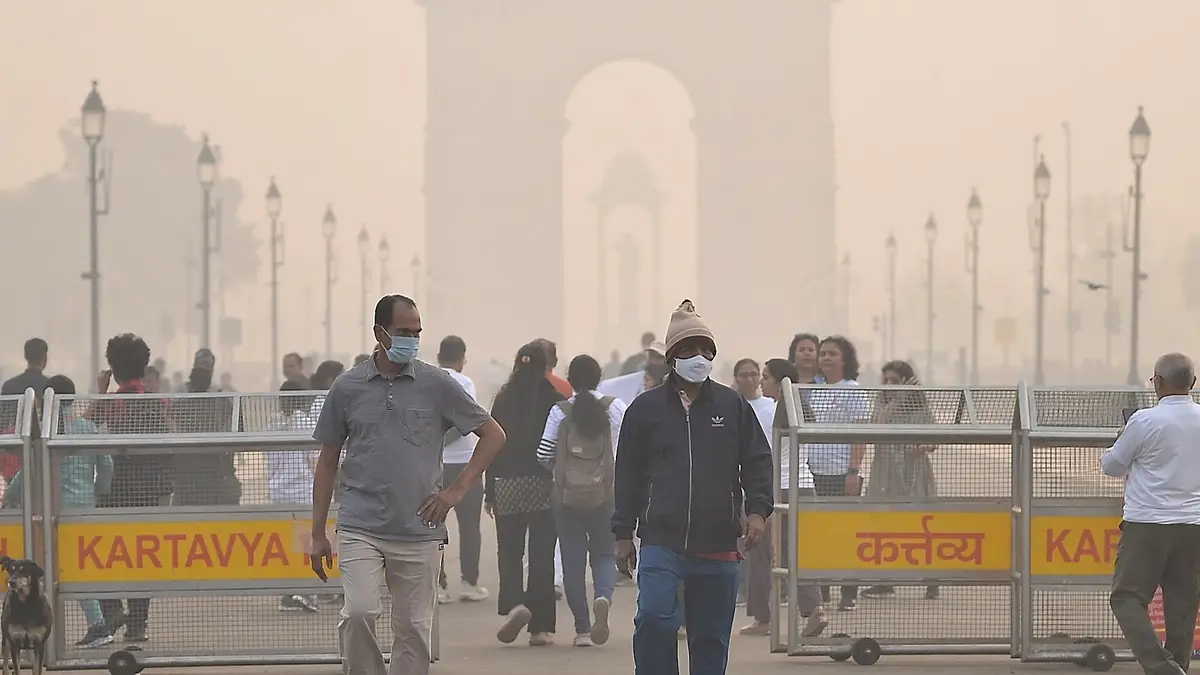
New Delhi – Air quality in the national capital showed a modest uptick on Thursday morning, with the overall Air Quality Index (AQI) dipping to 299 by 8 a.m., data from the Central Pollution Control Board (CPCB) showed. This marks a step down from Wednesday’s 4 p.m. reading of 342, which had locked the city firmly in the “very poor” bracket.
While the citywide figure edged into the “poor” range—defined under AQI guidelines as 201 to 300—pockets of relief emerged across the region. CPCB figures indicated cleaner air in select locales, with Najafgarh clocking in at 286 and the Indira Gandhi International Airport’s T3 terminal at 255. Nearby, Sri Aurobindo Marg and the North Campus area posted readings of 283 and 281, respectively, according to ANI.
Yet, the reprieve proved uneven, as a stubborn veil of hazardous smog persisted in multiple hotspots. Early morning reports highlighted choking fog around Ghazipur and Akshardham, where reduced visibility underscored the lingering threat. CPCB data confirmed that numerous neighborhoods stayed mired in the “very poor” zone, spanning 301 to 400 on the index.
ALSO READ : Delhi : Capital Records Five-Year Low in Minimum Temperatures
Anand Vihar, a bustling transport hub, exemplified the divide, swathed in heavy pollution with an AQI of 316. Other troubled spots included Sonia Vihar at 302 and the industrial Wazirpur at 323, while Patparganj hovered at 309, per ANI. For context, AQI levels from 0 to 50 qualify as “good,” 51 to 100 as “satisfactory,” 101 to 200 as “moderate,” and anything above 400 as “severe.”
In response to the persistent crisis, authorities ramped up countermeasures. Delhi Environment Minister Manjinder Singh Sirsa detailed the deployment of anti-smog guns, mechanized road sweepers, and water sprinklers across Delhi, Noida, Ghaziabad, Faridabad, Gurgaon, and Greater Noida. Speaking after a regional coordination meeting attended by northern Indian states, Sirsa said orders had been issued to activate these tools immediately, alongside a 72-hour deadline to identify and fix road potholes.
He reiterated Delhi Chief Minister Rekha Gupta’s zero-tolerance stance, emphasizing that violations of anti-pollution protocols by government or private entities would draw swift action. “Construction and demolition sites must be securely fenced, with water sprinklers mandatory to curb dust,” Sirsa noted. The Municipal Corporation of Delhi (MCD) received directives to ensure its 8,000 kilometers of roads remain free of potholes and dust, bolstered by approvals for 100 new mechanized sweepers and enhanced Public Works Department (PWD) infrastructure, including tube wells and pipelines.
Sirsa’s discussions with Union Environment Minister Bhupender Yadav also yielded commitments for expansive tree-planting drives, engaging the public in greening parks and roadside strips throughout the Delhi-NCR belt.
-

-

-

-