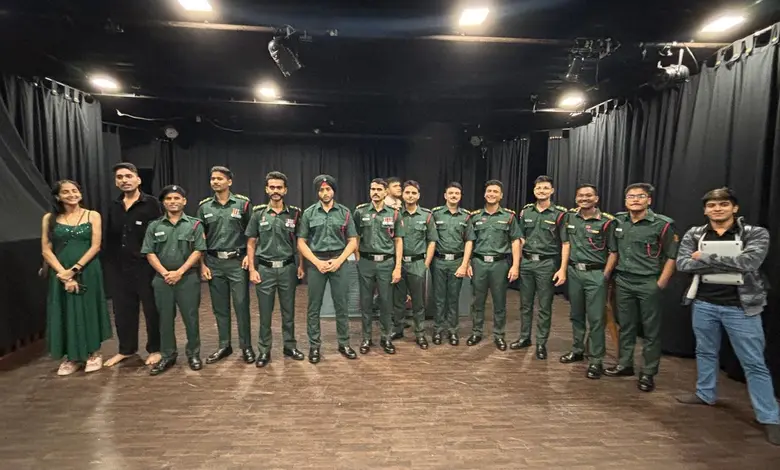
Andheri, Mumbai: The process of theatre demands sheer devotion and dedication, and if it is to be practiced in a place like Mumbai, it also needs to have at least a featherweight pocket. Amidst the flock of aspirational artists striving to be seen by the industry, there are many theatre troupes who, with bright eyes, perform on the stage to celebrate theatre and self. Among such groups is “Rangprasang Natmandal,” led by the artist Imran Hussain. The recent display of this group’s performance was the classic play “Court Martial,” written by the illustrious playwright Swadesh Deepak. Published in the 1990s, the piece always proves its relevance over the course of time.
Court Martial, a Hindi play, with a minimalistic production design, relies heavily on dialogues and situations which foreshadow numerous phenomena in society. The courtroom drama follows the trial of a military personnel, “Savar” Ramchander, who allegedly, in a fit of rage, shot two fellow army men, resulting in the death of one and a shoulder injury to another. What happens is the revelation of the major causes of the act and discrimination with a ruminating climax; the setting is a traditional military court with the nation leaders’ photo frames hung on the wall above the Indian tricolour flag. A few chairs, a presiding officer’s desk, and counsels’ designated spaces are accompanied by a sole balustrade. As the runtime progresses, character shades begin to be noticed by the viewers, whether it be Bikash Ray’s (defense counsel) logical and table-turning arguments, or the affirmative Major Puri’s (trial counsel) assertions on his answer-like questions. Commander Surat Singh’s (judge of the court) dynamic personality, attributed by the dilemma, is felt by the audience. Ramchander’s loud silence throughout the time signals something deeper, culminating in a breakdown of social inequality.
ALSO READ: Pankaj Tripathi’s “Lailaaj” Really Is Incurable, as Audiences Are Diagnosed With Joy
The performances were effort-driven. Parth Gohil as Savar Ramchander holds his back throughout, giving a sense of discomfort which the character demands. Imran Hussain’s love for the stage and life speaks through his presence; he also happens to be the director of the group and the play. B.D. Kapoor, played by Atharva, is a stark portrayal, Vaibhav Chavan shines as Subedar Balwan Singh, and Vaibhav Singh Gupta has held the crust very well. Commander Surat Singh, played by Bobby, had an authoritative existence and was importantly understood by the viewers. Apart from the main cast, Yash, Rishi, Avinash, and a youthful Manas Yadav, who, whenever he moved, always made the audience react with claps and whistles, delivered well. Lights and music by Swati and Shivraj, respectively, created a sound atmosphere for the thoughtful performance. As soon as the play ended, the director asked the audience, “Did you all understand the play?” When he received a positive nod from the audience, the director was satisfied. He was also delighted to see a child of around 9–10 years in the audience and asked him the same question; when the child affirmed, the team was happy and satisfied.
There are several stagings of classic plays, but the intent, process, and performance define a troupe’s truthfulness and love for the art. However, the play’s unconventional approach may not appeal to some people but the grittiness should always remain and be conveyed through the medium of the stage.
-

-

-

-