Mumbai: With BMC elections approaching, Mumbai’s H East Ward has come into sharp focus as one of the city’s most complex and contrasting civic zones. The ward covers Bandra East, Khar East and parts of Santacruz East, and starkly juxtaposes the gleaming Bandra Kurla Complex (BKC) business district with extensive slum clusters that have long struggled with civic neglect. Often described as a ward of extremes, H East encapsulates both Mumbai’s financial power and its toughest urban challenges.
BKC, the centerpiece of the ward, reflects Mumbai’s global ambitions with high-end office towers and key diplomatic missions. It hosts the US and Norwegian consulates, visa centres, offices of leading Indian corporate groups and important government establishments. The ward also includes a luxury mall, major concert venues, the Mumbai Cricket Association ground, courts, MHADA offices, the Mumbai Suburban Collector’s office and the headquarters of the Mumbai Metropolitan Region Development Authority (MMRDA).
H East Ward is also home to significant political addresses. Matoshree, the residence of the family of late Shiv Sena chief Balasaheb Thackeray, is located here, as is the residence of Union Minister Ramdas Athavale. Residential pockets such as Kalanagar Colony, MIG Colony and various government colonies are predominantly occupied by middle and upper-middle-class households.
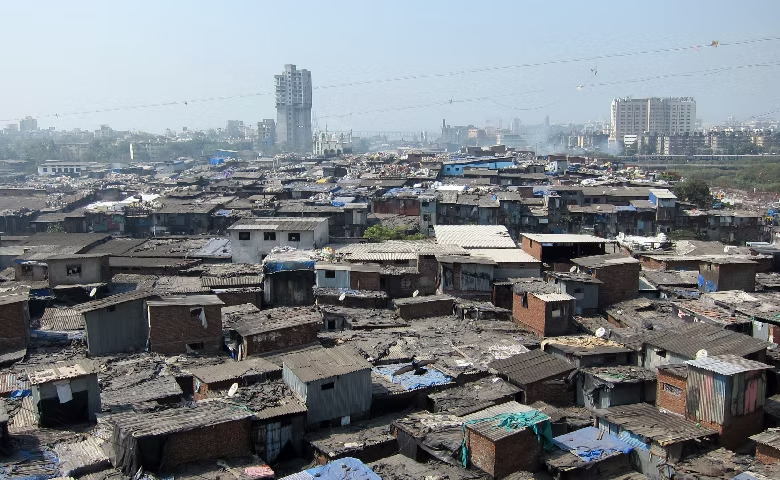
In sharp contrast, areas like Vakola, Kherwadi, Behrampada and several parts of Santacruz East are dominated by slum settlements, which account for an estimated 60–70% of the ward’s population. Despite containing Mumbai’s premier business district, large numbers of residents battle routine civic issues, including irregular water supply, poor drainage, garbage mismanagement, encroachments, damaged roads and worsening traffic congestion. Law-and-order concerns persist in some of the denser slum belts, while relentless construction activity has pushed up air, dust and noise pollution levels.
Water scarcity remains a major complaint across several neighbourhoods. Traffic, however, is widely seen as H East Ward’s most pressing problem. BKC has only two main exit routes to the Western Express Highway — via the Kalanagar junction and the Chetna College stretch — causing severe bottlenecks, especially during peak hours. The situation is further complicated by the fact that parts of BKC stand on land reclaimed after the narrowing of the Mithi River, which frequently overflows during the monsoon and floods adjoining areas, disrupting movement.
Residents have increasingly voiced their frustration as the civic polls near. Siddharth Parde, a MIG Colony resident and member of the Mumbai Citizen Forum, Bandra East, said rapid construction has sharply increased pollution and fuelled rampant encroachment, while constantly dug-up roads in areas like Kherwadi make it unsafe even for pedestrians. He also alleged that water supply is being prioritised for BKC, leaving nearby residential pockets to endure chronic shortages.
Sachin Sawant, who lives in a government colony in Bandra East, raised similar issues, pointing out that newly concretised roads are broken again without any clear explanation. He noted a rise in mosquito breeding and said that with multiple junctions feeding into BKC, heavy evening traffic has become unavoidable. Hemal Mehta, chairperson of the Santacruz East Residents Association, described daily life as a grind of water shortages, encroachments, dug-up roads and uncleared debris.
According to Mehta, pipelines are repeatedly damaged, streetlights have disappeared due to road concretisation work and electricity supply faces frequent disruptions, while even a political party’s booth office has been set up on footpaths. Another resident, Surendra Yadav, complained that road repairs are carried out in patches, drainage cleaning has effectively stopped and water pressure remains low despite metered connections. He added that nearby slum areas regularly face flooding during the monsoon.
Politically, H East Ward falls under the parliamentary constituency represented by Congress MP Varsha Gaikwad and the assembly segment held by Shiv Sena (UBT) leader Varun Sardesai. The area covers ten BMC wards, numbered 87 to 96. Shiv Sena has traditionally held sway in Bandra East, but the party’s split has injected uncertainty into the local political landscape.
In recent BMC elections, the BJP has emerged as a strong contender in the ward, while Congress lags behind and the MNS maintains only limited pockets of influence. With traffic gridlock, environmental stress and basic civic failures dominating public conversation, voters in H East are seeking focused governance and long-term, structural solutions. The ward now stands as a vivid example of how Mumbai’s global aspirations collide with the everyday struggle for essential services.
-

-
-
-