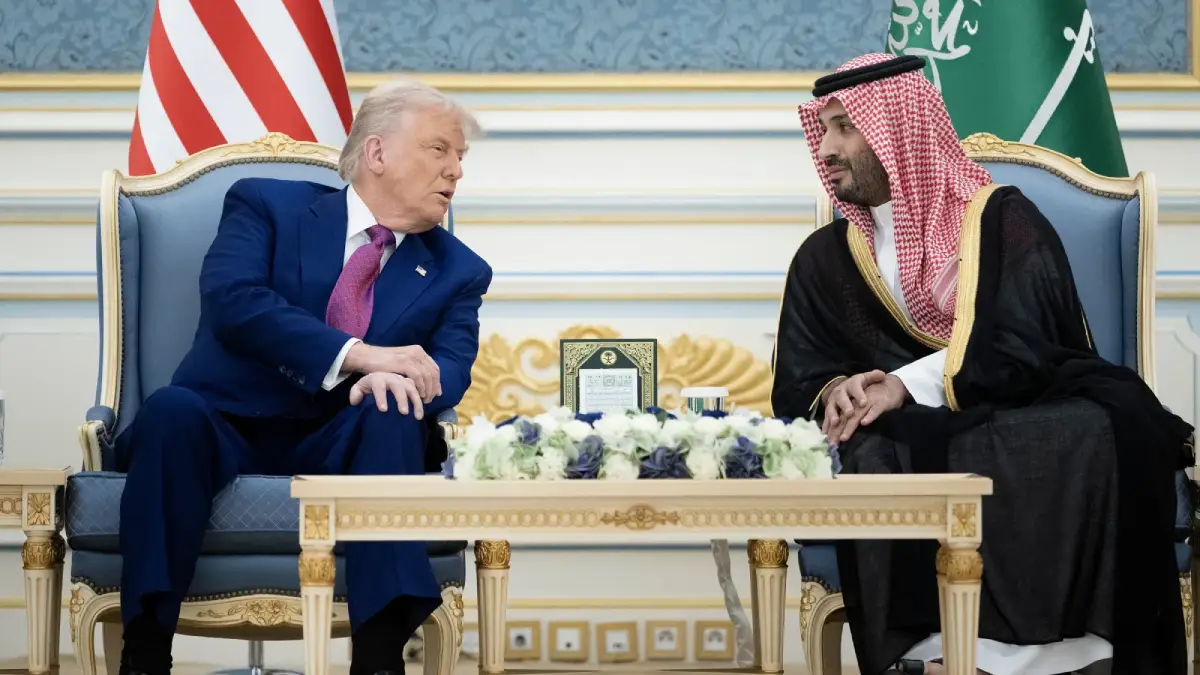
Saudi Crown Prince Mohammed bin Salman has privately urged US President Donald Trump to continue military operations against Iran, framing the moment as a rare strategic opportunity to dismantle a regime that Gulf nations have long viewed as an existential threat, according to individuals briefed by US officials.
In multiple conversations over the past week, Prince Mohammed reportedly argued that halting the campaign prematurely would be a strategic mistake, and that Iran’s current leadership can only be neutralised through regime change.
His position diverges from Israel’s. While Prime Minister Benjamin Netanyahu shares concerns about Iran’s threat, analysts say Israel may be willing to accept a weakened or internally destabilised Iran as a satisfactory outcome. Saudi Arabia, by contrast, fears that a collapsed Iranian state could unleash regional chaos and direct security risks on the kingdom itself.
That tension complicates Riyadh’s calculus. Officials in both Washington and Riyadh are wary that a prolonged conflict could spiral drawing the US into an extended war and inviting intensified Iranian strikes on Saudi oil infrastructure.
Trump’s public messaging has done little to clarify Washington’s intent. He has oscillated between signalling a wind-down and hinting at escalation, recently claiming “productive conversations” with Iran were underway. Tehran denied any negotiations were taking place.
Saudi officials have publicly rejected the characterisation of their crown prince as a war hawk. “The kingdom of Saudi Arabia has always supported a peaceful resolution to this conflict, even before it began,” the Saudi government said, adding that officials “remain in close contact with the Trump administration.” The statement also said: “Iran has chosen dangerous brinkmanship over serious diplomatic solutions. This harms every stakeholder involved but none more than Iran itself.”
Privately, however, sources indicate Prince Mohammed has encouraged continued pressure including strikes on Iran’s energy sector. Some discussions have reportedly extended to the prospect of US ground forces seizing critical oil infrastructure, including Kharg Island, an operation US officials regard as extremely high-risk.
The conflict has already strained regional energy flows. Iranian retaliation has severely restricted movement through the Strait of Hormuz, a chokepoint for Gulf oil exports. Alternative pipelines exist but have also come under attack.
Analysts familiar with Saudi policy suggest the crown prince may not have wanted this war initially, but now fears that a partial campaign could leave Iran emboldened and Gulf states exposed to sustained attacks without reliable US cover.
History weighs on Riyadh’s thinking. A 2019 strike on Saudi oil facilities, linked to Iran, caused a sharp production disruption and pushed the kingdom toward diplomacy. By 2023, Saudi Arabia had restored ties with Tehran, partly driven by doubts about US reliability as a security guarantor. The UAE and other Gulf states took similar steps. The current conflict has largely undone that rapprochement. As Saudi Foreign Minister Faisal bin Farhan put it: “What little trust there was before has completely been shattered.”
Saudi Arabia is currently relying on Patriot missile systems to intercept ongoing attacks, though interceptor stockpiles are tight globally. Strikes and debris have already caused casualties and damage inside the kingdom.
While Israel has pressed for actions that could topple Iran’s leadership, US officials remain doubtful that outcome is achievable. Despite significant losses within the Iranian leadership structure, the government has remained functional.
Saudi concerns go beyond the regime itself. Analysts warn that even a collapsed Iranian government could leave militant factions or rogue elements targeting Saudi oil assets. Trump has flagged concern about rising oil prices, but the crown prince has reportedly told him that any disruptions would be temporary an assurance many experts consider optimistic, given that alternative export routes cannot fully replace Hormuz access.
-

-

-
-