
US Supreme Court Strikes Down Trump’s IEEPA Tariffs in 6-3 Ruling, Citing Overreach of Presidential Authority
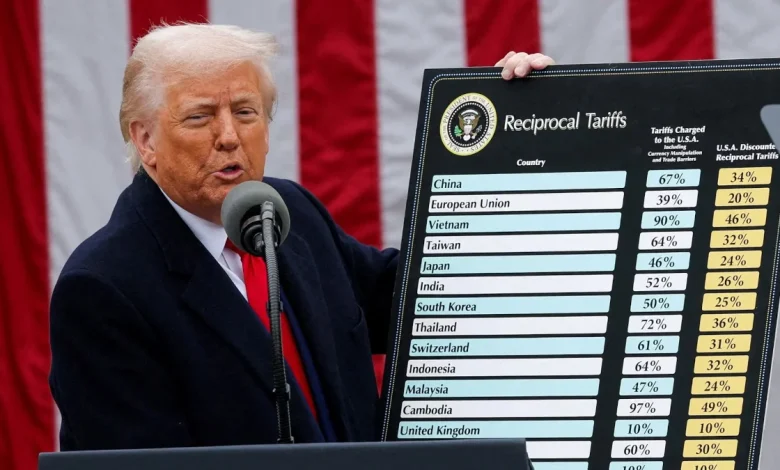
The United States Supreme Court delivered a landmark blow to President Donald Trump on Friday, striking down the sweeping tariffs he had imposed under the International Emergency Economic Powers Act (IEEPA) a 1977 law originally designed for use during national emergencies. The ruling carries significant implications for the global economy and marks one of the most consequential checks on Trump’s executive authority since he returned to office.
In a 6-3 decision authored by conservative Chief Justice John Roberts, the court upheld a lower court’s earlier finding that Trump’s use of IEEPA to unilaterally impose import taxes on nearly every US trading partner exceeded his presidential authority.
Also Read: Trump Repeats Claim Of ‘Stopping’ India-Pak War With New Twist
Roberts drew on a prior Supreme Court precedent in writing that “the president must ‘point to clear congressional authorisation’ to justify his extraordinary assertion of the power to impose tariffs,” before concluding plainly: “He cannot.”




How the Justices Voted
The majority opinion was joined by conservative Justices Neil Gorsuch and Amy Coney Barrett both appointed by Trump during his first term along with the court’s three liberal justices. The three dissenters were conservatives Clarence Thomas, Samuel Alito, and Brett Kavanaugh.
The Legal Reasoning
The court ruled that the Trump administration’s interpretation of IEEPA that the law grants the president broad power to impose tariffs would encroach on Congress’s constitutional authority and violate the “major questions” doctrine. This legal principle, long embraced by the court’s conservative wing, requires that executive actions of “vast economic and political significance” receive clear authorisation from Congress before they can take effect. The same doctrine had previously been used to block key executive actions under former Democratic President Joe Biden.
The legal challenge was brought by businesses directly affected by the tariffs, along with 12 states most of them Democratic-governed who argued against Trump’s unprecedented use of IEEPA to bypass congressional approval on trade policy.
The Constitutional Question
Under the US Constitution, the authority to impose taxes and tariffs rests with Congress, not the executive branch. Trump bypassed this framework by invoking IEEPA, making him the first president in history to use the law as a mechanism for imposing tariffs. His administration applied these levies broadly, targeting nearly all of America’s trading partners without legislative approval.
It is worth noting that Trump has also imposed certain additional tariffs under separate laws not covered by this ruling. According to government data from October through mid-December, those tariffs account for roughly one-third of the total revenue generated by Trump-era import taxes.
Trump’s Defence of the Tariffs
Trump had consistently framed the tariffs as essential to US economic security. In November, he told reporters that without them, “the rest of the world would laugh at us because they’ve used tariffs against us for years and took advantage of us.” He argued that the United States had long been exploited by foreign nations, citing China the world’s second-largest economy as a key example.
The ruling represents a significant judicial boundary placed on one of the most assertive uses of executive power in recent memory, a pattern that has also included Trump’s immigration crackdown, dismissals of federal agency officials, domestic military deployments, and overseas military operations.