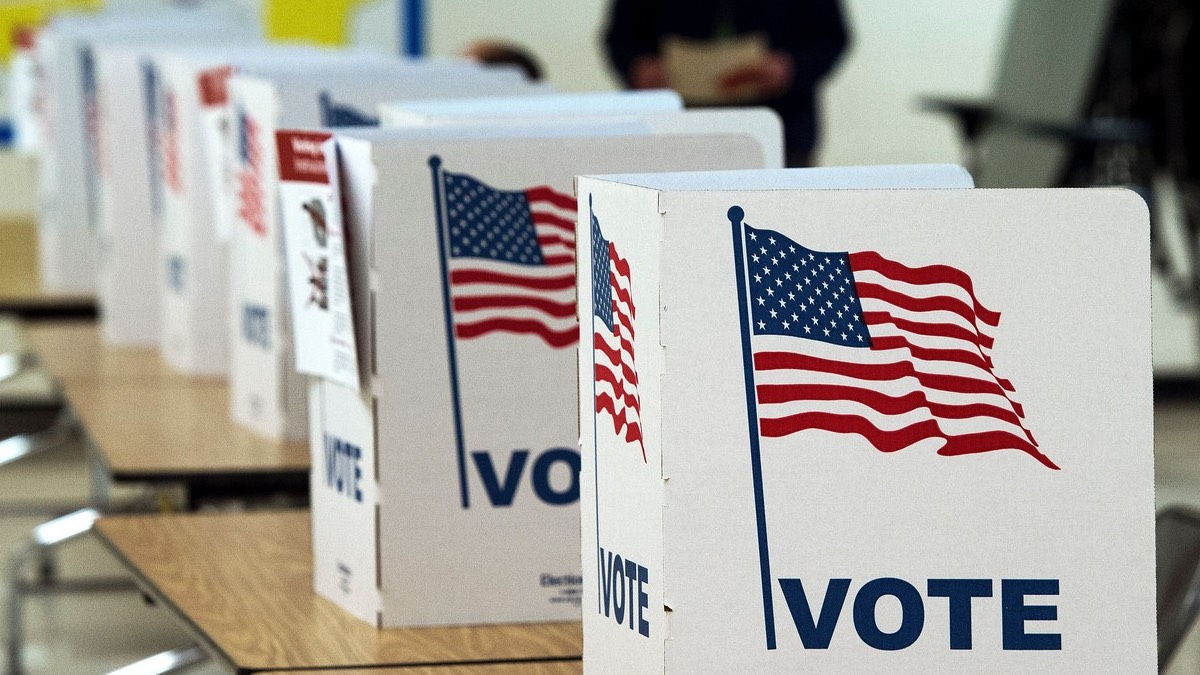
The United States will hold midterm elections on November 3, 2026, halfway through President Donald Trump’s second term. Voters will decide who controls both the US House of Representatives and the US Senate, and the result will set the balance of power in Washington. Across the states, they will also elect governors, state legislators and other key officials, and consider a range of ballot measures.
What are the midterm elections in the US?
Unlike parliamentary systems, where elections can sometimes be called early or legislatures dissolved, the US follows election schedules set by its Constitution. Midterm elections are general elections held every four years, midway through a president’s four-year term. The presidency is not on the ballot, but many of the country’s most important federal and state offices are.
US House of Representatives
All 435 voting seats in the House are contested every two years. Representatives serve two-year terms, so every congressional district across the 50 states votes.
US Senate
Senators serve six-year terms, with elections staggered across three classes. Roughly one-third of the Senate is up for election every two years. In 2026, voters will choose candidates for the 33 regular Class 2 seats, along with special elections for seats with unexpired terms.
Governors and state offices
Governors in 36 states and three US territories are up for election in 2026. Governors hold significant authority over state budgets, executive agencies, judicial appointments, education and healthcare policy. Voters will also decide thousands of state legislative races and contests for offices such as secretary of state and attorney general.
Ballot initiatives
Voters in many states will also weigh in on ballot initiatives covering constitutional amendments, taxes, reproductive rights, voting rules and other state policies.
How does the staggered Senate system work?
The US Constitution divides Senate seats into three classes so that the chamber does not see a complete turnover in a single election.
- Class 1: Up for election in 2024, 2030 and subsequent cycles.
- Class 2: Up for election in 2026, 2032 and subsequent cycles.
- Class 3: Up for election in 2022, 2028 and subsequent cycles.
The Class 2 seats being contested in 2026 were last elected in 2020. Because Senate elections are statewide contests, individual races can draw substantial national attention, particularly in states where the partisan balance is closely divided.
What is the historical ‘midterm curse’?
The party holding the White House has frequently lost seats in Congress during midterm elections. Since the American Civil War, the president’s party has lost House seats in more than 90 per cent of midterm elections and Senate seats in a majority of them. The pattern is often called the ‘midterm curse’ or ‘midterm penalty’, and several factors are commonly cited to explain it.
Opposition-party voters can be especially motivated to turn out because they want to register their dissatisfaction with the administration. Voters who backed the president, meanwhile, may become less engaged after the presidential election or divided over the administration’s record. Economic conditions, inflation, consumer sentiment and presidential actions can also shape how voters approach a midterm.
Presidential coalitions can also become less unified once a new administration begins governing, as disagreements emerge over policy priorities. There have been notable exceptions. The 1998 midterms took place during Bill Clinton’s presidency, while the 2002 elections came during George W. Bush’s presidency and followed the September 11 attacks.
What is at stake in the House of Representatives?
Control of the House has major consequences for the legislative agenda and for congressional oversight of the executive branch.
The House majority controls the chamber’s legislative schedule, committee leadership and appropriations process. It also has extensive authority to conduct congressional investigations and issue subpoenas. At the start of the 119th Congress, Republicans held a narrow House majority, with 218 seats to Democrats’ 214.
All 435 districts will vote on November 3, 2026, so relatively small shifts in competitive districts could prove important to control of the chamber. The House map is shaped by congressional redistricting, population changes, regional political trends and the political characteristics of individual districts. Only a portion of the 435 districts is expected to be highly competitive, as many are strongly tilted toward one party because of geographic political patterns and district boundaries.
Suburban communities around major metropolitan areas are expected to get significant attention, including those around Atlanta, Phoenix, Dallas-Fort Worth, Philadelphia, Detroit and Minneapolis. Other closely watched contests are expected in states such as California, New York, Pennsylvania, Ohio, Michigan and Wisconsin. Economic issues, including manufacturing, energy prices, trade and employment, can feature prominently in competitive districts. Arizona, Nevada, Georgia and North Carolina are also important areas to watch because of population growth and changing political demographics.
Why do House retirements matter?
Retirements by incumbents can significantly alter individual congressional contests. When a sitting representative does not seek another term, the resulting open-seat race can draw candidates from both parties and potentially change the competitive landscape. The 2026 cycle includes a number of incumbent retirements, including lawmakers leaving Congress to pursue other offices or to retire from public life.
Also Read:Pakistan Blocks Russian Aircraft On Route With Bangladesh’s Nuclear Fuel
What is at stake in the Senate?
Senate races differ from House contests because each election covers an entire state and senators serve six-year terms. The Senate also carries several constitutionally important responsibilities. It provides advice and consent on presidential nominations, including federal judges and Supreme Court justices, and approves treaties.
In 2026, 35 Senate seats are scheduled to appear on the ballot: 33 regular Class 2 contests and two special elections involving unexpired terms. Republicans have more Class 2 seats up for election than Democrats, which gives the party a larger numerical defensive map. However, the competitiveness of individual races varies significantly from state to state.
What are the key Senate battleground states?
Georgia: Democratic Senator Jon Ossoff is seeking another term in Georgia, one of the country’s closely divided states. The state’s rapidly changing electorate and the growth of the Atlanta metropolitan area have made it an important focus of national political campaigns.
Michigan: Democratic Senator Gary Peters’ retirement has created an open-seat contest in Michigan, a state that has remained important in recent presidential and congressional elections.
Maine: Republican Senator Susan Collins is seeking another term in Maine. Her political career has included repeated statewide contests in a state where voters have shown a willingness to split their tickets.
North Carolina: Republican Senator Thom Tillis’ retirement has created another open-seat contest. Former Democratic Governor Roy Cooper’s entry into the race has added national attention to the contest, which is expected to draw substantial campaign spending.
Minnesota and New Hampshire: Retirements have also created open-seat contests in Minnesota and New Hampshire. These states have traditionally leaned Democratic at the federal level in recent presidential elections, but Senate races can feature different candidates, issues and electoral dynamics.
Kentucky and Iowa: Open Republican-held seats in Kentucky and Iowa have generated significant interest. Senate Minority Leader Mitch McConnell’s retirement in Kentucky and Senator Joni Ernst’s retirement in Iowa have opened two Republican-held seats to new candidates.
Special Senate elections
Two special elections involving Class 3 seats are also part of the 2026 Senate landscape.
Florida: The special election was triggered after Marco Rubio left the Senate to become US Secretary of State. Governor Ron DeSantis appointed Ashley Moody to serve temporarily, and voters will now choose who completes the remainder of the term.
Ohio: The special election followed JD Vance’s departure from the Senate after he became Vice President. Governor Mike DeWine appointed Jon Husted to the seat on an interim basis, and Ohio voters will subsequently choose who serves the remainder of the term.
How do you win a midterm election in the US?
Midterm campaigns operate in a different electoral environment from presidential elections. Turnout is generally lower in midterm years. Presidential-election turnout has typically been around 60 per cent to 66 per cent of eligible voters, while midterm participation has often been closer to 40 per cent to 50 per cent. Lower turnout can change the composition of the electorate.
Older voters generally participate at higher rates, while younger voters and some lower-turnout demographic groups can make up a smaller share of the electorate unless campaigns and organisations successfully mobilise them. Campaigns therefore devote considerable resources to voter registration, early voting, absentee voting and turnout operations.
Political coalitions have also shifted in recent election cycles. College-educated voters, particularly in suburban areas, have increasingly backed Democratic candidates, while many non-college-educated working-class voters in rural and industrial regions have moved toward Republican candidates. Voting patterns among Hispanic, African American and Asian American voters have varied by state, region, age and other demographic factors. Independent and unaffiliated voters can also be particularly important in closely contested suburban and statewide races.
How do voting rules differ across states?
Election procedures vary significantly across the United States.
Early voting: Most states offer some form of early in-person voting, though the length of the voting period and eligibility rules vary.
Mail and absentee voting: States also have different rules on mail ballots, absentee voting, signature verification, ballot drop boxes and ballot-receipt deadlines.
Counting and reporting results: Election-night reporting does not necessarily mean every ballot has been counted. States have different procedures for processing mail ballots and early votes. In closely contested elections, final results can take additional time, particularly in states where large numbers of ballots are counted after Election Day.
What can be expected from the 2026 US midterms?
The 2026 midterms will determine the composition of the 120th Congress and influence the political environment for the rest of President Trump’s second term. If Republicans retain control of both chambers, the administration would continue to operate with unified party control of Congress, subject to the Senate’s procedural rules and other institutional constraints. If Democrats win control of either chamber, divided government would change how legislation, oversight and appointments are handled.
If Democrats control the House: A Democratic House majority would give the party control of House committees and the chamber’s legislative agenda. It would also provide greater authority over congressional investigations, oversight hearings and subpoena activity.
If Democrats control the Senate: A Democratic Senate majority would give the party control of Senate committees and a central role in considering presidential nominations, including federal judicial appointments. The Senate would also have a different role in considering executive branch nominees and other matters requiring its approval.
Why the 2026 midterms matter for 2028
The midterms will also shape the political landscape ahead of the 2028 presidential election. Governors, senators, representatives and other national political figures will gain greater national exposure through competitive races, policy debates and campaign organisations.
The results will give political parties information about voter turnout, regional voting patterns and the issues that resonated with voters in 2026. Ultimately, the 2026 midterms will determine more than the balance of power in Congress. They will also shape the governing environment in Washington and influence political competition heading into 2028.
-

-

-

-