
Trump’s Forced-Labour Tariffs Face Legal Challenge as 25 US States Sue; Here’s What It Could Mean for India
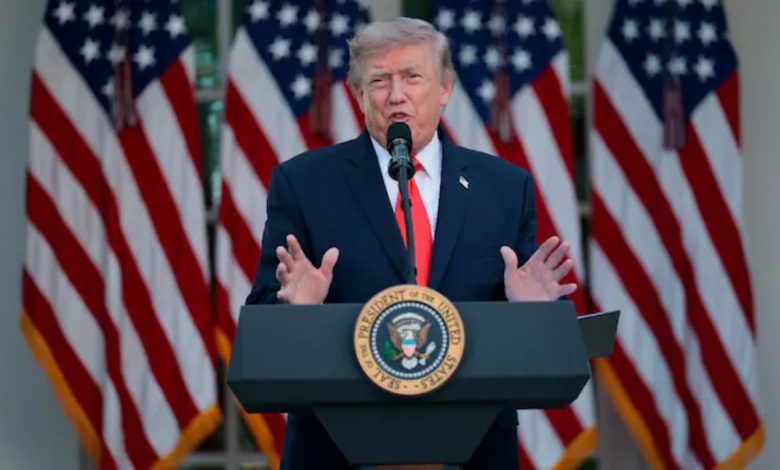
The Trump administration is facing a fresh legal fight after 25 US states sued on Monday, August 3, over the latest round of tariffs on imported goods.
The lawsuit, filed in the US Court of International Trade, challenges 10% and 12.5% tariffs imposed on countries the administration says account for 99.4% of US imports, according to the states’ complaint.
The case lands just as a separate, unrelated piece of legislation one that could hit India with steep tariffs over its continued purchases of Russian oil gains momentum in the Senate.
What the states are arguing
The 25 states say the new tariffs, introduced under the banner of cracking down on forced labour in global supply chains, are really an attempt to bring back import taxes the Supreme Court already struck down.




“After losing at the Supreme Court, the administration is once again trying to illegally raise taxes on families and businesses with a new round of tariffs,” New York Attorney General Letitia James said in a statement.
The states argue the administration is trying to recover revenue lost when the Supreme Court blocked its earlier use of emergency powers to impose tariffs.
Separately: a bill that could hit India over Russian oil
A different and unrelated fight is unfolding in Congress. The Sanctioning Russia Act, first introduced by the late Senator Lindsey Graham, has picked up renewed momentum since Graham’s death last month.
The bill’s original version proposed a blanket 500% tariff on countries that continue buying Russian oil, gas or other energy products a provision that named India and China as major targets. But a revised, bipartisan version of the bill, negotiated with the White House shortly before Graham died and unveiled in mid-July, scales that back: it caps tariffs on the top five buyers of Russian oil and gas a group that includes India and China at up to 100%, while keeping the steeper 500% rate specifically for goods imported directly from Russia. The Senate has since advanced the bill in a bipartisan vote.
Also Read:Nearly A Dozen Killed In Fresh Skirmishes Between Russia And Ukraine
A White House official told ANI that President Trump supports the bill, saying simply, “President Trump supports the bill.”
Trump’s tariff strategy so far
Trump’s administration first relied on the International Emergency Economic Powers Act (IEEPA) of 1977 to impose sweeping tariffs, which pushed several countries into trade negotiations with Washington. The Supreme Court later ruled that IEEPA didn’t actually give the president authority to impose tariffs, forcing the administration to refund duties already collected.
After that ruling, the administration rolled out temporary 10% tariffs worldwide, which expired on July 24. It then turned to Section 301 of the Trade Act of 1974, which lets the president impose tariffs and other measures on countries found to be engaging in unfair trade practices. Under that authority, the new 10-12.5% forced-labour tariffs took effect on countries — including India and China that together account for most of what the US imports.
What this could mean for India
Whichever version of the Russia sanctions bill ultimately passes, added tariff pressure over Russian oil purchases could push India to reconsider how much crude it buys from Moscow. If it shifts to costlier suppliers, that could raise India’s import bill and, in turn, fuel and transport costs at home.
The issue has also become part of the broader India-US trade conversation. External Affairs Ministry spokesperson Randhir Jaiswal has said New Delhi is watching developments closely and staying engaged with US counterparts.
The states’ lawsuit against the forced-labour tariffs is unrelated to the Russia sanctions bill, but a prolonged legal fight over Trump’s tariff authority generally could still work in India’s favour giving negotiators more time and leverage in the trade talks running alongside it.