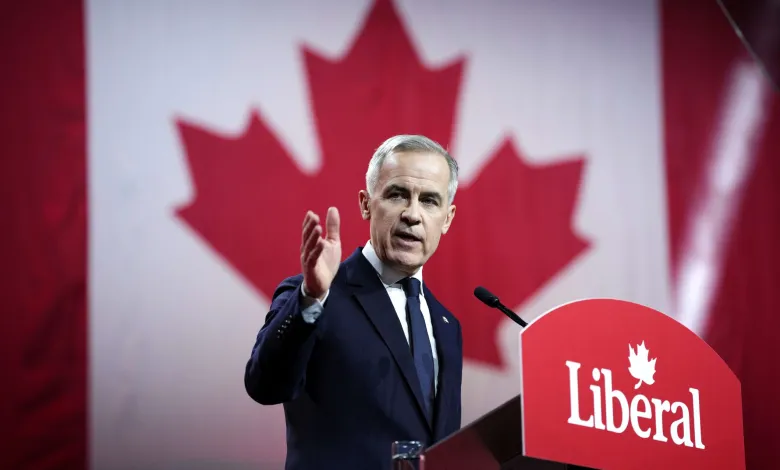
New Delhi: In a significant recalibration of foreign policy driven by mounting pressure from the United States, Canada is aggressively pivoting toward India as a primary strategic and economic partner. This diplomatic shift, aimed at shielding Ottawa’s sovereignty from the protectionist measures of US President Donald Trump, will be headlined by an upcoming visit from Canadian Prime Minister Mark Carney.
News agencies reported on Monday that PM Carney is expected to visit India soon to rapidly expand bilateral trade. The move signals a distinct thaw in the diplomatic frost that characterized the Justin Trudeau era. According to Indian High Commissioner Dinesh Patnaik, the visit is likely to take place in the first week of March, shortly after India presents its Union Budget on February 1. The agenda includes signing crucial deals on uranium, energy, minerals, and artificial intelligence.
Diplomatic Thaw and High-Level Engagement
The renewed engagement follows what was described as a “fruitful conversation” between Canadian Foreign Minister Anita Anand and Indian External Affairs Minister S. Jaishankar on India’s 77th Republic Day. The two leaders reportedly discussed continued high-level exchanges and deepening cooperation in economic partnerships and AI.
The urgency of this pivot is underscored by Ottawa’s need for “trade diversification.” Minister Anand recently stated that Canada “won’t be derailed” by Trump’s threats, emphasizing a strategy to double non-US exports within ten years.
“That is why we went to China, that’s why we will be going to India and that is why we won’t put all our eggs in one basket,” Anand said.
The Tariff Storm and ‘51st State’ Rhetoric
The backdrop to this geopolitical realignment is an increasingly hostile trade environment in North America. President Trump has threatened a 100% tariff on all Canadian goods if the country becomes a “drop off port” for Chinese exports. This specific threat was triggered by a Canadian agreement allowing 49,000 Chinese electric vehicles (EVs) annually in exchange for food trade concessions.
Currently, Canada faces a 35% US tariff despite a trade relationship that saw the US export $280 billion to Canada and import $322 billion in the first ten months of last year. Similarly, India is facing a 50% tariff from the Trump administration, partly attributed to its purchase of Russian oil.
Beyond economics, concerns over national sovereignty are rising in Ottawa. Reports indicate that the Canadian military has modeled hypothetical responses to an American invasion after Trump publicly referred to Canada as a potential “51st state” on several occasions. Addressing these fears at the World Economic Forum in Davos, Anita Anand asserted, “Canada will never be the 51st state.”
Experts like Wesley Wark of the Centre for International Governance Innovation note that while a military strike is “extremely unlikely,” the real danger lies in economic coercion regarding access to Canadian water, energy, and critical minerals, as well as potential interference in separatist movements in Alberta and Quebec.
India as a Strategic Counterweight
For India, Canada’s pivot serves as a bonus alongside a major trade agreement currently being finalized with the European Union. EU leaders are in New Delhi as chief guests for Republic Day celebrations to sign what has been described as the “mother of all deals.”
Bloomberg reports that the parallel pressure from the US has accelerated the push for a Comprehensive Economic Partnership Agreement (CEPA) between India and Canada, with a target to raise bilateral trade to $50 billion by 2030. Analysts suggest that Ottawa views New Delhi as a stable democratic partner for long-term relations compared to China.
This renewal of ties comes after envoys returned in August 2025, following friction over the killing of a Sikh separatist leader in Canada an incident India has consistently denied involvement in. Strengthening defense ties with India, a key Indo-Pacific power, also provides Canada with a counterweight to US dominance.
Energy and Future Outlook
Focusing on vital resources, Canadian Energy Minister Tim Hodgson is scheduled to visit Goa soon to attend a conference and hold meetings with Indian industry officials and the government. Discussions are expected to center on critical minerals, uranium, and liquefied natural gas resources Canada possesses in abundance.
Despite the pivot, Minister Anand emphasized that Canada expects its strong relationship with the US to continue. However, the economic risks remain high for Ottawa’s smaller, less diversified economy.
“We have a highly integrated market with Canada,” US Treasury Secretary Scott Bessent told TV channel ABC on Sunday. “The goods can cross across the border during the manufacturing process six times. And we can’t let Canada become an opening that the Chinese pour their cheap goods into the US.”
(Inputs from AP, Bloomberg)
-

-

-

-