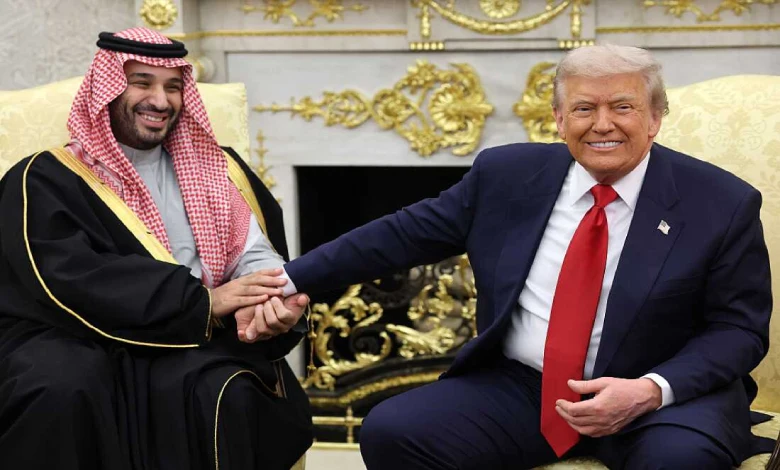
According to news sources quoting people acquainted with the situation, Donald Trump has signed an agreement with Saudi Arabia that might give the kingdom uranium enrichment capacity for its civilian nuclear program.
The deal may be disclosed soon, according to the persons who were not permitted to speak publicly about the decision that has not yet been formally announced. The Wall Street Journal and the New York Times both covered the transaction.
In addition to involving US companies in the program’s development, the agreement is anticipated to last 30 years. Following a joint US-Saudi review, it might permit the construction of a uranium enrichment facility in Saudi Arabia.
It is anticipated to be sent to Congress for assessment, where it may encounter opposition from senators who worry that assisting the Saudis in achieving their long-standing goal of enriching their own uranium will lead to new rounds of nuclear competition and proliferation.
Saudi Arabia is a member of the International Atomic Energy Agency (IAEA), a Vienna-based organization that conducts inspections to ensure that nations do not have covert atomic weapons programs while simultaneously promoting peaceful nuclear activities.
According to one of the sources who disclosed it, the IAEA’s “additional protocol,” which would enable enhanced monitoring, inspections, and verification, is not anticipated to be included in the agreement.
The anticipated disclosure coincides with the US and Israel’s campaign against Iran, which is partly predicated on eliminating Tehran’s capacity to produce nuclear weapons. Although Iran has previously boasted of enriching uranium to the point where it is ready to detonate a nuclear bomb, the country maintains that its nuclear enrichment program is peaceful.
Trump and previous President Joe Biden both attempted to negotiate a nuclear agreement with the kingdom in order to exchange American technology.
Non-proliferation specialists caution that any centrifuges used in Saudi Arabia to enrich uranium might lead to a weapons program for the kingdom, which its de facto leader, Crown Prince Mohammed bin Salman, has not ruled out in the event that Iran acquires an atomic weapon.
There are other steps, including becoming proficient with synchronized conventional high explosives, that lead from enrichment to a nuclear weapon. However, it makes weaponization possible, which has increased Western fears over Iran’s program.
Chris Wright, Trump’s energy secretary, visited Saudi Arabia in 2025 just before Trump did, and he spoke with his Saudi counterpart about expanding the kingdom’s commercial nuclear power sector. Requests for comment late on Tuesday were not immediately answered by the US Department of Energy.
Following Israel’s attack on Qatar that targeted Hamas officials, Saudi Arabia and nuclear-armed Pakistan inked a mutual defense agreement. Then, in an apparent warning to Israel, which has long been thought to be the sole nuclear-armed state in the Middle East, Pakistan’s defense minister declared that his country’s nuclear program “will be made available” to Saudi Arabia if necessary.
Saudi Arabia’s neighbor, the United Arab Emirates, inked what is known as a “123 agreement” with the United States to construct its nuclear power project in Barakah with help from South Korea. However, the UAE did not pursue enrichment, which non-proliferation experts have referred to as the “gold standard” for nations pursuing nuclear power.
Also Read – Fresh US Strikes Trigger Explosions Across Iran, Deepening Fears Of A Wider Middle East War
-

-

-
-