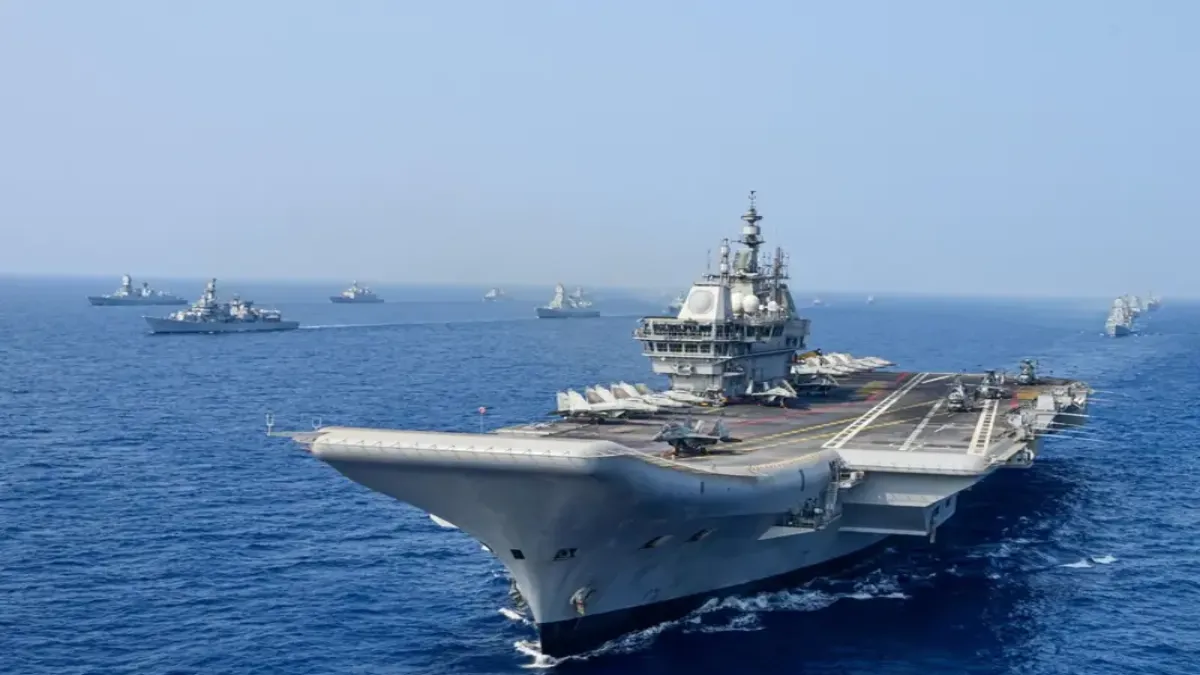
Warships do not accidentally find themselves on a collision course. They carry powerful radars, navigation systems, and communications equipment that constantly track everything happening around them. So when PNS Hunain, a Pakistani naval vessel, closed in at high speed on an Indian Navy Kolkata-class warship in the North Arabian Sea, the obvious question is: how could such a thing even happen?
Senior journalist and defence expert Sandeep Unnithan told India Today Digital that he does not believe it was an accident. He sees it as a form of maritime intimidation — a tactic increasingly associated with China’s naval and maritime forces in the South China Sea.
“This is not an accident at all,” Unnithan said. “This is part of intimidation and belligerence and what the PLA Navy does, what they call the maritime militia, the China Coast Guard, People’s Armed Forces Maritime Militia.” He also pointed to China’s confrontations with the Philippines, Taiwan, and Japan.
A serving Lieutenant Commander from the Eastern Naval Command, speaking to India Today Digital on condition of anonymity, said that with the technology available on modern warships, it is almost impossible for such an incident to occur due to a simple mistake unless “the entire crew and the captain are asleep.”
A Chinese Playbook At Sea
The possibility of Pakistan borrowing tactics from China becomes more significant because Pakistan’s navy is increasingly equipped with Chinese-built ships and submarines. The two navies also hold joint drills, creating a rub-off effect.
“The Pakistanis are buying ships and submarines from the Chinese. We have to ask whether they have been importing these tactics also of coercion out at sea,” Unnithan said.
The Pakistani vessel PNS Hunain approached a frontline Indian Navy warship at high speed on Tuesday in international waters in the North Arabian Sea, about 120 nautical miles from the Gulf of Oman.
Indian officials said Hunain was manoeuvring in an “unprofessional and unsafe manner,” resulting in a collision. The Pakistani vessel was damaged and headed towards its home port, while no damage was reported to the Indian warship, which continued its surveillance mission.
Unnithan said the manoeuvre resembled tactics China has used against other vessels in the East China Sea and the South China Sea. “They essentially try to shoulder other vessels, attempt to collide with them, or cut across their bows,” he said. “All these are old tactics that many countries involved in maritime disputes have used.”
He compared the incident to Cold War-era encounters, in which Soviet warships would attempt to cut across the paths of Western naval vessels. “There have been instances of very close encounters and near-collisions of this nature,” he said.
Unnithan also drew a direct comparison with the previous India-Pakistan naval incident in 2011, when the Pakistan Navy’s PNS Babur came into contact with Indian Navy frigate INS Godavari in the Gulf of Aden.
Pakistani Vessel Could Have Sunk Due To Collision
The risk, Unnithan said, was particularly high for the Pakistani ship because of the size difference between the two vessels. “The difference in the size of the two ships is significant,” he said. The Indian warship, he noted, was a Kolkata-class destroyer weighing more than 7,000 tonnes, while PNS Hunain is an offshore patrol vessel of around 2,600 tonnes.
“It’s extremely dangerous what the Pakistanis tried,” he said. “Had the captain of the Kolkata-class destroyer responded more aggressively, the consequences could have been far more serious.”
According to Unnithan, the Indian officer instead appears to have responded calmly to the Pakistani provocation.
The serving Lieutenant Commander India Today Digital spoke to said, “Modern warships have radars, automatic identification systems (AIS), and multiple communication systems to track and identify vessels around them. But technology cannot eliminate the consequences of a deliberate decision by a commanding officer to close the distance.”
Unnithan echoed this point, saying, “If there is a deliberate intent to engage in what you might call road rage or, at sea, ‘sea rage’, then no amount of technology can necessarily prevent the consequences.”
There Have Been Genuine Accidental Collisions Involving Naval Vessels
There have, however, been genuine accidental collisions involving naval vessels in the past.
Unnithan cited the case of the Indian Navy’s Veer-class missile corvette, INS Prahar, which collided with the merchant vessel MV Rajiv Gandhi and sank off the Goa coast in April 2006.
He also referred to the Nilgiri-class frigate INS Vindhyagiri, which collided with the Cyprus-flagged merchant container ship MV Nordlake inside Mumbai harbour on January 30, 2011. That incident eventually led to the loss of the warship after a major fire broke out and extensive flooding occurred; firefighting operations resulted in the vessel taking on large quantities of water, before it was ultimately decommissioned in 2012.
In large vessels, a course correction does not immediately translate into a change in position, because of the ship’s size and momentum. “Ships are not like cars,” Unnithan explained.
But he drew a clear distinction between an unintended collision and what he described as a deliberate act.
The Existing Safeguard Mechanism
India and Pakistan already have a mechanism intended to prevent such dangerous encounters.
Article 10 of the April 1991 Agreement on Advance Notice on Military Exercises, Manoeuvres and Troops Movements states, “The Naval ships and submarines belonging to the other country are not to close less than three Nautical Miles (NMs) from each other so as to avoid any accident while operating in international waters.” Three nautical miles translate to around 5.5 km.
India has said Tuesday’s collision was in “direct contravention” of the provision and summoned Pakistan’s Charge d’Affaires in New Delhi. India has also instructed its Charge d’Affaires in Islamabad to lodge a similar protest.
The immediate safeguard remains the same one India and Pakistan agreed on in 1991: maintaining sufficient separation to prevent accidents.
Experts say Pakistan’s collision was deliberate, and it shows how technology can detect a threat but cannot check intentions. It also reveals how Pakistan has brought not just Chinese ships, but Chinese tactics, to the Arabian Sea.
-

-

-

-