
Pakistan’s Growing Spy-In-The-Sky Network Raises Strategic Questions For India
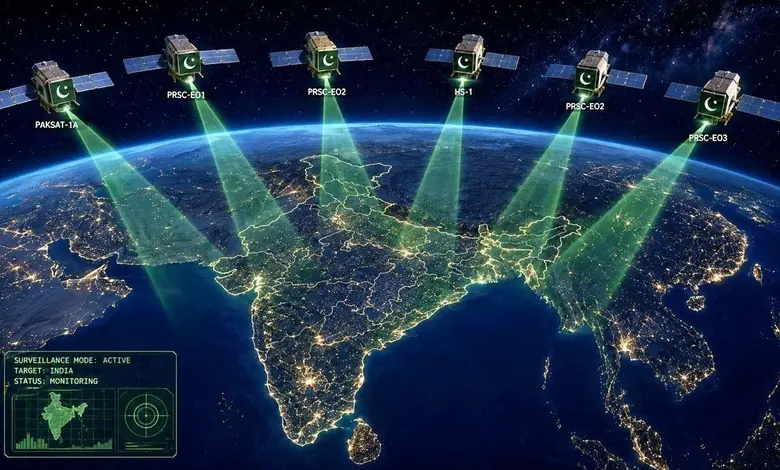
New Delhi: While the guns may have fallen silent after the recent India Pakistan military tensions, a quieter contest is now unfolding hundreds of kilometres above the Earth. Over the past 16 months, Pakistan has rapidly expanded its space based surveillance network, launching six Earth observation satellites with significant Chinese support a development that is drawing increasing attention from India’s strategic and defence community.
The pace is unprecedented for Pakistan. For decades, Islamabad’s space programme remained relatively modest. But between early 2025 and mid 2026, the country deployed six new observation satellites, creating what analysts describe as a growing orbital surveillance capability with the potential to monitor large parts of the Indian subcontinent on a regular basis.
According to reports, the newly launched satellites include optical imaging, remote sensing and hyperspectral platforms placed in Sun synchronous orbits, allowing them to repeatedly pass over the same locations and capture updated imagery. Some assessments suggest the network can revisit and image key areas of Indian territory every few days, providing Pakistan with far greater situational awareness than it possessed in the past.
A majority of these missions have relied heavily on Chinese technology, launch facilities and technical assistance. One of the most notable satellites in the constellation is PRSC-EO1, Pakistan’s first domestically produced Electro Optical Earth observation satellite, reportedly capable of capturing high resolution imagery. Other launches have further strengthened Islamabad’s ability to gather geospatial intelligence from space.




For India, the concern is not merely the number of satellites but their strategic purpose. Modern Earth observation satellites can track military infrastructure, troop movements, airbases, naval deployments, border construction projects and critical transportation networks. While Pakistan officially presents the programme as a tool for development, disaster management and resource monitoring, defence experts note that such capabilities often carry both civilian and military applications.
However, it is important to note that there is no official public evidence proving these satellites were launched exclusively to spy on India. What is clear is that their coverage includes Indian territory and that the constellation significantly enhances Pakistan’s intelligence gathering capacity from space.
India, meanwhile, remains far ahead in the space domain. The country’s space programme, led by Indian Space Research Organisation, operates one of the world’s most sophisticated satellite fleets, covering communication, navigation, weather forecasting, Earth observation and national security missions. New Delhi has also approved an ambitious 52 satellite surveillance network aimed at strengthening real time monitoring capabilities and improving military intelligence against regional threats, including China and Pakistan.
Strategic experts believe South Asia is witnessing the emergence of a new space race. Unlike traditional arms competitions involving tanks, missiles or fighter jets, the latest contest revolves around data, surveillance and information dominance. In modern warfare, the side that sees first often gains a decisive advantage.
Pakistan’s recent satellite launches may not alter the military balance overnight, but they signal a clear shift in Islamabad’s priorities. With Chinese backing and a growing constellation of observation satellites, Pakistan is investing in the ability to watch developments on the ground from orbit. For India, that means the strategic competition is no longer confined to land, sea and air it is increasingly extending into space.
As both nations continue to strengthen their orbital capabilities, the skies above South Asia are becoming the newest frontier of security competition.
ALSO READ: PoJK Unrest Deepens As Pakistan Intensifies Crackdown On JAAC Protesters