
Francis Halzen Wins Nobel Prize in Physics 2026 for IceCube Neutrino Discovery
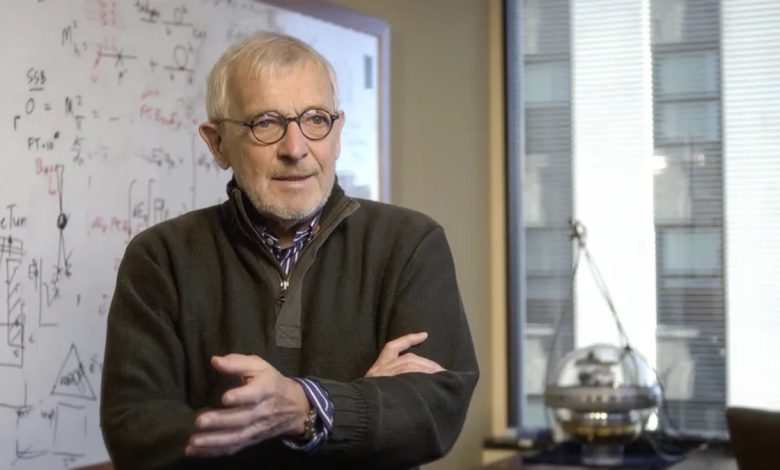
The 2026 Nobel Prize in Physics has been awarded to Francis Halzen “for decisive contributions to the IceCube Neutrino Observatory and the discovery of high-energy neutrinos of astrophysical origin,” the Royal Swedish Academy of Sciences announced on Tuesday.
In a post on X, the Nobel Prize handle said the Academy had decided to award the prize to Halzen for those contributions.
“Francis Halzen has led an international team of researchers and engineers who have provided us with a fantastic instrument. His tenacity and scientific vision paved the way for a new kind of astronomy,” said Mark Pearce, chair of the Nobel Committee for Physics, in a news release.




Who is Francis Halzen?
Halzen, an 82-year-old Belgium-born scientist, is the principal investigator of IceCube. He is also Vilas Research Professor and Gregory Breit Professor at the University of Wisconsin-Madison in the US, and he studies problems that span the particle physics, astrophysics and cosmology communities.
In 1987, Halzen began working on the AMANDA experiment, a first-generation neutrino telescope at the South Pole that served as a proof of concept for the IceCube Neutrino Observatory.
How the discovery works
Halzen realised that ice at the South Pole could be used to track particles known as neutrinos. Neutrinos are everywhere but rarely make themselves known, passing through the Earth and through human bodies without being noticed.
His vision and scientific leadership have been fundamental to IceCube, a cubic kilometre of ice equipped with light sensors. Using the observatory, researchers can capture neutrinos from extremely energy-rich processes in the distant universe.
Halzen also serves on advisory committees for the SNO, Telescope Array and Auger upgrade experiments, the Max Planck Institutes in Heidelberg and Munich, the ICRR of the University of Tokyo, the US Particle Physics Prioritization Panel, and the ApPEC particle astrophysics advisory panel in Europe.
The prize money this year is 12 million Swedish kronor (about $1.2 million), whether it goes to an individual, a small group of laureates or an organisation.
Last year’s winners and the 2026 schedule
Last year, three scientists won the Nobel Prize in Physics for research on the strange behaviour of subatomic particles known as quantum tunnelling. Their work enabled the ultra-sensitive measurements achieved by MRI machines and laid the groundwork for better cellphones and faster computers.
The 2026 Nobel announcements began on Monday, when the Prize in Medicine was awarded to three scientists whose work led to a tool that uses light to help unravel how the brain works.
The Chemistry prize will be announced on Wednesday, followed by Literature on Thursday and Peace on Friday. The Nobel Memorial Prize in Economic Sciences will be announced on Monday.