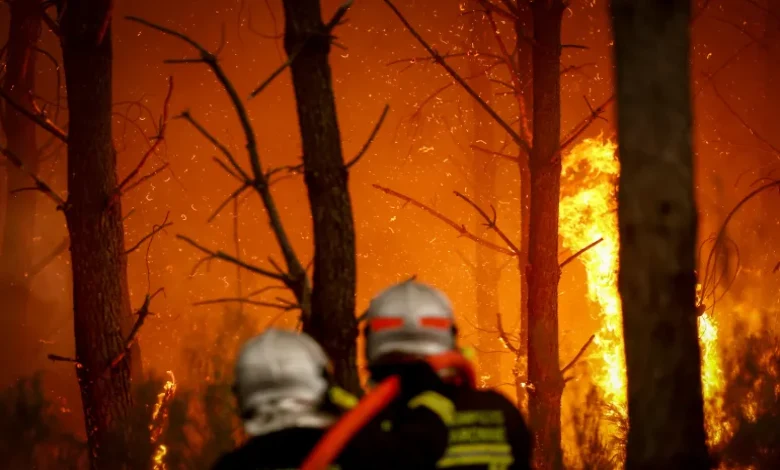
As early indications that the large wildfires devastating southwest France may be beginning to slow, President Emmanuel Macron held an emergency cabinet meeting to coordinate efforts to extinguish the fires. After the Monday meeting, Macron remained silent. Although the wildfires had not “progressed during the night,” Interior Minister Laurent Nunez warned that authorities needed to stay “very concentrated, very determined, to go at any moment.”
The urgency of the meeting on Monday was increased by predictions that France may experience another heatwave later this week.
The provincial government of Gironde, the wine-growing region that contains Bordeaux, reported that the situation remained “broadly stable” despite firefighters fighting the fire all night.
The fire “is still at the gates of the metropolitan area,” according to Bordeaux Mayor Thomas Cazenave on Sunday.
The city of Bordeaux, which is home to roughly 850,000 people, was 15 km (9 miles) away from the flames at their closest point.
Video footage of the wildfires depicts scenes of extensive devastation, including vast tracts of woodland where the trees are consumed by flames and dense clouds of smoke blocking the sky.
The mayor of Cestas, a suburb outside Bordeaux city, Jerome Steffe, declared, “This is a fire of a size never seen before.”
More than 300,000 people have been forced to leave their homes as a result of the extensive disruption caused by wildfires in France and Spain. Scientists warn that the intense heat is drying out Europe, which is experiencing record-breaking temperatures at the time of the fires. This summer, Europe has already seen three heatwaves, which have fueled flames. New temperature records have been set in a number of nations.
The intensity of the fires in France has caused pyrocumulonimbus clouds, a phenomena.
These massive clouds created by fires have the ability to create thunderstorms and transport moisture, smoke, and heated air into the upper troposphere and lower stratosphere (UTLS). Over the past ten years, the size of smoke plumes that reach the UTLS has occasionally exceeded that created by volcanic eruptions, according to the Harvard School of Engineering and Applied Sciences.
Over 75,000 individuals in Spain have had their homes evacuated. The regional government stated on Monday that while some of the deadliest fires are approaching Madrid, they have “slowed their advance.”
Rocio Dominguez, 35, who escaped her home in Chapineria, west of the city, with her two dogs, said, “It looked like the apocalypse.” You were unable to see anything. Ash blanketed everything.
Some Madrid evacuees will be permitted to return to their houses, according to the authorities.
Also Read – Wildfires Wreak Havoc Across Spain And France, Over 250,000 Displaced
-

-

-
-