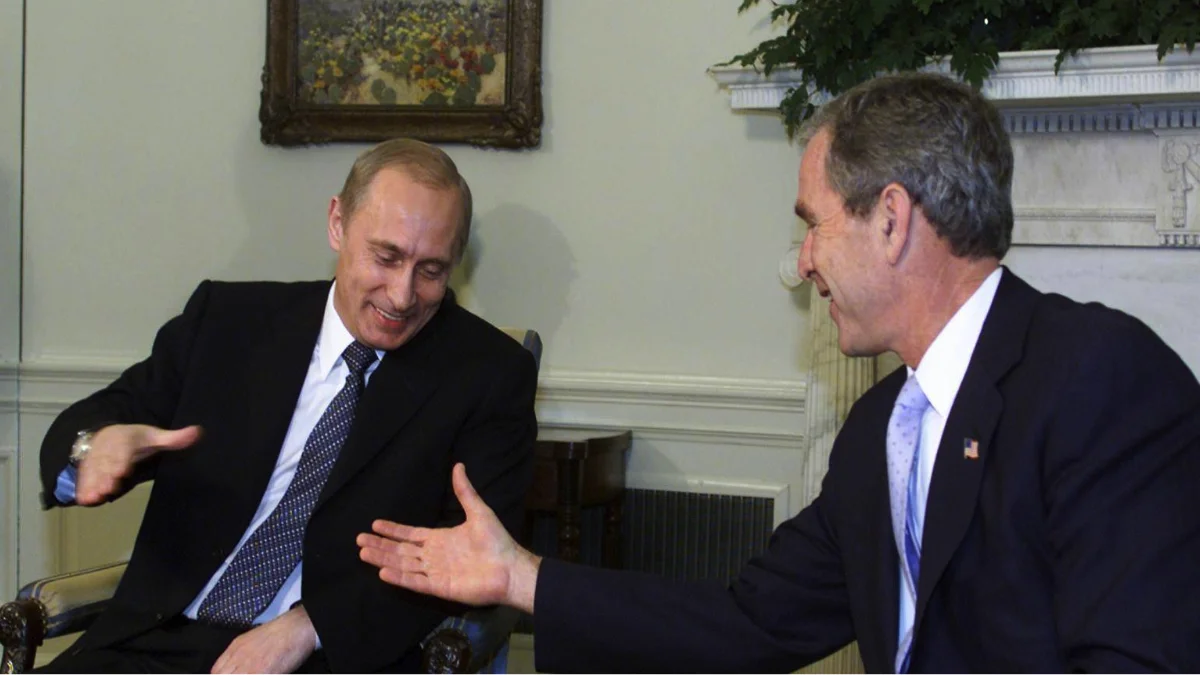
New Delhi: Pakistan’s nuclear proliferation activities raised significant alarm within the highest echelons of American and Russian leadership, with both nations acknowledging that Islamabad’s atomic programme left them deeply unsettled, according to newly released classified documents from the US National Security Archive.
The materials, disclosed this week following a Freedom of Information Act legal challenge, contain word-for-word records of conversations and telephone exchanges between former US president George W Bush and Russian president Vladimir Putin spanning 2001 to 2008. The transcripts document ongoing deliberations regarding Pakistan’s nuclear stockpile, connections to Iran’s atomic ambitions, and the operations of the AQ Khan proliferation network.
During a pivotal Oval Office discussion in 2005, Putin voiced apprehension over intelligence indicating that uranium traced to Pakistani sources had been discovered in Iranian centrifuge equipment, challenging Western acceptance of Islamabad despite its proliferation track record.
“But it’s not clear what the labs (Iran) have, where they are. Cooperation with Pakistan still exists,” Putin stated during the exchange.
Bush referenced his communications with then Pakistani president Pervez Musharraf, responding, “I talked to Musharraf about that. I told him we’re worried about transfers to Iran and North Korea. They put AQ Khan in jail, and some of his buddies under house arrest. We want to know what they said. I keep reminding Musharraf of that. Either he’s getting nothing, or he’s not being forthcoming.”
Putin reinforced his unease, noting, “As far as I understand, they found uranium of Pakistani origin in the centrifuges.”
Bush confirmed the matter, stating, “Yes, the stuff the Iranians forgot to tell the IAEA about. That’s a violation.”
“It was of Pakistani origin. That makes me nervous,” Putin remarked, prompting Bush to respond, “It makes us nervous, too.”
The archive also captures Putin’s stark characterization of Pakistan during an earlier Bush meeting in Slovenia in 2001. “I am concerned about Pakistan. It is just a junta with nuclear weapons. It is no democracy, yet the West makes no criticism of it. Should talk about it,” Putin declared.
The transcripts show both heads of state shared apprehensions about Pakistan’s domestic political volatility, its military-dominated administration under Musharraf, and the danger that critical atomic technology might be compromised. The conversations frequently circled back to the AQ Khan network, subsequently verified to have provided nuclear capabilities to Iran, North Korea, and Libya.
The declassified material emphasizes persistent international unease about Pakistan’s nuclear oversight mechanisms and the wider consequences of its proliferation conduct.
These disclosures emerge alongside fresh examination of Pakistan’s nuclear behavior. Last month, India condemned Islamabad after US President Donald Trump made allegations suggesting Pakistan had been covertly conducting nuclear weapons tests.
Responding to Trump’s statements, Ministry of External Affairs spokesperson Randhir Jaiswal characterized such conduct as aligned with Pakistan’s established pattern. “Clandestine and illegal nuclear activities are in keeping with Pakistan’s history, which is centred around decades of smuggling, export control violations, secret partnerships, AQ Khan network and further proliferation,” he stated.
“India has always drawn the attention of the international community to these aspects of Pakistan’s record,” Jaiswal added.
-

-

-

-