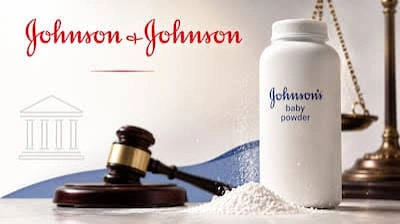
New Delhi: After years of courtroom battles, healthcare giant Johnson & Johnson has agreed to a proposed $5.5 billion (around rs 47,000 crore) settlement to resolve tens of thousands of lawsuits in the United States alleging that its talc based baby powder caused ovarian cancer.
The settlement, which covers nearly 76,000 claims, is one of the largest ever offered in a consumer product liability case. However, it is not yet final. It will only move forward if at least 95% of eligible claimants agree to the deal. Even as it offers compensation, Johnson & Johnson continues to insist that its baby powder is safe and says the settlement should not be seen as an admission that its products caused cancer.
The legal dispute has been unfolding for more than a decade. Thousands of women in the US claimed that long term use of the company’s talc based baby powder led to ovarian cancer. Many lawsuits also alleged that some talc products contained traces of asbestos, a known cancer causing mineral.
Johnson & Johnson has consistently rejected those allegations. The company says decades of scientific research and regulatory reviews have found its cosmetic talc products to be safe and asbestos free. According to J&J, the decision to settle is aimed at ending years of expensive and time consuming litigation rather than admitting wrongdoing.
The latest settlement proposal comes after a series of important court developments in the United States. In recent months, the company strengthened its legal position after a federal judge raised concerns over whether expert testimony presented by plaintiffs was sufficient to prove that talc directly caused individual cases of ovarian cancer. Despite those developments, thousands of lawsuits remained pending, prompting both sides to explore a broader resolution.
The controversy has already changed Johnson & Johnson’s flagship baby powder business. In 2020, the company stopped selling its talc based baby powder in the United States and Canada. Two years later, it phased out the talc formulation worldwide and replaced it with a cornstarch based version.
That means consumers in India today purchase the cornstarch based Johnson’s Baby Powder, not the older talc based product that became the focus of litigation overseas.
For Indian consumers, the settlement does not mean there is a health advisory against products currently sold in the country, nor does it automatically create any right to compensation. The agreement applies only to eligible lawsuits filed in the United States. India has not announced any similar nationwide legal action or compensation process related to Johnson & Johnson’s baby powder.
Even so, the case has once again drawn global attention to product safety, corporate accountability and the importance of long term scientific research in resolving public health disputes. It has also become one of the most closely watched corporate legal battles in recent history.
The next step will be crucial. If the required 95% of claimants approve the proposal, the settlement could finally bring an end to years of litigation that has cost Johnson & Johnson billions of dollars and generated worldwide scrutiny. If that threshold is not met, the company could find itself back in court, facing thousands of individual lawsuits once again.
For now, one thing remains clear while the proposed settlement could close a major legal chapter for Johnson & Johnson, the debate over talc, consumer safety and corporate responsibility is likely to continue for years to come.
-

-

-

-